
 San Diego Swift
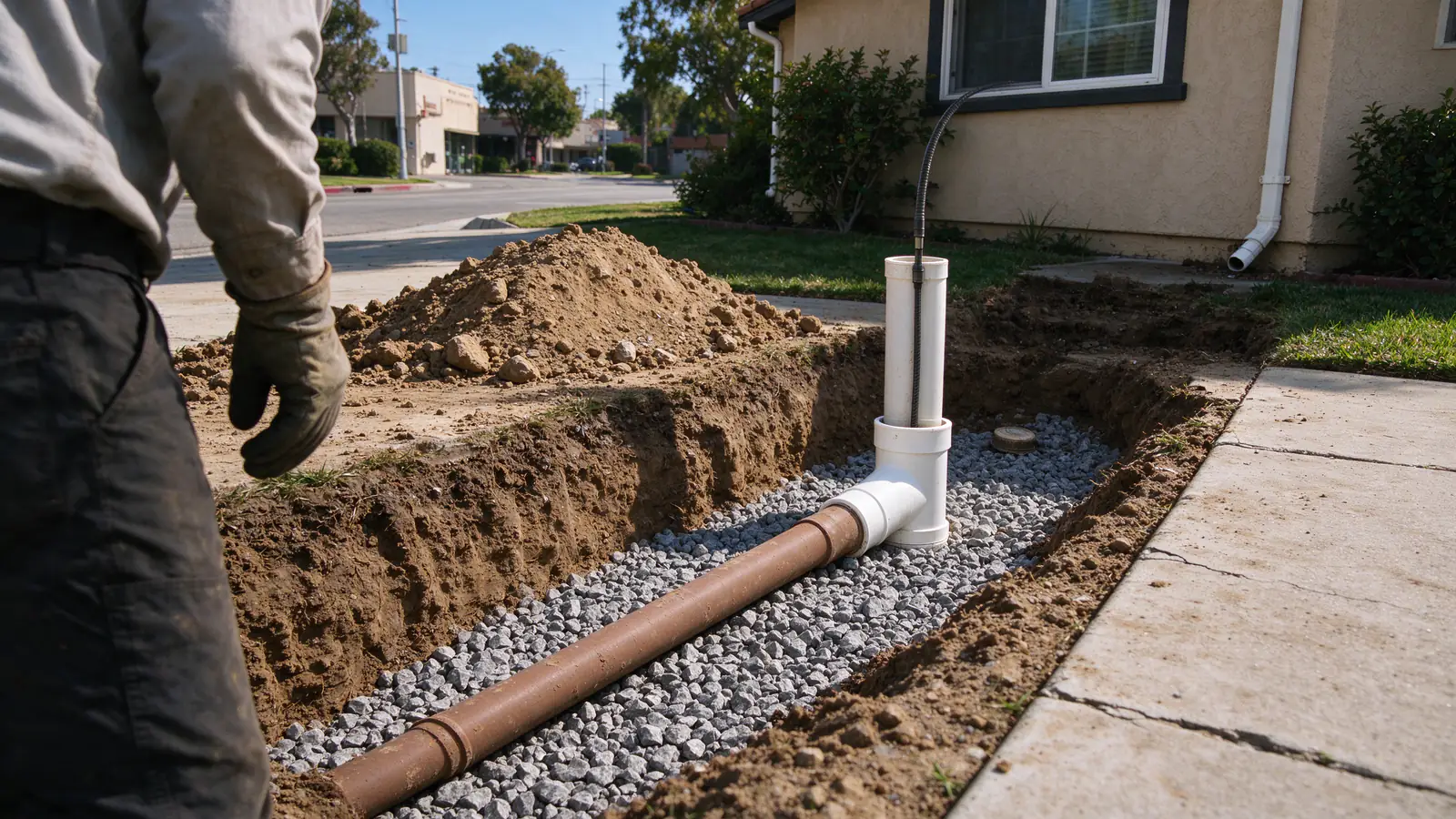
A sewer lateral is the pipe that carries everything that goes down your drains from the house to the public sewer main. In the City of San Diego it belongs to you the whole way, from the house to the connection at the City main, even where that connection sits under the sidewalk and street. When it fails, the repair, the permit and the bill are yours.
That one fact shapes almost every sewer decision in San Diego, so this guide starts with how the system is put together, then walks through who is responsible for what, how laterals fail, how the problem is found and how each repair method fits. San Diego Swift Sewer Line Repair repairs and replaces laterals across the City and nearby San Diego County, and we’ve answered the questions owners ask first.
How the system is put together
Inside the house, every fixture drains into branch lines that join the building drain, the large pipe under the slab or in the crawlspace. Where that pipe leaves the foundation it becomes the building sewer, and the run from there to the public sewer is what San Diego and most utilities call the lateral. At the far end it joins the main, the public pipe that collects sewage from the whole street and carries it, by gravity and pump stations, to treatment.
Everything in a lateral works by gravity. The pipe has to fall steadily from the house to the main so that water carries solids with it. City standards for a standard public lateral call for a minimum 2 percent slope, and for private laterals 1 percent. Where a section loses that fall, water slows, solids settle, and the low spot becomes the place where blockages start.
Along the way are cleanouts, capped fittings that give a camera, a cable or a jetter access to the pipe. A cleanout may sit near the foundation or, on some lots, closer to the street as a two-way cleanout. A lateral without a usable cleanout can still be inspected, but adding one is often the first step before any repair, because it is also how a liner or a cleaning head gets in later.
A sewer lateral is not a storm drain and not a water line. Rain from roofs and yards belongs in the storm drain system, which is a separate set of pipes from the sanitary sewer. The water line is a pressurized supply pipe that runs the other way. And a property on a septic system has no lateral to a public main at all; septic work is a separate trade.
Who is responsible for which part in San Diego
In the City of San Diego, the Public Utilities Department puts it plainly: the property owner maintains the lateral “from the property all the way to the connection with the sewer main.” That connection may be in the street, past the property line, on an easement, or in a canyon. The City maintains the main itself.
There is one narrow exception. When all sewer service is lost and a licensed plumber or drain cleaner finds a blockage or break beyond the property line, the plumber can file a Plumber’s Report on the City’s sewer emergency line, and the City may clear or repair the right-of-way section. Even then the City’s policy is to bill the owner when the cause was a lack of routine maintenance, such as roots or grease, and the City will not dig on private property under any circumstances. For a structural defect that has not stopped flow completely, the City’s fact sheet points owners to submitting the plumber’s video to Public Utilities rather than expecting a repair.
Outside the City, the rules change by agency. Poway cleans the lateral from the property-line cleanout to the main at no charge, if the house has a property-line cleanout. Escondido makes the owner responsible up to the main and requires a City repair permit even for work on private property. Lemon Grove’s sewers belong to a separate sanitation district that inspects with the City before a trench is closed, and unincorporated areas such as Spring Valley follow County sanitation district rules. Each has its own page: Poway, Escondido, Lemon Grove and Spring Valley. Our guide to who is responsible for the sewer lateral in San Diego goes through each.
What laterals are made of
The City has no inventory of private lateral materials, so the material of any one line is something the camera confirms. What the City does say is that newer plastic laterals with intact joints can go years without trouble, while older laterals of concrete, clay or cast iron may have root intrusion or deteriorated sections and need regular inspection or more frequent cleaning.
Vitrified clay pipe has a hard, durable barrel but was laid in short sections joined with mortar or early gaskets, and the joints are its weak point: they can open, offset or let roots in. Cast iron is strong but corrodes from the inside over decades, building scale that narrows the pipe and eventually thinning the wall until it cracks. Concrete and Orangeburg, a fiber pipe made with bitumen, show up in some older lines; Orangeburg in particular can soften, blister and go oval under soil load. ABS and PVC plastic are the modern materials, with long sections and tight joints, and PVC is what most San Diego replacements use today. Our guide to what sewer pipe your house has covers how to tell them apart on camera.
Housing age is a rough clue. In the Census Bureau’s American Community Survey, 6.4 percent of the City of San Diego’s homes were built before 1940 and about half before 1980, while older neighborhoods run much higher: 21.3 percent pre-1940 in ZIP 92104 around North Park, and 55.3 percent pre-1960 in 92106 in Point Loma. A house’s age tells you what era its lateral likely dates from, not what condition it is in.
How laterals fail
Roots. Roots follow moisture, and a lateral’s joints leak a little vapor and water. A hairline gap becomes a way in, the roots grow into a mass inside the pipe, and the mass catches paper and solids until the line backs up. City design rules keep trees and shrubs taller than 3 feet at least 10 feet from public laterals for this reason. Cutting the roots restores flow, but the gap they came through is still there; our guide to getting rid of roots in a sewer line explains the options.
Settlement and offsets. When the soil under a section of pipe settles, the joints can shift out of line. An offset joint catches solids and lets in roots and soil. San Diego’s soils vary widely, from sands near the coast and in Mission Valley to clays with high shrink-swell potential in parts of the inland neighborhoods and East County, and movement in the ground translates directly into movement in a rigid pipe.
Sags, or bellies. A section that loses its support sinks and holds water. Waste settles in the low spot and the line clogs there again and again. A belly is a grade problem, not a crack, which is why it changes the repair method, as our page on sewer belly repair explains.
Corrosion and collapse. Cast iron thins until it cracks or collapses; fiber pipe deforms; a crushed section can come from construction, heavy loads or soil movement. A collapse usually announces itself as a line that won’t clear at all; see collapsed sewer line repair. Old cast iron and clay lines each have their own page.
Grease. Grease poured down a drain cools and coats the pipe wall, narrowing it until a backup follows. It is a maintenance problem rather than a structural one, but the City treats grease-caused stoppages in the street section as the owner’s responsibility.
Signs, and how the problem is found
The symptoms that point to the lateral rather than a single fixture are system-wide: several drains slow at once, a toilet backs up when the washer drains, water rises in a shower or floor drain, or gurgling comes from fixtures that weren’t in use. A wet, sunken or unusually green strip across the yard, or a sewage odor outside, can point to a break. None of these proves the cause on its own; a clogged branch line or a problem in the main can look the same. Our guide to the signs of a broken sewer line goes deeper.
The diagnosis is a sewer camera inspection. A camera goes in through a cleanout, often after the line has been cleaned so it can see, and records the pipe from end to end with a footage counter. Every defect is noted by its distance from the cleanout, and a locator follows the camera head from the surface to mark the path and depth on the ground. Our guide to reading a sewer camera report explains the terms. That footage answers the questions that set the repair: what the pipe is made of, where it fails, whether the failures are spread out or in one place, and whether the line still holds its shape and grade.
Repair options, and which pipe each one fits
Cleaning. Cabling or hydro jetting clears roots, grease and debris and restores flow. It is the right first step for a blockage and the wrong permanent answer for a broken joint. Our page on root removal covers what cleaning can and can’t do.
Spot repair. One bad section, dug out and replaced, or lined with a short sectional liner, when the camera shows the rest of the line is sound. It is the most economical structural repair when the damage really is in one place, and the camera should check the rest of the line before and after.
Lining (cured-in-place pipe). We set a resin-saturated liner inside the old pipe and cure it into a new pipe wall, sealing cracks and joints with little digging. It needs a continuous host pipe that holds its shape, and it follows that pipe’s geometry: a sag stays a sag. Collapsed, badly offset or deformed sections usually have to be opened or reconnected before a line can be lined.
Pipe bursting. We pull a bursting head through the old pipe, breaking it outward while it drags new HDPE pipe in behind it, from a launch pit to a receiving pit. It replaces a broken line along its existing path with digging only at the ends, and it needs room around the path for the old pipe to break into, away from gas and water lines.
Trench replacement. We dig the line out and lay new pipe on proper bedding at the right slope. It is the only method that fully corrects a lost grade or a poor route, and its cost depends mostly on what sits on top of the line. Our sewer line replacement page compares the three replacement methods in detail, and lining vs pipe bursting compares the two trenchless ones.
Permits, the street and inspections
Most single-family and duplex lateral repairs in the City use the Simple No-Plan plumbing permit from Development Services, $264.25 for a residential repair or replacement. Properties in a designated historic district or on a historic site may need historic review instead. Work in the public right-of-way or a sewer easement needs a Right-of-Way Permit with a construction plan, a City inspection after the trench is dug and before the connection, traffic control, and trench resurfacing to the regional standard drawings; the City’s inspection fee is $1,412.54 per lateral. City crews no longer install laterals, and the City directs owners to a Class A licensed contractor for that work.
Two street rules catch owners off guard. Where a lateral already serves the lot and the street has been paved, the municipal code requires that lateral to be reused unless the City grants an exception. And under the Street Preservation Ordinance, a street resurfaced within the last three years (one year for a slurry seal) can’t be opened without an approved moratorium waiver, and restoring it can mean repaving the full width of the lane. Our permit guide covers each step, and street sewer lateral repair covers the street work itself.
Insurance, warranties and the home sale
Many homeowners policies cover sudden water damage inside the house but exclude the lateral itself (does homeowners insurance cover sewer line repair?), and some insurers offer a separate service-line endorsement. The City of San Diego’s fact sheet states there is no reimbursement for plumbing costs, and the City doesn’t list a lateral rebate; ask Public Utilities if you want that checked for your address. The service line warranty the City promotes is a private, insurance-style plan with its own coverage limits.
If a sewer backup is caused by a blockage in the City’s main rather than the lateral, the City’s claims policy can cover cleanup and damage where the owner was not at fault; claims are filed in writing with Risk Management, generally within six months. Backups from the lateral, including roots “from any source,” are excluded.
There is no point-of-sale lateral inspection ordinance in the City of San Diego, but the City recommends that buyers get a licensed plumber’s report on the lateral, and many buyers do. A scope during escrow is often how an owner first learns what their lateral looks like; our home-buyer sewer inspection page covers what to ask for, and the cost guide covers what a repair would run.
Living with a lateral
Most of what keeps a lateral working is unglamorous: keeping grease and wipes out of drains, keeping new trees and large shrubs away from the line’s path, knowing where the cleanout is and keeping it accessible, and getting a camera inspection when backups start to repeat rather than clearing the same line year after year. If a cleanout ever overflows into the street, the City asks owners to call its sewer line at 619-515-3525, and it bills the owner when the cause was in the private lateral.
When the camera shows a problem, the right repair depends on the pipe, and the right first step is footage you can read; we start every job there. If the house has lost its sewer altogether, our emergency sewer repair page covers what to do first, and what to do when your sewer backs up covers the first hour. Get an estimate with your address and any footage you already have, or call us, and we’ll tell you the next step that fits your line.