 San Diego Swift
Yes. In the City of San Diego, replacing or repairing a sewer lateral needs a permit, and the only real question is which one. A job that stays in the yard of a single-family house usually needs one no-plan plumbing permit. A job that crosses into the sidewalk, street or an easement adds a right-of-way permit, inspections and often traffic control, each with its own fee.
San Diego Swift Sewer Line Repair works out your permit path before we price the job, because the permits often decide the schedule as much as the digging does. This guide sorts the City’s requirements by situation, then covers the agencies outside the City. Who pays for which section is a separate question, answered in who is responsible for the sewer lateral.
Permits by situation in the City of San Diego
| Situation | What it needs | Agency fee or rule |
|---|---|---|
| Repair or replacement on private property, single-family or duplex, not historic | Simple No-Plan Residential Combination permit (no plans) | $264.25 for a residential unit (DSD Information Bulletin 103) |
| Property on a designated historic site or in a historic district | Historic review may be required; the no-plan path covers non-historic properties only | See Information Bulletin 581 |
| Any work in the public right-of-way or a sewer easement | Right-of-Way Permit with a construction plan (Bulletin 166) | Inspection $1,412.54 per sewer lateral (Bulletin 502) |
| Lateral with a direct wye or saddle connection to the main | Minor Right-of-Way “Rapid Review” (Bulletin 165) | Up to three Rapid Review items per plan set |
| Lateral with a manhole connection (most 8-inch and larger laterals) | Full submittal with plans | Plan check from $3,179.40 for up to five sheets (Bulletin 502) |
| Lane or sidewalk closure for the work | Traffic control plan and Traffic Control Permit | Plan review from $353.13 (Bulletin 502); permit $131.52 per block for up to three weeks (Bulletin 177) |
| Street resurfaced within the moratorium period | Excavation Moratorium Waiver before excavating (SDMC 62.1207, form DS-350) | Restoration can mean the full lane width, or curb to curb |
| Dewatering a trench into the sewer | Groundwater Discharge Permit from Public Utilities | No discharge until the permit issues |
| Easement or encroachment lateral | Encroachment Maintenance and Removal Agreement | $25 sewer lateral inspection fee (Public Utilities) |
The private side
Development Services’ Simple No-Plan permit lists “water or sewer piping repairs” and “repair or replacement of drains” among the work it covers, and its own permit chart says a single-family or duplex sewer replacement needs a permit but no plans. The permit normally issues within two business days. Installing a two-way cleanout in a front yard also appears in the City’s open permit records under no-plan residential permits. All of it is inspected against the 2025 California Plumbing Code, which San Diego adopted with local amendments in SDMC 147.0103 and which took effect statewide January 1, 2026.
Historic properties
The no-plan path applies to non-historic properties only. A house on a designated historic site or inside a City-register district, such as North Park Dryden, Burlingame or Mission Hills, may need historic review under Bulletin 581 first. The sewer itself is underground, but the work disturbs front yards and walks that the designation may protect, so check the address before scheduling. The North Park and Mission Hills pages cover those districts.
What changes once the work reaches the street
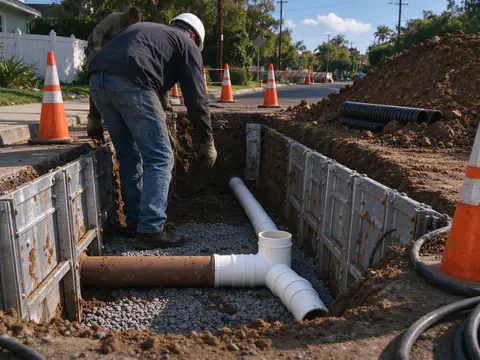
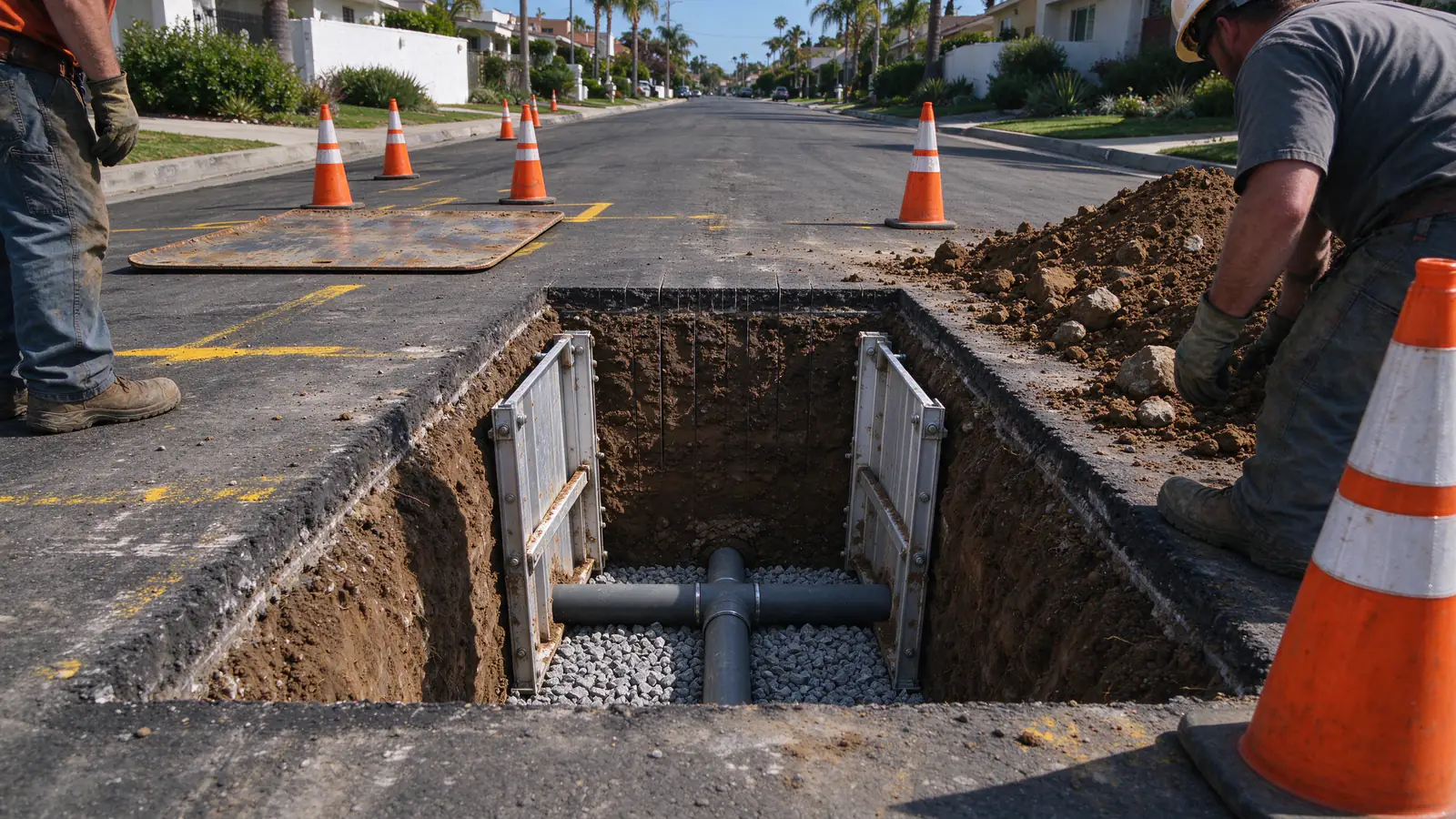
The Right-of-Way Permit is the one that surprises people. It needs a construction plan, an inspection after the trench is open and before the connection is made, and a final inspection. City wastewater crews no longer install laterals, so the work goes to a Class A licensed contractor under a public improvement permit.
Rapid Review or full plans
The connection type decides the review track. A 4- or 6-inch lateral joins the main by a wye, or by a saddle where the main is clay, and that qualifies for Minor Right-of-Way Rapid Review; curb, gutter and sidewalk replacement up to 150 linear feet can ride along in the same review. Larger laterals generally need a manhole connection, and a manhole connection has to be submitted with plans. Projects that are not cleared by the third review cycle pay an added hourly fee, which is a reason to get the plan right the first time. Fees are paid at issuance under Bulletin 502, and the work follows the San Diego Regional Standard Drawings and the standard public works specifications.
Traffic control
Most street openings on a residential block close part of a lane or the sidewalk. That brings a traffic control plan, reviewed from $353.13, and a Traffic Control Permit at $131.52 per block for up to three weeks. A longer job on a busier street can need more than one.
Moratorium streets and resurfacing
The Street Preservation Ordinance protects newly paved streets. Since its update took effect January 1, 2024, the excavation moratorium runs three years after an asphalt overlay and one year after a slurry seal. Excavating a moratorium street needs an approved waiver first, and most trenching and restoration must be finished within 180 days. A Street Damage Fee applies, but the City waives it when the excavator resurfaces the full width of the impacted lane, or restores curb to curb on a moratorium street. Trench resurfacing follows Standard Drawing SDG-107 for asphalt and SDG-108 for concrete.
One more rule sits here: where a lateral already serves the lot and the street has been paved, SDMC 64.0402 requires that lateral to be reused unless the City grants an exception. A new connection point is the exception, not the default.
Work headed for the street?
Send the address and what the camera found; we'll map the permits and inspections the job needs before pricing it.
Groundwater
Where an excavation fills with water, it has to be pumped somewhere. Public Utilities issues Groundwater Discharge Permits for temporary construction dewatering to the sewer, and no discharge may occur until the permit is issued. City-filed geotechnical reports record shallow groundwater near Mission Bay and in parts of Mission Valley, so on low ground the application belongs at the start of the schedule, not in the middle of a flooded trench.
Permits outside the City
- Escondido requires a City repair permit before any lateral work starts, even on private property, through the Building Division, plus an encroachment permit for digging in a street or right-of-way. See Escondido.
- Lemon Grove requires a City Encroachment Permit for right-of-way digging, and the Sanitation District and the City both inspect before backfill. See Lemon Grove.
- Unincorporated County areas such as Spring Valley need a County Excavation Permit when the private lateral being repaired is in a public road.
- Poway’s published lateral page covers cleaning, not permits, so ask the City for the permit path before work starts. See Poway.
Reading the permit lines in a quote
A quote for street sewer lateral repair should name each permit it includes, whether the agency fees are in the price, who prepares the construction and traffic control plans, and who schedules each inspection. A quote that mentions only “permits” is hard to compare; our guide to comparing sewer repair quotes shows what to ask, and the cost guide shows how these fees sit inside a full budget. Get an estimate and we’ll send the permit list with it.