 San Diego Swift
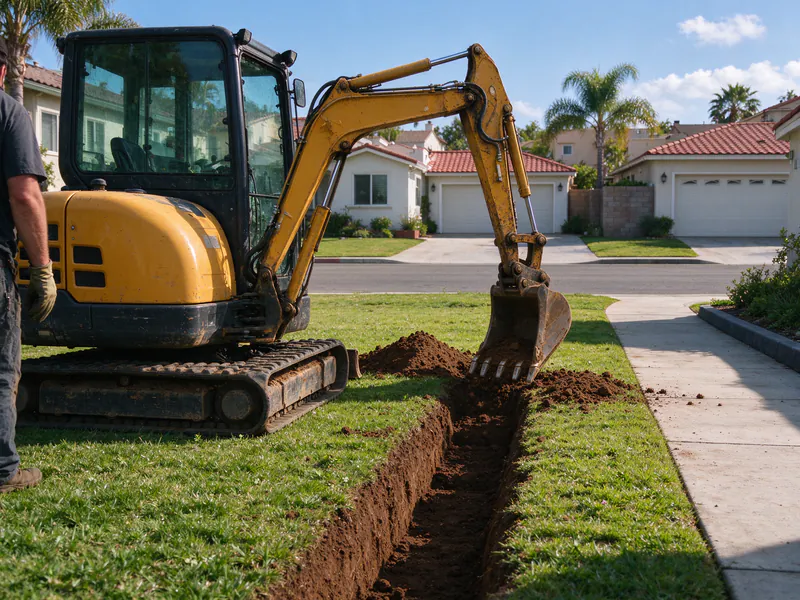
Your line has sagged, collapsed or runs where it can’t be lined, and the honest answer is that it has to be dug up. Sewer line excavation is the dig itself: opening the ground to reach a lateral, protecting the trench, laying pipe on a proper bed at the right slope, and closing it all up so it stays put. San Diego Swift Sewer Line Repair handles open-trench and pit excavation for laterals across San Diego, whether the dig is for a full sewer line replacement, a single spot repair, or the pits a trenchless method needs.
Most of what goes wrong after a sewer repair goes wrong in the ground around the pipe, not in the pipe. That’s why this page is about the parts of the dig you won’t see once the lawn is back.
Does your line have to be dug up?
We dig when the pipe’s slope must be corrected, when the route has to change, when a section has collapsed and blocks every other method, or when the line is shallow under open ground and a trench is simply the simplest fix. Excavation also provides the pits for bursting, reconnections at the main, and point repairs.
The common thread is that excavation is the only approach that lets us see and rebuild everything: the slope, the bedding, the joints and the route. A lateral that has bellied and holds water cannot be lined or burst back to grade; it has to be dug out and relaid. Where your line runs under hardscape or mature landscaping and the pipe is sound enough, compare trenchless sewer repair first.
What’s in the ground besides your sewer?
Before we dig, we find the lateral itself. We run a camera down the line and follow the sonde in its head from the surface with a locator, marking the path and depth every few feet. City records help with the far end: Development Services can identify where a property’s lateral connects to the City main, but the City has no diagrams of private lines on the lot, so a sewer camera inspection is what maps the rest.
Then come the neighbors in the ground. We file an 811 one-call locate request, and the utilities mark their gas, water, electric and communication lines with paint or flags. Those marks cover public utilities, not private ones, so we trace irrigation lines, landscape lighting, a feed to a detached garage or a gas line to a backyard grill separately or expose them with care. Near marked lines, the excavator gives way to careful hand digging. Never dig toward a sewer line, a gas line or a marked utility yourself to “help out.”
How we keep the trench safe
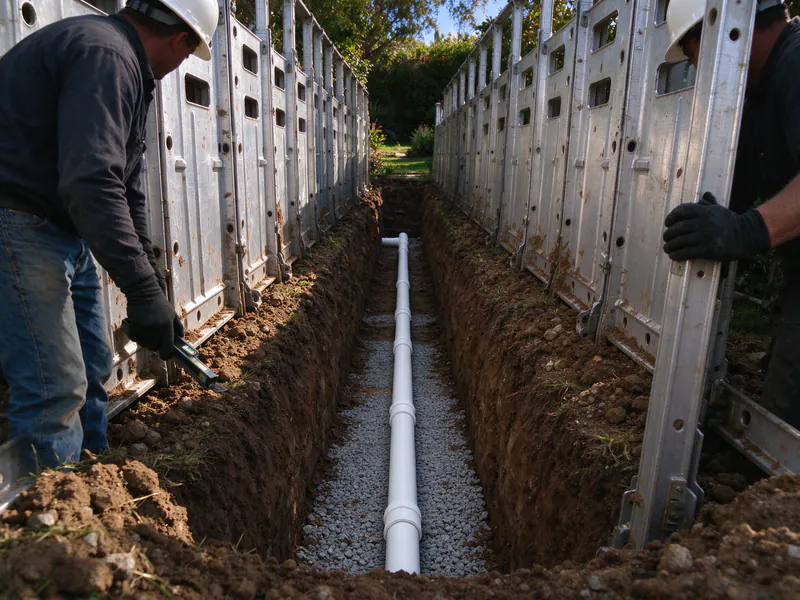
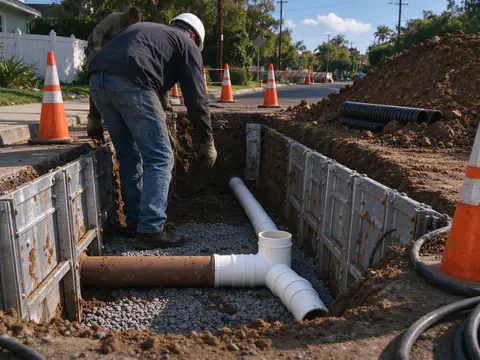
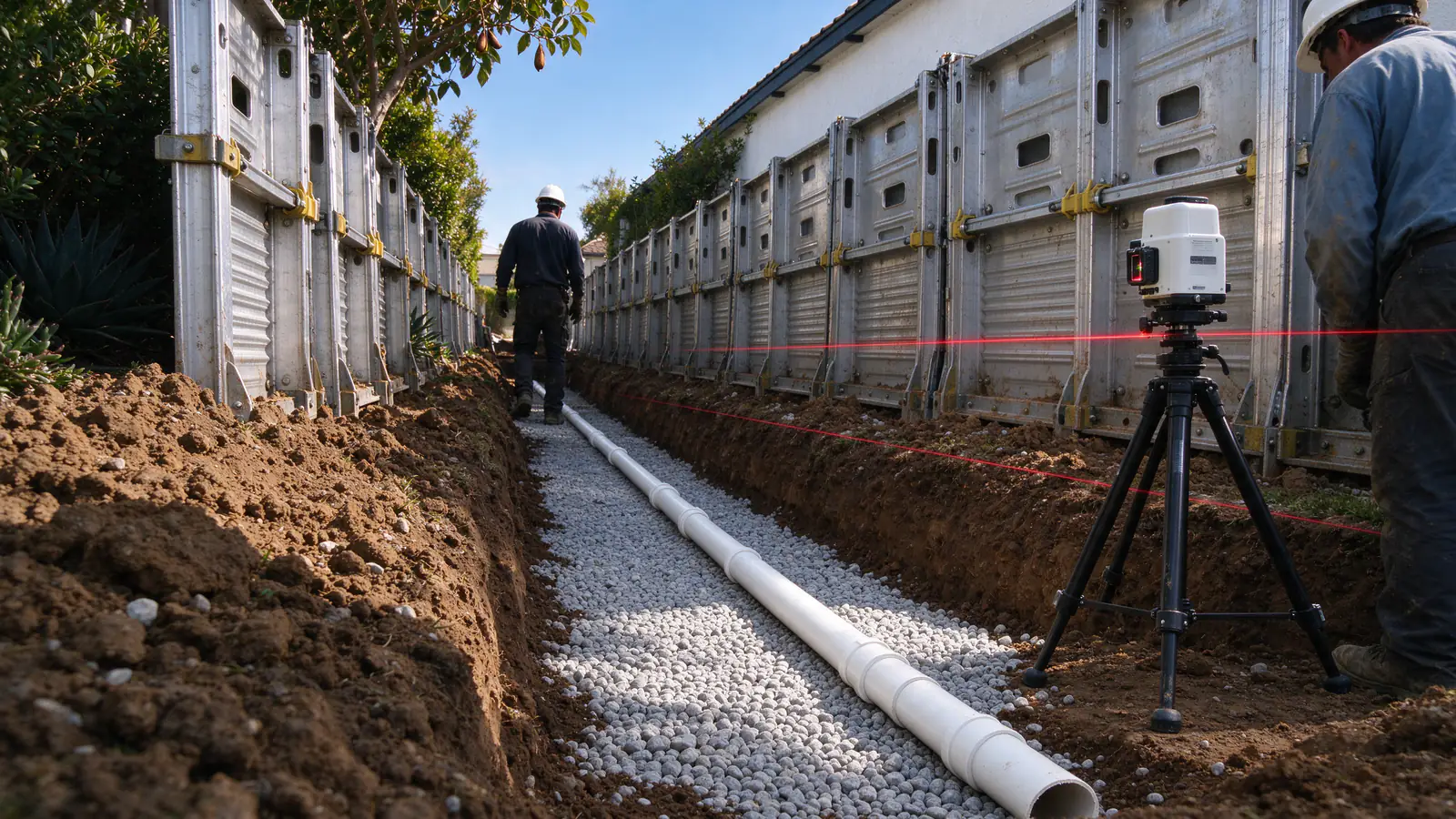
A trench is the most dangerous part of any sewer job. Soil weighs far more than it looks, and a wall that seems firm in the morning can slough off after an hour of drying or a little seepage. Cal-OSHA requires a protective system, such as shoring, a trench box or sloped walls, for trenches 5 feet or deeper, and the City’s easement-lateral policy makes the owner responsible for shoring to Cal-OSHA specifications where an easement lateral is 5 feet or more deep or the soil is poor.
That depth is common here. City standards set a standard public lateral at 5 to 7 feet of cover at the property line, so a trench approaching the sidewalk needs protection even when the end near the house is shallow. Nobody should enter an unprotected trench, and only the trained workers doing the job belong in a protected one.
What if the trench hits water?
Most San Diego laterals sit above the water table, but not all. A City-hosted geotechnical study for Mission Bay Park describes hydraulic fill with groundwater at about sea level that rises and falls with the tides, and a geotechnical report filed with the City for a Mission Valley site recorded groundwater about 7.8 feet down in one boring. A trench that meets water needs dewatering, and pumping it to the sewer needs a Groundwater Discharge Permit from Public Utilities before any discharge, so the application starts well ahead of the dig. Shallow water like that is one reason a trenchless method with only two pits can make sense near the bay.
How we lay the new pipe
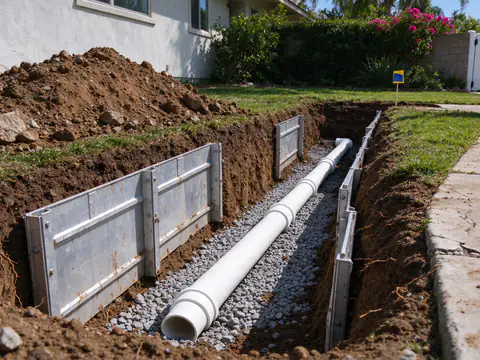
We dig the trench bottom a little below the pipe and level it, then lay down a layer of granular bedding, not loose native soil with rocks in it. Bedding gives the pipe even support along its whole length; a pipe resting on a few high points will crack or sag.
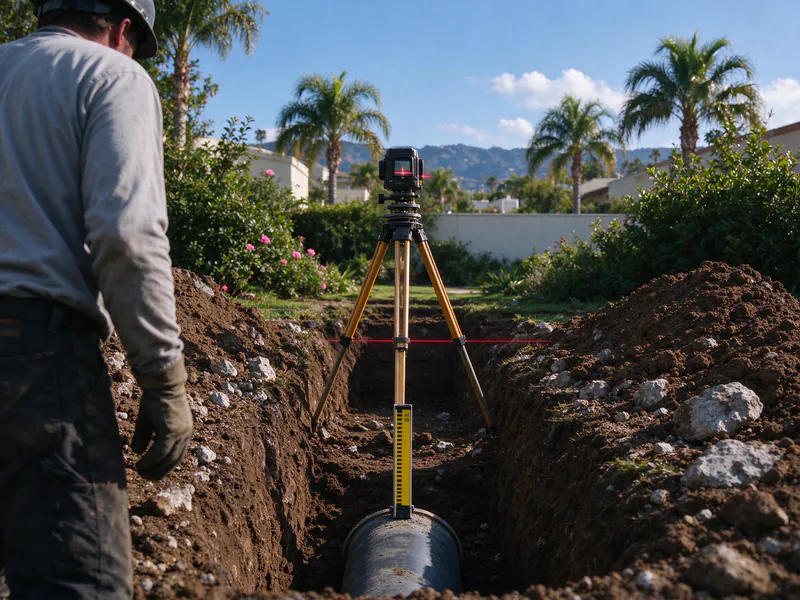
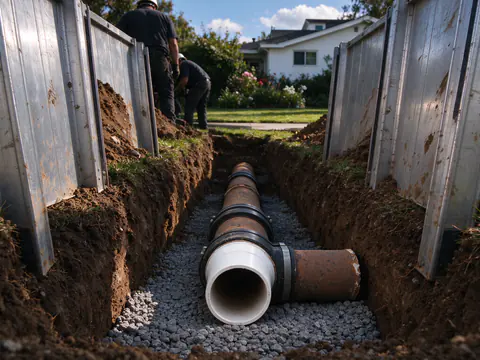
We set new pipe, usually PVC, on that bed to a checked slope, often with a laser level. City Wastewater Review requirements call for at least 2 percent slope on public laterals and 1 percent on private ones, because too little fall leaves solids behind while an overly steep run lets water outrun them. Transitions to old pipe use listed couplings for the two materials. We place more granular material around and just over the pipe before the general backfill begins.
How we close it up so it doesn’t sink
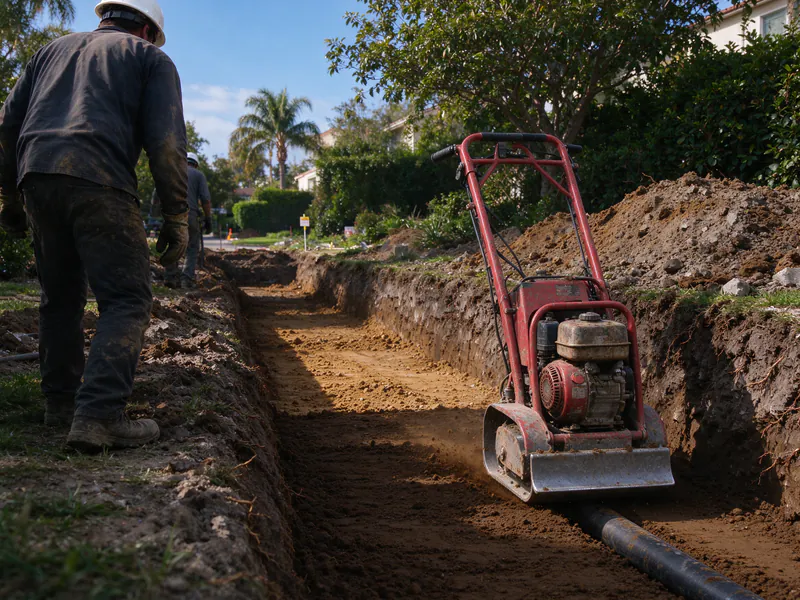
We backfill in layers, each compacted before the next. The City’s easement-lateral policy calls for backfill in 12-inch lifts, and the logic applies to any trench: thin layers can be compacted all the way through, while a trench filled in one go and flooded with a hose leaves voids that settle for months. Settlement over a trench is more than cosmetic. It can pull a joint, or let the new pipe sag at the edge of the old excavation.
Before backfill, the permit’s inspection happens with the pipe exposed. In the right-of-way, City rules require an inspection after the trench is dug and before connection, plus a final inspection; on the private side, inspections are scheduled once the permit invoice is paid. Restoration follows the scope: lawn and planting, concrete or pavers, and in the street, resurfacing to the San Diego Regional Standard Drawings, as our street sewer lateral repair page explains.
What will the dig cost?
Our typical range for open-trench replacement is $50 to $250 a foot, and your final price comes from a written quote after we see the job. We price the whole excavation from its depth, the trench protection it needs, the soil, any groundwater, the utilities in the way and the restoration on top, which vary so much from lot to lot. Plumbers in the San Diego metro earn a mean $37.78 an hour against a $34.70 national mean (May 2025 BLS data), and a wage is not a billing rate. The sewer line replacement cost guide lays out the full breakdown, and how deep a sewer line is explains the depth side.
If a dig is on the table, get an estimate with the address and a description of what sits over the line, or call us. We’ll tell you what the excavation needs and whether a smaller one would do.