 San Diego Swift
Your sewer line needs work, but it runs under the driveway, the front walk or a tree you want to keep. Trenchless sewer repair means we fix or replace the lateral from a few access points instead of digging along its whole length. San Diego Swift Sewer Line Repair offers the two trenchless methods that matter for house laterals, sewer pipe lining and pipe bursting, and we tell you plainly when neither one suits your pipe.
That last part matters. Trenchless is a family of methods with real limits, and whether your lateral can use one is a question the footage answers, not a sales pitch.
What still gets dug in a trenchless job?
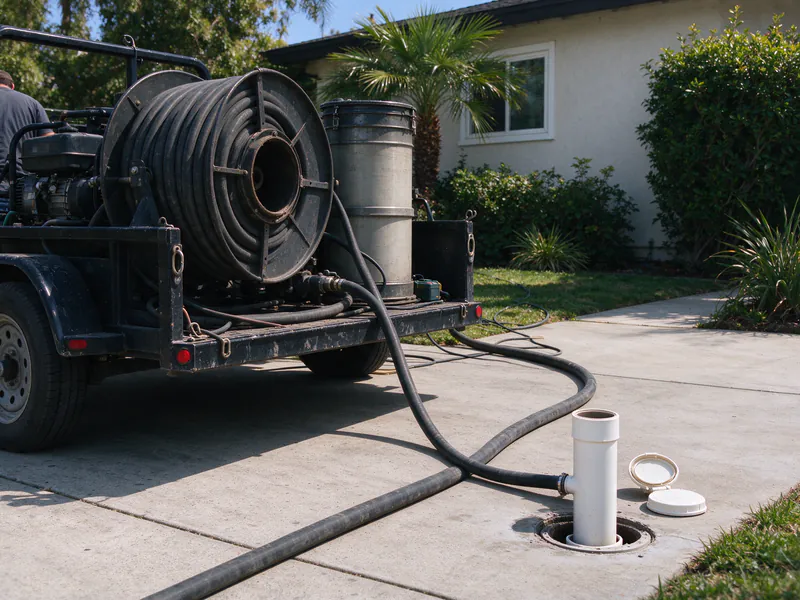
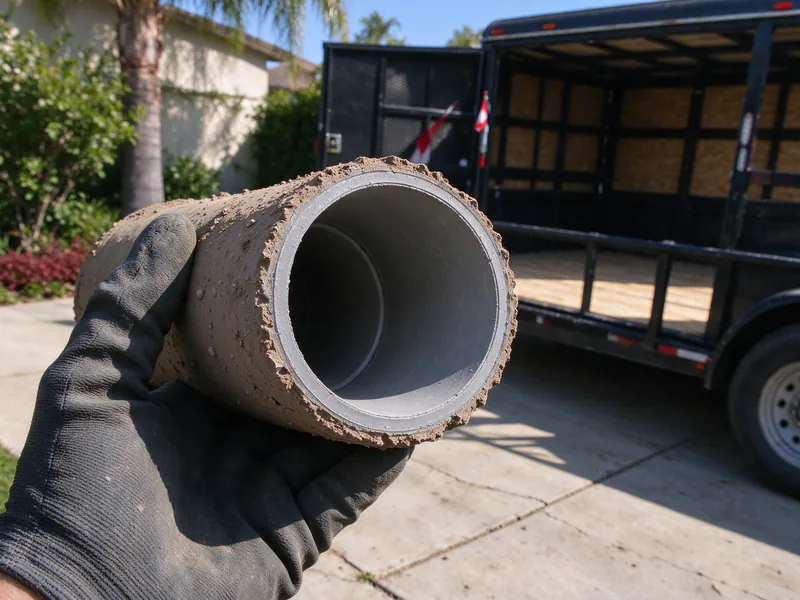
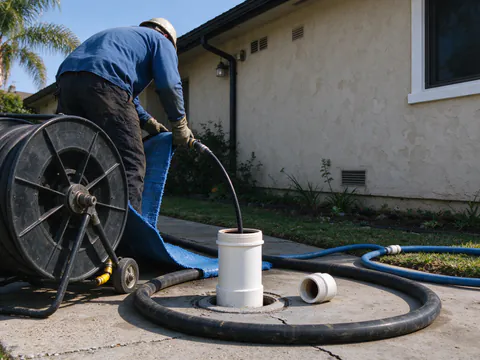
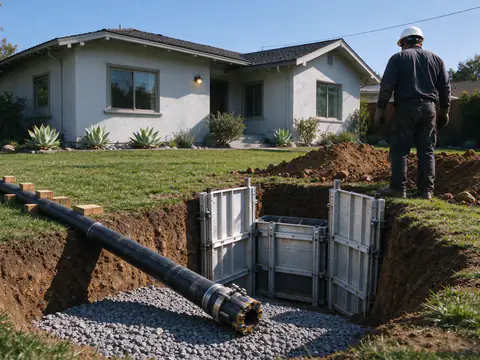
Two methods cover nearly all trenchless lateral work. Lining builds a new pipe wall inside the old pipe: we push or pull a resin-saturated tube in, press it against the host pipe and cure it hard. Bursting pulls a cone-shaped head through the old pipe, fractures it outward into the soil, and drags new HDPE pipe in behind. A third variant, the short sectional or point liner, patches one defect from inside and belongs with spot repair.
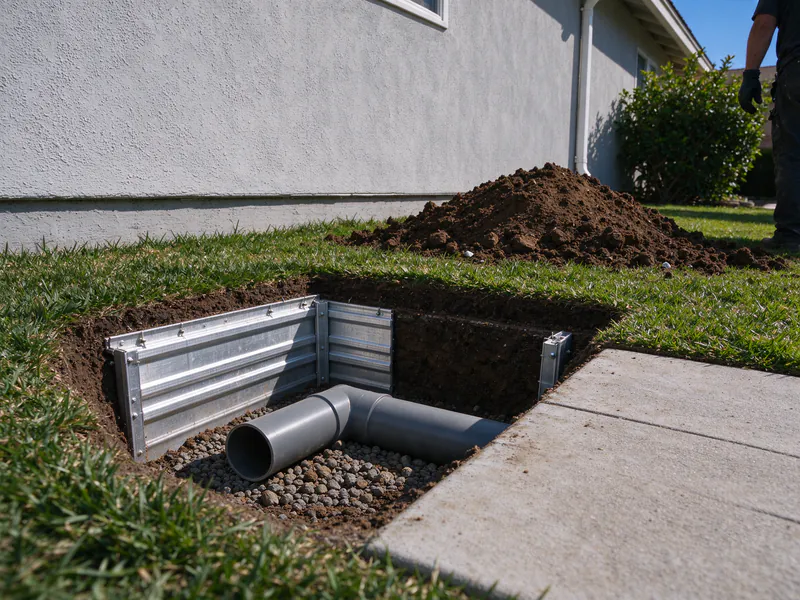
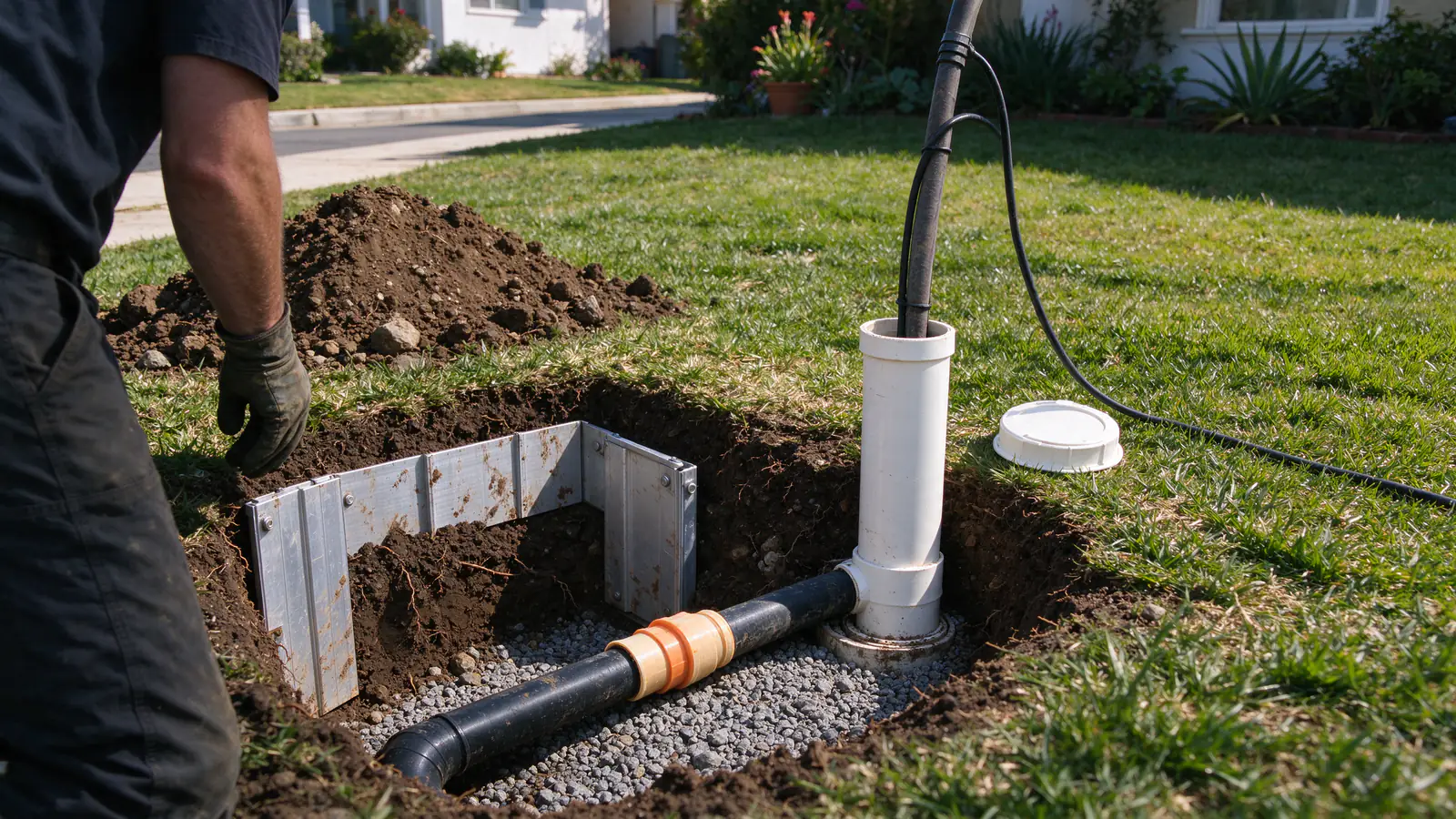
None of them is zero-dig. Lining needs a way in, which is normally a cleanout near the house; where there isn’t one, we put in a new cleanout first, which may mean a small hole. Bursting needs a launch pit and a receiving pit, often one near the house and one at the far end of the run. Either method may need a pit where the new pipe meets the building drain or the connection at the main.
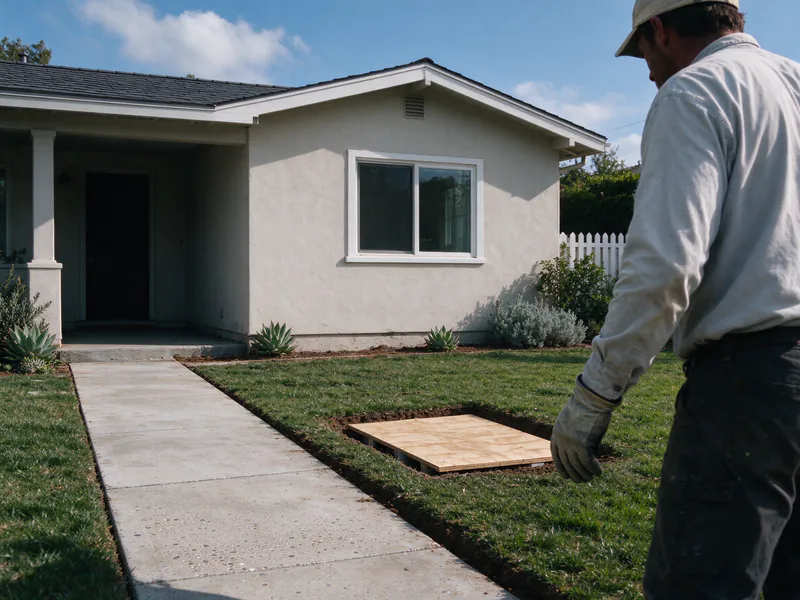
What trenchless spares is everything in between: your driveway, the front walk, the hedge, the block wall, the mature tree whose roots wrap the old line. On plenty of San Diego lots that middle stretch is exactly where the expensive surfaces are.
Can my sewer line be repaired without digging a trench?
Often, yes, if the camera shows a pipe that is still continuous, keeps its round shape, holds its slope well enough and has access at the right points. A lateral that has collapsed, sagged into a belly that holds water, or shifted badly at a joint needs at least some excavation before, or instead of, a trenchless method.
We check your line against a short list, and each item can rule a method in or out:
- Continuity. A liner needs a host pipe to form against. Where a section has caved in or is missing, there is nothing to line until that spot is opened and rebuilt.
- Shape. Pipe that has gone oval or flattened can wrinkle a liner or stop a bursting head. Deformed pipe is a reason for us to slow down, not push through.
- Grade. Both methods follow the existing line. A belly in the pipe stays a belly after lining, and bursting only softens a shallow one.
- Bends and size changes. Tight 90-degree turns, a 3-inch section under the house meeting a 4-inch yard line, or several fittings close together all complicate both methods.
- Access. Where can a liner go in, and where can a pit go? A cleanout buried under a patio, or a connection behind a wall, changes our plan.
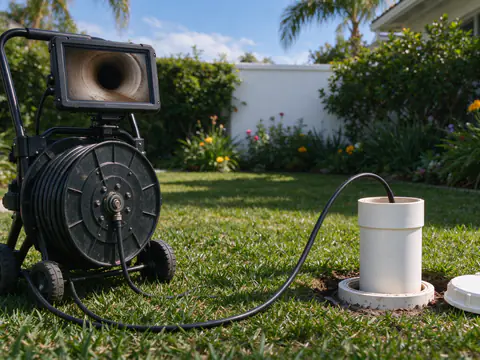
A sewer camera inspection, with the line cleaned first so the lens can see, gathers all of that in one pass, and we mark the path and depth on the ground with a locator. Our guide to reading a sewer camera report explains the defect codes you’ll see.
Should you dig instead?
The two approaches trade different things. When we excavate, we expose the pipe, so we can see and correct everything, including slope and route, at the cost of opening the surface along the repair. Trenchless leaves the surface largely alone but inherits the old pipe’s path and, for lining, its geometry and diameter.
A dig wins when the line is shallow under open ground, when it has lost its fall, when the route itself is the problem (under a later addition, or too close to a tree), or when failures are scattered and severe. Trenchless wins when the line runs under hardscape or landscaping worth keeping, when the pipe is sound enough to line or burst, and when the defects are spread along the run rather than piled into one bad spot. Some laterals get both: a short excavation to rebuild one collapsed section, then a liner through the rest. The guide is trenchless sewer repair worth it? works through the trade-off with examples.
Not sure which side of the line your pipe is on?
Send the footage and the address, and we'll tell you which methods your pipe can actually take.
Driveways, street trees and old clay in San Diego
City design rules keep trees and large shrubs at least 10 feet from public laterals, which tells you how often the two collide. On an older lot where a street tree or a backyard ficus already sits over the line, we can line through the root zone and avoid cutting the roots that a trench would sever.
The street is the other big driver. In the City of San Diego your lateral runs all the way to the main, often under the sidewalk and the street, and opening pavement brings in a right-of-way permit, traffic control and resurfacing. On a recently resurfaced street, the Street Preservation Ordinance adds an excavation moratorium and a waiver. A method that reaches the street section without cutting the pavement avoids that excavation, though the permit the street section still needs is something we settle with Development Services for your address. Our street sewer lateral repair page covers that process.
The City uses trenchless rehabilitation on its own system, too. Its Pipeline Rehabilitation BA-1 project covers trenchless rehabilitation of about 4.67 miles of vitrified clay mains plus 633 lateral rehabilitations. That is public pipe, not private laterals, but it shows how much clay is still in San Diego ground and how readily the City rehabilitates it in place rather than digging it out.
In older neighborhoods such as North Park and Mission Hills, a designated historic district can add review to the permit path, and a method that leaves original front walks and steps alone is the easier one to restore around.
How you know the job is done right
A trenchless repair is only as good as its ends and its reconnections, because those are the parts you can’t see from the yard. Before we close the job, we run a camera through the whole repaired length to show the liner or new pipe meeting the house drain and the connection cleanly, with any branch openings in a lined pipe cut back open. That footage, with the permit sign-off, is your record of what you paid for.
What trenchless repair costs
Our typical range for lining is $80 to $250 a foot, or $4,000 to $15,000 for a full residential lateral. Our typical range for pipe bursting is $60 to $200 a foot. Pit restoration, permits and any street work sit on top, and your final price comes from a written quote after we see the job. The trenchless sewer repair cost guide breaks the numbers down, and pipe lining vs pipe bursting compares the two methods head to head.
If your line has already been scoped, get an estimate with the footage attached, or call us, and we’ll tell you whether the pipe is a trenchless candidate and, if it isn’t, why.