 San Diego Swift
The line clogs at the same spot every few months, and the camera shows the lens disappearing under water partway down. That is a belly: a section of sewer lateral that has sunk below the line on either side of it, so wastewater pools there instead of running to the main. In San Diego the fix that actually removes a belly is almost always the same: we expose the low run, rebuild what it rests on and relay it at a proper fall. San Diego Swift Sewer Line Repair repairs bellies across the City and nearby San Diego County.
A sag is a geometry problem, not a crack, and that changes which methods work. Several trenchless options that suit broken pipe simply copy the sag into a new pipe. This page explains why, how we measure the slope and when a belly can be left alone.
Why does the same spot keep clogging?
A lateral relies on gravity, and gravity needs a steady downhill fall. Where a section dips, flow slows as it enters the low spot, so solids drop out and settle. Each flush adds a little more until the sediment, paper or grease builds into a blockage. Cleaning clears it, but the dip refills, so the same spot keeps clogging.
City standards show how much fall a lateral is expected to have. The City’s Wastewater Review requirements set a 2 percent minimum slope for public laterals and 1 percent for private ones, roughly a quarter inch and an eighth of an inch of drop per foot. Under DSD Information Bulletin 166, a lateral with less than 2 percent slope cannot be a standard public lateral and has to be treated as private with an Encroachment Maintenance and Removal Agreement. A belly is a local reversal of that fall, where the pipe briefly runs flat or uphill.
How did your line sag?
Rigid pipe holds its shape well but rests on whatever is under it. If that support settles, the pipe goes down with it. The common causes are:
- Poor bedding or backfill. A trench filled with loose soil, or pipe laid without firm granular bedding, compacts over the years and the pipe follows.
- Soil movement. USDA soil data shows high shrink-swell clays at sample points in Encanto, Mira Mesa, Lemon Grove, Spring Valley and Escondido, and those soils swell when wet and shrink when dry. Sandier ground, as at sample points in Mission Valley, is less prone to that movement.
- Washout from a leak. A cracked or open joint lets water escape into the soil, carrying fines away and leaving a void under the pipe.
- Later digging. A utility trench, a footing or a tree removal near the line can disturb its support.
The camera shows the sag. We infer the cause from the soil, the pipe and the lot’s history, and it matters because new pipe laid on the same poor support can sink again. That’s also why a collapsed section and a belly sometimes turn up together.
How we measure the sag
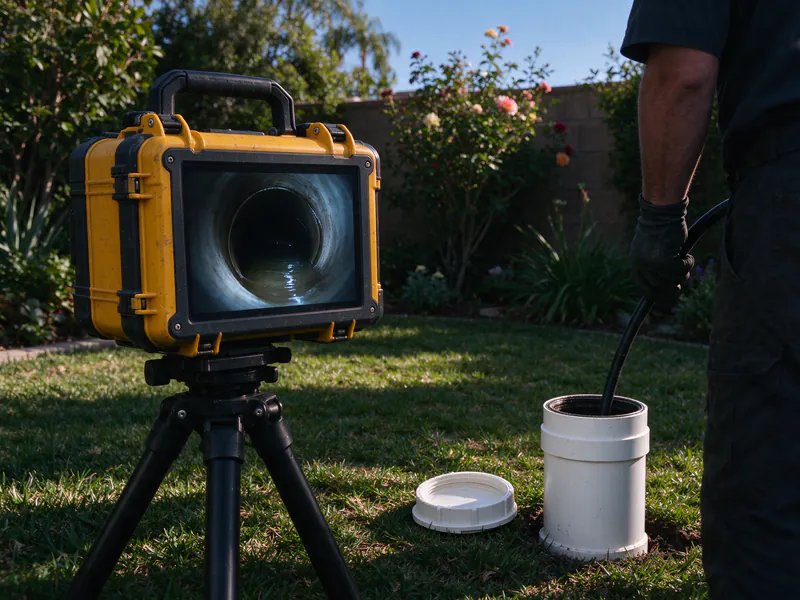
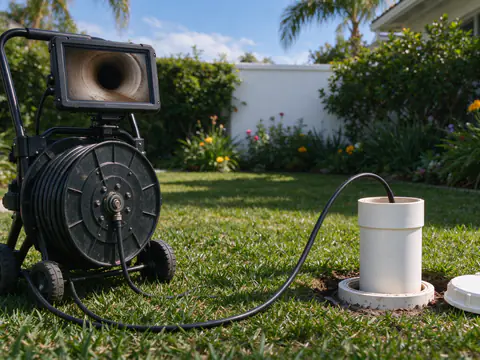
We use two sources. Inside the pipe, the camera inspection records where water stands and over what length; when the lens dips below the surface for several feet, that stretch is low. The amount of water on screen gives a rough sense of depth, but video alone doesn’t measure the sag precisely.
Outside, we read approximate depth to the camera head with the locator at intervals along the path. Comparing those readings against the ground surface gives a rough profile of the pipe, which shows whether the low spot is a short dip or a long flat run. Our guide on how deep a sewer line is explains how depth is read and why it varies across a lot, and our guide to reading a sewer camera report covers how bellies are noted.
Can’t you just line it?
Cured-in-place lining forms a new pipe wall against the inside of the old one. It follows every curve and dip of the host pipe, so a lined belly is still a belly. Lining can seal cracks and joints inside the sagging run, but solids will still settle in the same place.
That doesn’t make lining wrong for a line that has a belly, only incomplete. When the sag is minor and the real problem is roots or cracks elsewhere, lining the line and maintaining the low spot can be a reasonable plan. When the belly is the cause of your backups, it needs to be corrected. Pipe bursting follows the old path too; a stiff new pipe can ease a shallow dip, but it doesn’t reliably restore lost grade. Our comparison of lining and bursting covers the difference.
Not sure the sag is the problem?
Send the footage, and we'll tell you whether the belly explains the backups or whether something else does.
How we fix a belly
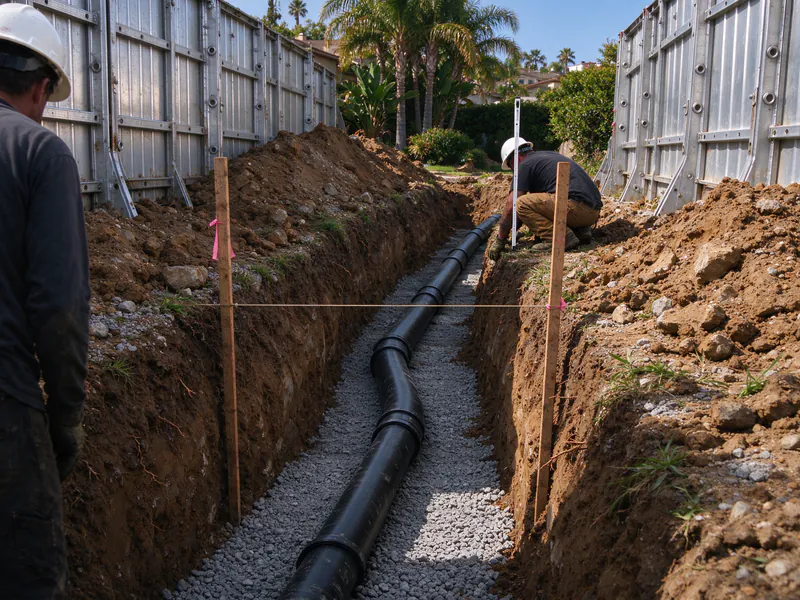
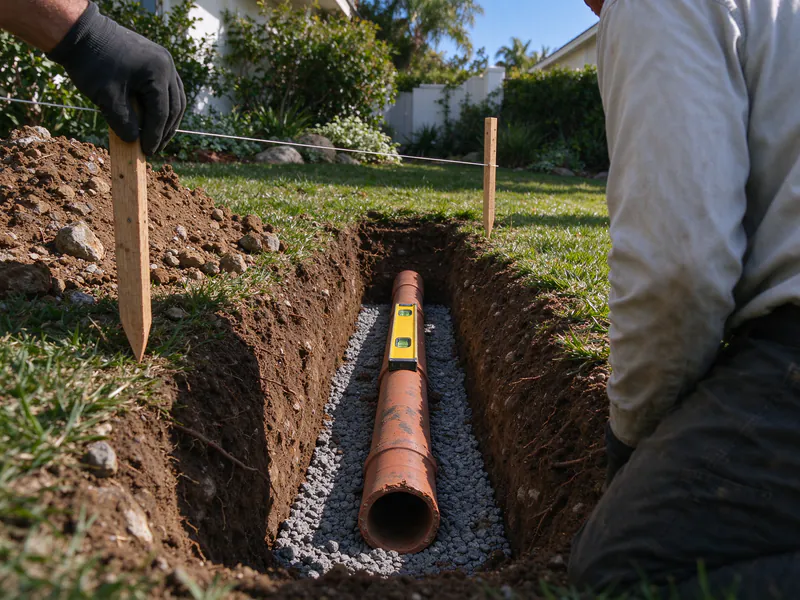
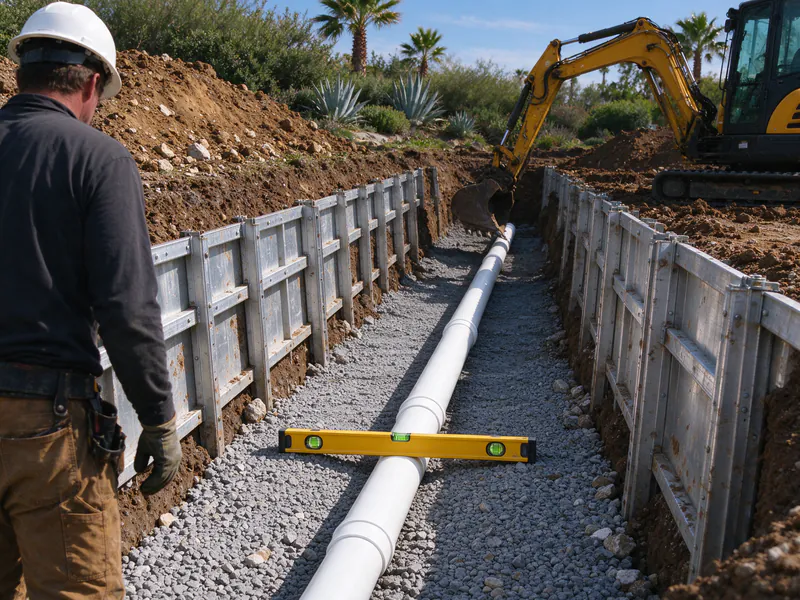
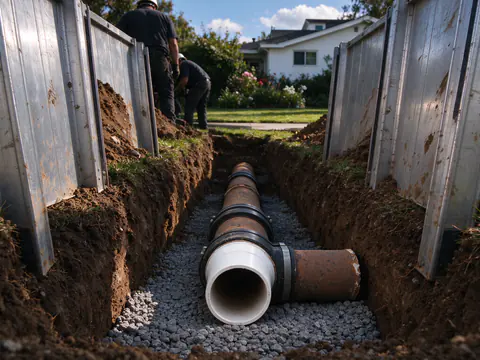
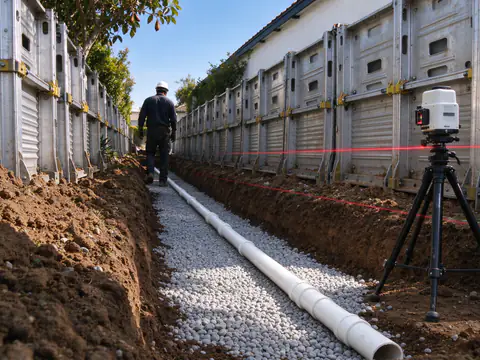
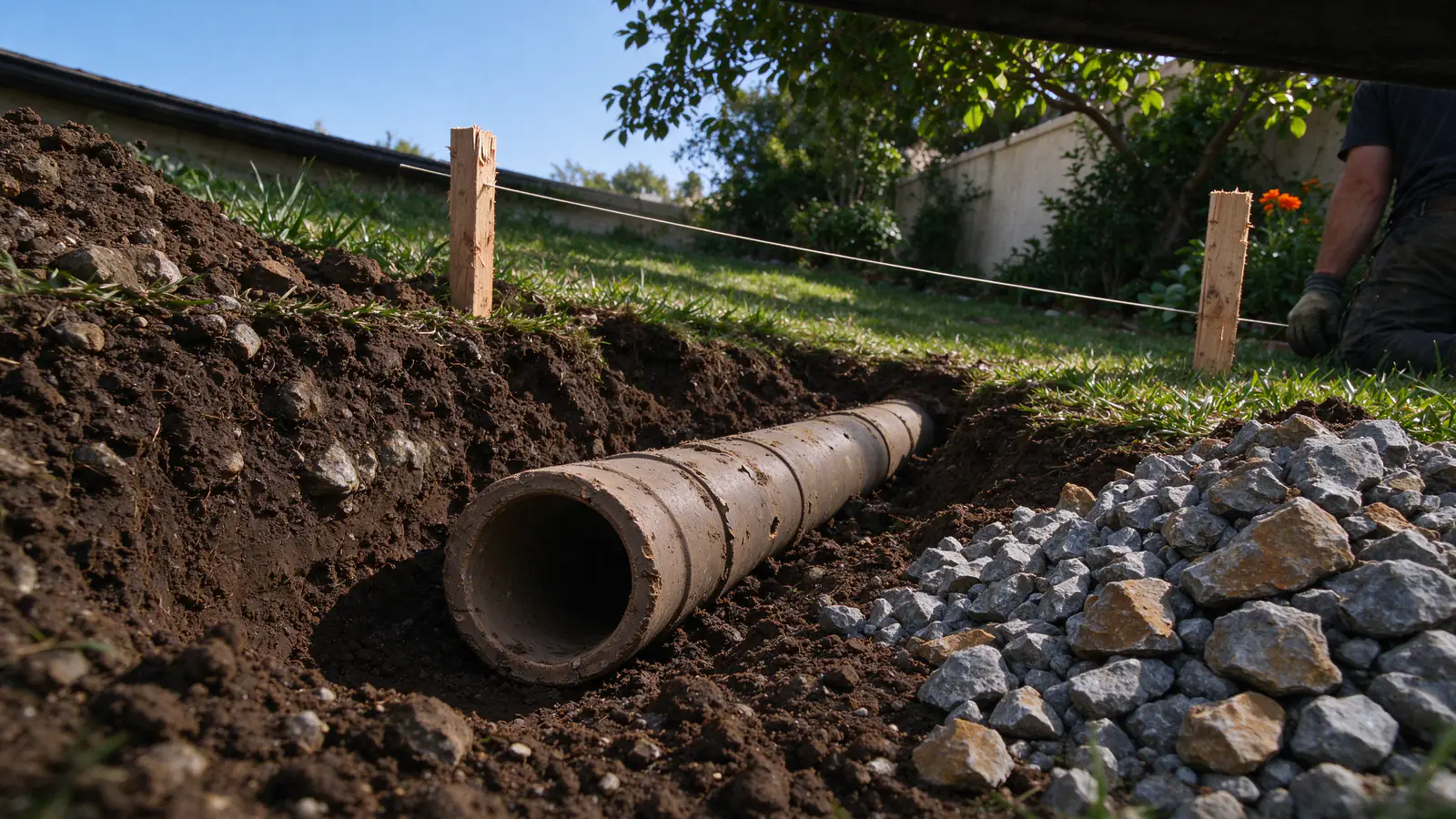
Correcting a belly means digging. We expose the low section, remove the old pipe, and rebuild the trench floor with compacted granular bedding. We set new pipe, usually PVC, on that bedding to a measured slope, check it with a level or laser, and tie it into the old pipe on each side with listed transition couplings. If the run on either side has also lost grade, the excavated length grows. A short belly with sound pipe beyond it is effectively a spot repair, and our typical range for one is $1,500 to $5,000; a line that has sagged in several places may be better replaced end to end through sewer line excavation, at our typical $50 to $250 a foot. Your final price comes from a written quote after we see the job.
Backfill matters as much as bedding. The City’s policy for easement laterals calls for backfilling in 12-inch lifts, and compacting each layer is what keeps the new section from settling the way the old one did.
Is your line deep or wet?
A belly near the front of the lot can sit deep, because standard laterals carry 5 to 7 feet of cover at the property line. Any trench 5 feet or deeper needs shoring to Cal-OSHA standards, and trenches can collapse without warning, so never dig toward the line yourself.
A City-hosted geotechnical study of Mission Bay Park found groundwater at about sea level in its hydraulic fill, and excavations on ground like that may need dewatering and stabilization. Pumping groundwater into the sewer needs a Public Utilities Groundwater Discharge Permit before any discharge.
Can your belly wait?
A short, shallow sag in sound pipe with no history of stoppages may never need digging. Scope it again in a year or two and clear it if solids build up. If the footage shows long standing water, repeated blockages at the same distance or cracks in the low run, a correction becomes the cheaper path. Our guide to sewer line repair vs replacement helps with that call. If you have footage that shows a sag, get an estimate with the distances and what sits above the low spot.