 San Diego Swift
Your Escondido line is backing up or a scope found a crack, and you’d like to just get it fixed. Here the permit comes before the shovel, even when the broken pipe never leaves the backyard. A City repair permit is needed before work starts on any part of the lateral, and your responsibility runs all the way to the public main, under the sidewalk and street included.
Those two rules, more than anything about the pipe, shape how we plan a repair here. San Diego Swift Sewer Line Repair repairs and replaces laterals in Escondido, and the permit is part of the scope from the first conversation.
Do you need a permit for work in your own yard?
Plenty of owners assume that a repair inside their own fence is a private plumbing matter. Escondido’s sewer FAQ says otherwise: “a City of Escondido repair permit is required (even for repairs on private property)” before any work is begun. The permit comes from the Building Division and applies wherever the bad section is. If the repair digs in a street or other public right-of-way, a second permit is needed, an encroachment permit from the agency that maintains that street, which is the City through its Field Engineering section in most cases.
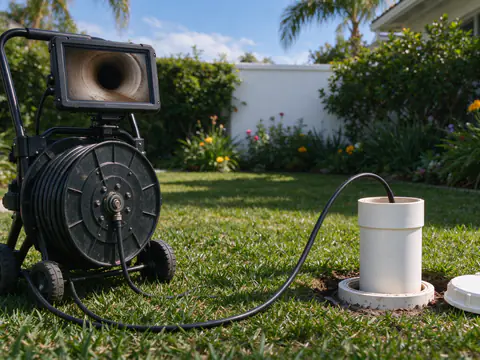
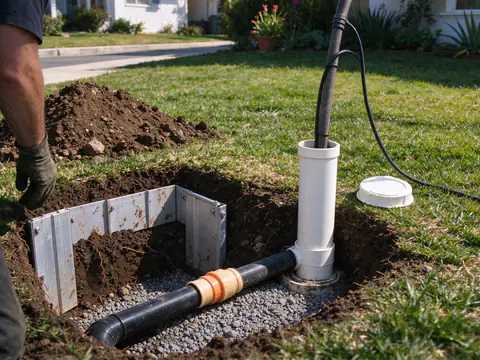
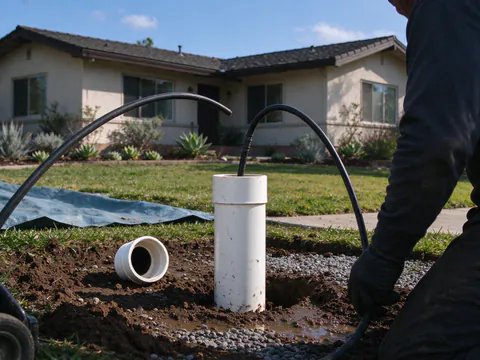
In practice that sets the order of a job. The camera inspection comes first, because it defines the work the permit describes. The permit is then pulled before excavation or lining begins, and a permit normally brings an inspection, so the Building Division’s checkpoints go into the schedule. Trenchless work is not exempt by default: a liner is still a repair to the lateral, and lining still needs access points. Our trenchless sewer repair page covers what each method opens up.
Your written scope names who pulls each permit and shows the permit and encroachment costs as their own lines. If a quote leaves them out, it is either assuming you will handle them or assuming they are not needed, and in Escondido the City’s FAQ rules out the second. When the contractor doing the work holds the permit, the inspections are scheduled around the work rather than after it, which keeps a trench from sitting open while someone waits for an appointment.
Is the break under the sidewalk or street?
The City’s FAQ, citing the Escondido Municipal Code, places maintenance and repair of the lateral on the owner “from the house up to the point of connection with the public sanitary sewer main,” including the portion “beneath the sidewalk and street.” The City maintains more than 350 miles of public mains, and its responsibility starts at the main itself.
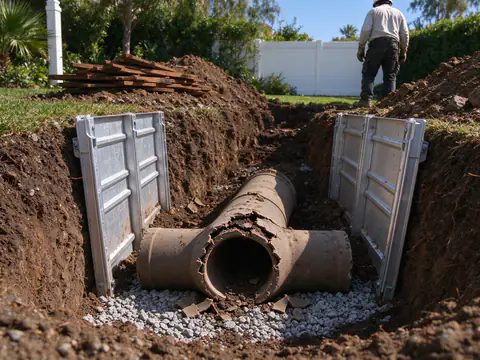
That differs from the City of San Diego, where the City may correct a total blockage in the street section when all service is lost. Escondido’s FAQ describes no such arrangement, so a cracked or collapsed pipe under the sidewalk is your repair, with an encroachment permit, plus whatever traffic control and pavement restoration the agency that maintains the street requires. Our street sewer lateral repair page explains how we open and close a connection in the street, and collapsed sewer line repair covers the case where the pipe has failed and can’t be lined.
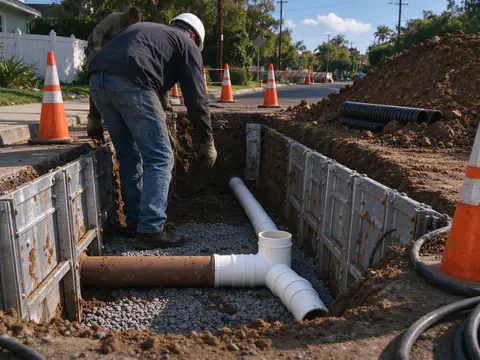
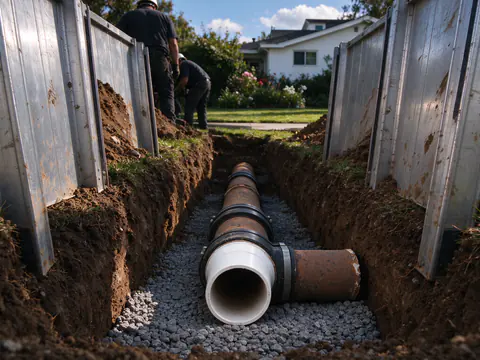
A street-side trench is often deeper than the yard run, because the line keeps falling toward the main. Trench work at that depth is safety-critical and needs shoring; our sewer line excavation page describes how we do it.
Could the backup be the City’s main?
Not every backup is the lateral. For a backup, the City’s FAQ gives a 24-hour number and says the City inspects the main free of charge. That call is worth making first, because a blocked main and a blocked lateral look the same from inside the house: drains slow, the lowest fixture overflows first.
If the main is flowing, the stoppage is in your line. Clearing it restores service, but clearing alone says nothing about why it stopped. Our camera run after the line is cleared shows whether roots, an offset or a sag is behind it. Our guide on what to do when your sewer backs up covers the first hour, and emergency sewer repair covers what happens when the line can’t wait for a scheduled visit.
Can Escondido’s ground move your pipe?
Escondido sits inland of the coast and gets more rain. NOAA’s 1991 to 2020 normals for the Escondido No. 2 station average 14.52 inches a year, against 9.79 inches at Lindbergh Field, with about 1.8 nights a year at or below freezing. Frost is still not a meaningful cause of pipe damage here.
Soil may be. A Natural Resources Conservation Service sample near central Escondido maps Placentia sandy loam, with a subsoil of up to 43 percent clay and a high shrink-swell rating. Clay-rich soil swells when it takes on water and shrinks as it dries, and that movement can pull rigid pipe joints apart or crack a pipe that is held at one end. It is a single sample, not a survey of every lot, so it describes a possibility to check for, not a diagnosis. On the camera, soil movement tends to show up as offset joints, cracks near fittings or a section that has dropped. A single bad section points to a spot repair; several suggest the run as a whole.
What will the camera show at your house?
Escondido’s housing is mostly post-war. The Census Bureau’s American Community Survey puts 10.4 percent of the city’s homes before 1960 and 46.9 percent before 1980. That narrows the era of the plumbing but not the material, which only the footage confirms.
Read a scope report for location as well as defect. Distance from the cleanout, measured on the video, tells you whether a fault is in the yard, under the sidewalk or at the main, and that decides which permits apply. Our typical range for a camera inspection is $100 to $500 and for an excavated spot repair $1,500 to $5,000, and your final price comes from a written quote after we see the job. Our guides on the signs of a broken sewer line and how to compare sewer repair quotes help you check that two scopes describe the same work. The sewer camera inspection page covers what a good inspection records, and to the south, Poway shows how differently a neighboring city can split the same pipe.
Escondido lateral needs work?
Send the address and any camera footage, and we'll map out which permits your repair will need.