 San Diego Swift
The signs of a broken sewer line are the ones that affect the whole house or show up outside: several drains slowing together, backups at the lowest fixture, gurgling from drains no one is using, sewage odor in the yard, and wet, sunken or unusually green ground over the line’s path. None of them proves a break by itself. They tell you where to point a camera.
That distinction is the whole point of this guide. A clog, a grade problem, a vent fault or a stoppage in the City main can produce the same symptoms as a cracked lateral, and the repair for each is different. At San Diego Swift Sewer Line Repair we treat symptoms as the case for an inspection, not the diagnosis. If sewage is already in the house, start with what to do when your sewer backs up and come back here later.
Signs inside the house
Several drains slow down together
The mechanism: every fixture shares the lateral, so a restriction there slows everything upstream of it. A single slow sink is almost always its own trap or branch line; a sink, a tub and a toilet slowing in the same week points to the main building drain or the lateral. The lookalike: a clog in the building drain under the slab, before the lateral begins, behaves the same way.
The same backup keeps coming back
The mechanism: a recurring blockage at the same spot usually means something in the pipe keeps catching waste: a root mass growing back through a joint, an offset lip, a belly that holds water and drops solids, or a crack that lets soil in. Clearing restores flow, and the defect stays. The lookalike: grease buildup or a foreign object can also cause repeat stoppages without any structural damage. A recurring clog is a reason to film the line, not proof it has collapsed. Our guide to hydro jetting versus repair explains when cleaning is the fix and when it is the warning.
Backups at the lowest fixture
The mechanism: when the lateral is blocked, water rises until it finds the lowest open drain, usually a shower, a floor drain or a ground-floor toilet. That is why a washing machine discharge can push water up into a tub across the house. The lookalike: a blockage in the City main can back up into several houses on the street at once; if neighbors have the same problem, that is useful information for the City.
Gurgling and bubbling
The mechanism: a partial blockage traps air, and the air escapes back through the nearest trap, making a toilet bubble when the tub drains. The lookalike: a blocked or undersized vent produces the same gurgle with a perfectly sound lateral. A vent problem usually affects one group of fixtures; a lateral problem tends to show everywhere.
Sewer gas odor
The mechanism: a break near the foundation can let sewer gas into a crawlspace or through slab cracks. The lookalikes: a dry trap is far more common, followed by a failed toilet wax ring. Run water into every rarely used drain first. An odor that persists after that, or one in the yard, points outward.
Signs outside the house
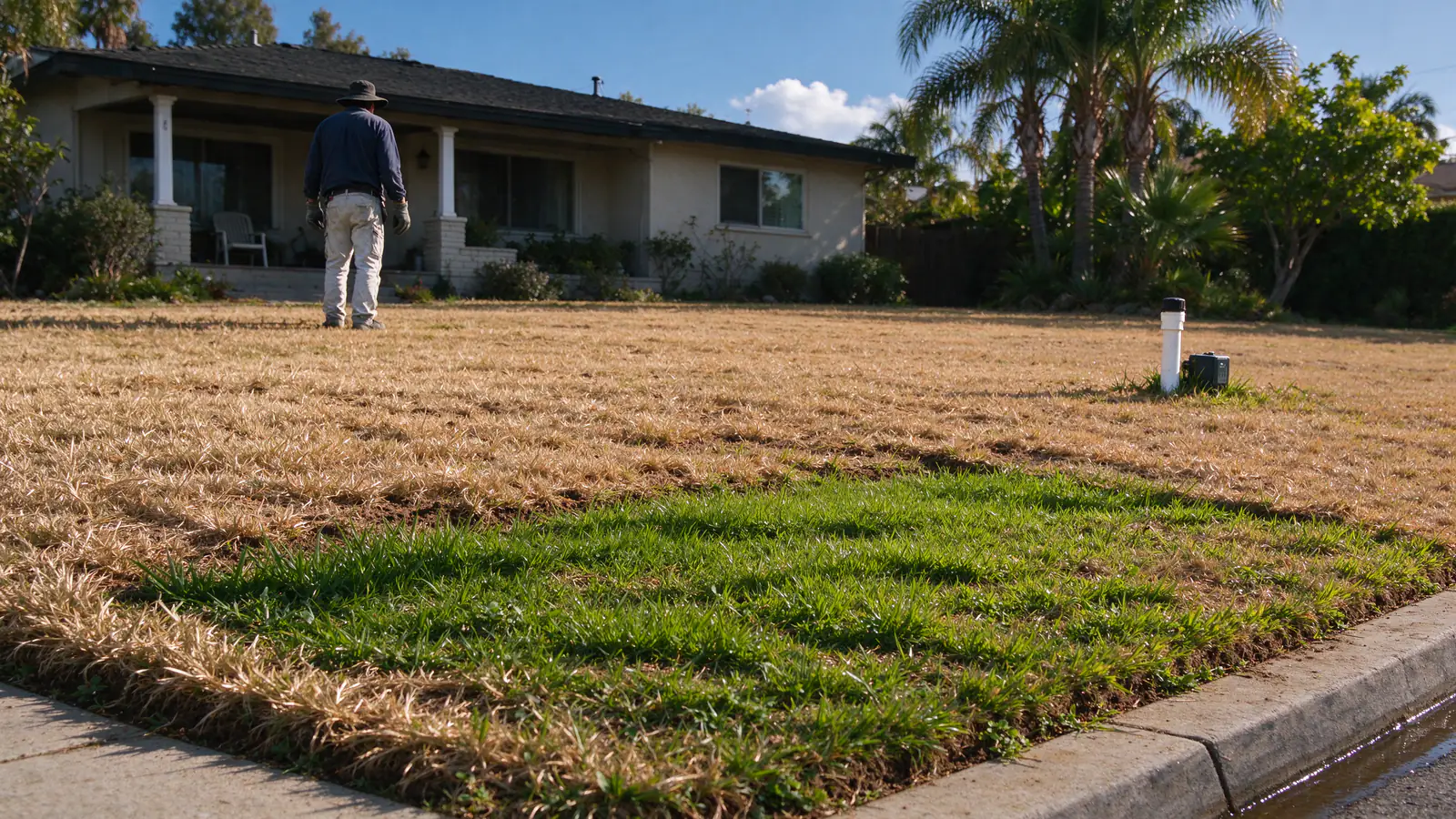
Wet ground, pooling or a green stripe
The mechanism: a crack in the bottom or side of the pipe lets wastewater leak out into the soil, which engineers call exfiltration. The leak feeds the grass above it and keeps the ground damp. The San Diego angle: Lindbergh Field averages 9.79 inches of rain a year, nearly all of it between November and March, with June through September averaging about a tenth of an inch a month or less. A persistent damp patch or a lush stripe across a lawn in August, with irrigation ruled out, is hard to explain by weather. The lookalike: a leaking irrigation line or water supply line. The water line is pressurized and leaks constantly; a sewer leak tracks household use.
Settling, sinkholes and soft spots
The mechanism: where a pipe is broken, soil can wash into it and get carried away with the flow, leaving a void that settles. A depression along the line’s path, or a soft patch near the cleanout, deserves a camera before it deserves a shovel. Clay subsoils with high shrink-swell potential, recorded at sample points in Encanto, Mira Mesa, Lemon Grove, Spring Valley and Escondido, move with moisture and can stress rigid pipe; sandy ground near the coast and in Mission Valley drains differently and can wash into a break faster.
Problems that follow rain
The mechanism: cracks and open joints work both ways. When the soil is saturated, groundwater and rain seep in, a process called infiltration, and a lateral that copes in July can back up in February. The lookalike: roof downspouts or yard drains connected to the sewer by mistake, or a City main surcharging in a storm.
What a broken line actually looks like on camera
The camera turns symptoms into a defect with an address. A crack shows as a dark line in the wall, sometimes weeping. An offset joint shows as a lip where one section has dropped. A break shows soil or open ground through the wall. A belly shows as standing water the camera head sinks into. A sewer camera inspection records each by its distance from the cleanout, and a locator marks the spot on the surface. The material matters too, since clay, cast iron and fiber pipe each fail in characteristic ways; see what sewer pipe your house has.
Seeing more than one of these signs?
Tell us the symptoms and the address; we'll set up a camera inspection and explain what the footage shows.
What the findings point to
One cracked or offset section with sound pipe either side usually points to a spot repair. Root intrusion through joints may be cleared with root removal, with the understanding that cutting reopens the pipe without sealing the joint. A sag points to belly repair, because lining follows the existing grade. A line that will not take a camera at all may be collapsed. Defects spread along the whole length are a repair versus replacement decision. The camera report guide helps you read the footage yourself, and you can get an estimate from us once you have it.