 San Diego Swift
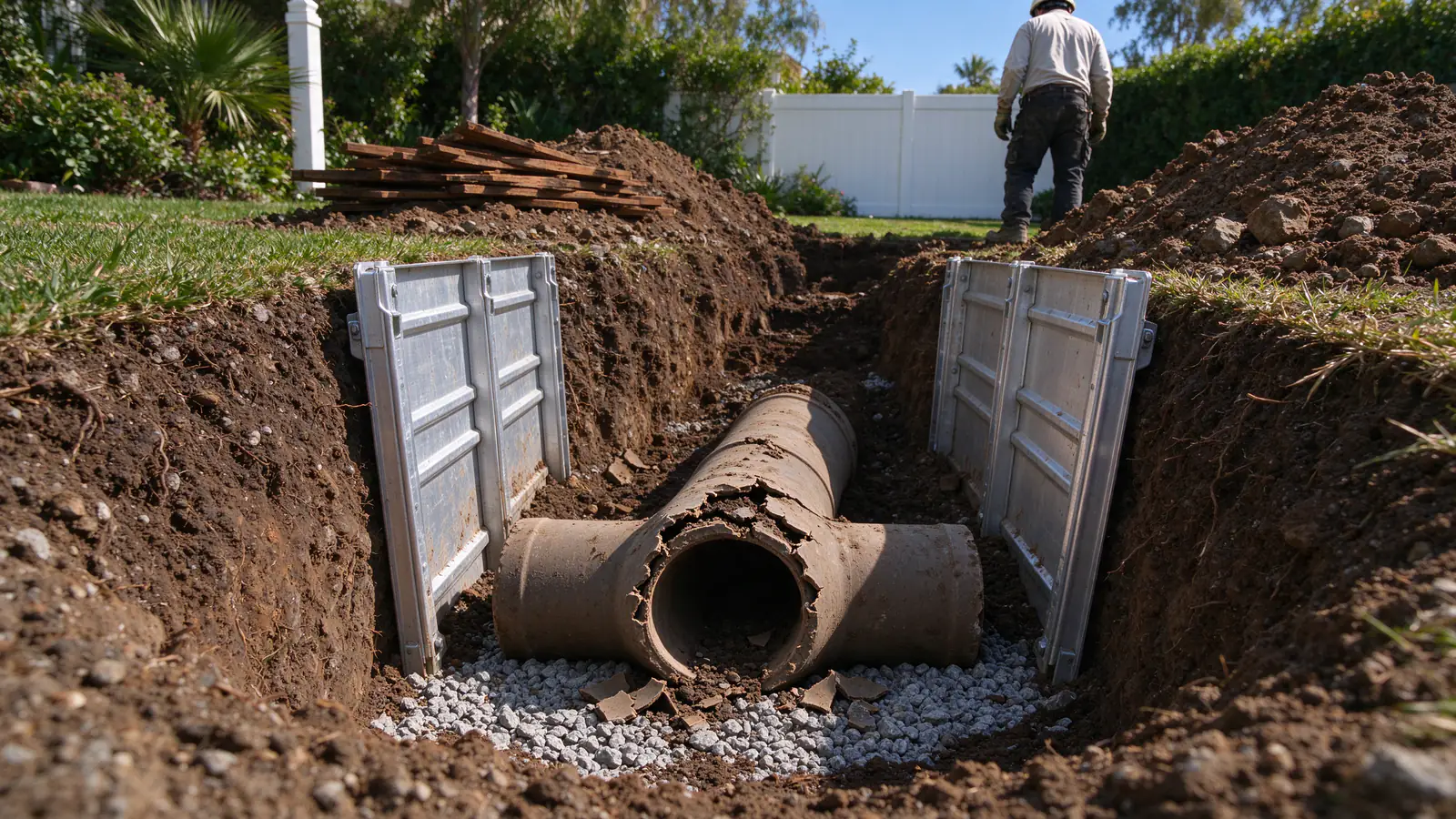
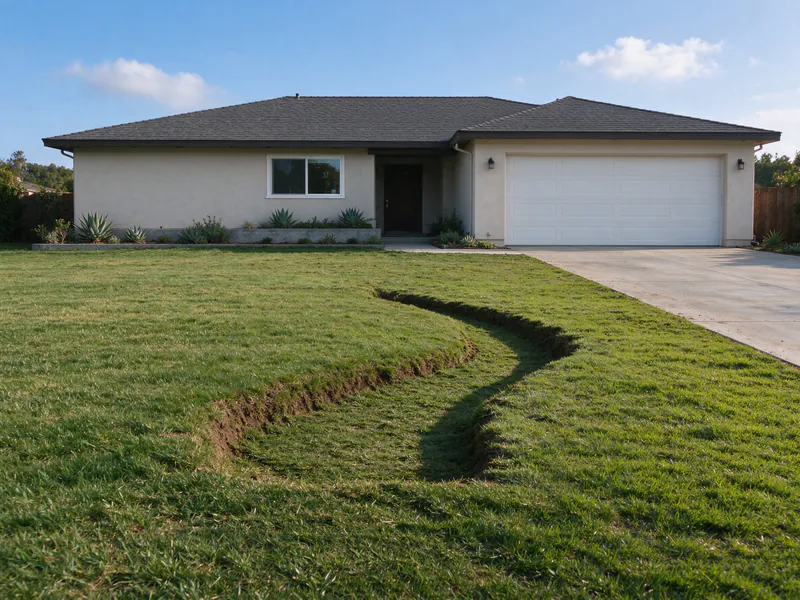
Nothing drains, the cable keeps hitting the same spot, or a soft patch has opened in the yard over the line. A collapsed sewer line is a lateral that has caved in: the pipe has broken and lost its shape, and soil, rock or pieces of pipe have fallen into the opening. San Diego Swift Sewer Line Repair repairs collapsed laterals across San Diego, and we start with the step that matters most: proving it really is a collapse and finding exactly where it is.
That step matters because “collapsed” gets used loosely. Plenty of lines described as collapsed turn out to be packed with roots or grease, or sitting in a belly, and those need different work. The signs of a broken sewer line overlap heavily with the signs of a plain blockage.
How do you know if a sewer line has collapsed?
A camera inspection confirms it. The clues are a complete stoppage that cleaning can’t clear, a cable or jetter that keeps hitting the same point, soil or rock coming back on the cleaning head, or a soft spot in the yard over the line. Those suggest a collapse but don’t prove one.
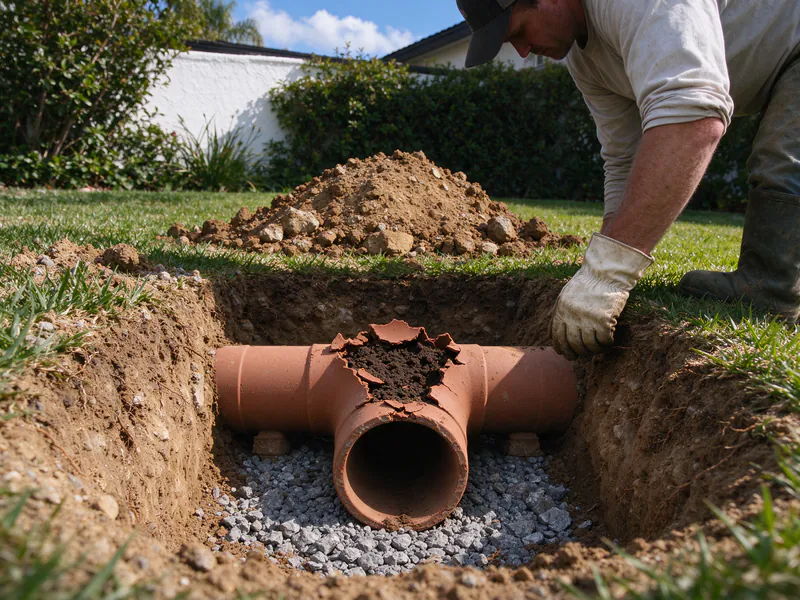
On the footage, a collapse looks like the crown of the pipe sagging inward, broken pieces lying in the bottom, soil filling the bore, or a point beyond which the camera simply cannot go. We pick up the camera’s sonde from the surface with a locator at that footage count, which puts the collapse on the ground to within a few feet. A sewer camera inspection is how we do it, and the guide on reading a camera report explains the terms.
When the camera stops at the collapse, what lies beyond is unknown. If there’s a second cleanout or an access point downstream, we can run the camera from that end to see whether the rest of the line is sound, which changes the repair. If there isn’t, our plan says so and allows for what the dig might reveal.
Why did your line cave in?
Material failure. Old clay, once its joints have opened and its barrel has cracked, can lose support and fall in. Cast iron corrodes from the inside, and a bottom that has rotted thin eventually gives way under the soil above it. Bituminous fiber pipe softens and ovals with age until it flattens. The City’s lateral fact sheet notes that older clay, cast iron and concrete laterals are the ones prone to deteriorated sections. Our pipe material guide covers each one.
Soil movement and load. Settling backfill, shrink-swell clay subsoils of the kind USDA sampling found at points in Encanto, Mira Mesa, Lemon Grove, Spring Valley and Escondido, and heavy loads on shallow pipe all stress brittle pipe until an already cracked section gives way.
Roots. Roots don’t usually crush a sound pipe, but a root mass growing inside a cracked section can pry it apart until it falls in.
Did nearby work break the pipe?
A sudden collapse can trace to work done nearby rather than to age alone. A new fence line with posts driven or augured along the property edge, an irrigation trench, a tree planted over the line, a retaining wall footing, or utility work that bored across the lateral’s path can all crack or puncture the pipe, and a cracked pipe under load can collapse weeks or months later. Heavy machinery crossing a yard is another cause, especially over a shallow line.
When you suspect damage like that, the timeline matters. Keep the dates of the nearby work, photos of it, and the camera footage of the damaged section with its distance marked. Whether another party is responsible is a question for the parties and their insurers, not something the footage settles alone, but footage taken before the repair is the evidence everyone will ask for. The guide on whether homeowners insurance covers sewer line repair explains how coverage splits.
Camera stopped at the same spot?
Send the footage and the distance from the cleanout, and we'll tell you whether it's a collapse and how we'd repair it.
Is the collapse under the street?
In the City of San Diego your lateral runs all the way to the main, so a collapse under the sidewalk or street is still yours to repair in most cases. There is one exception worth knowing. If a plumber finds a break-in or collapse beyond the property line, the City’s Public Utilities page asks the licensed plumber to call its Sewer Emergency Line and file a Plumber’s Report, and the City investigates.
The City may correct a total blockage or break in the right-of-way section at no cost to the owner, but only when all sewer service is lost and the plumber has filed that report. It won’t work inside the property line, it won’t work where a private structure such as a block wall blocks access, and it bills the owner if the cause was a lack of routine maintenance such as roots or grease. For a structural defect without a full blockage, the City accepts a plumber’s video for review. Who is responsible for the sewer lateral covers those rules in full.
How we repair a collapse
Lining is not the first answer for a collapse. A liner needs a continuous host pipe to form against, and a caved-in section has none, so we open or replace the collapse first. You have three paths.
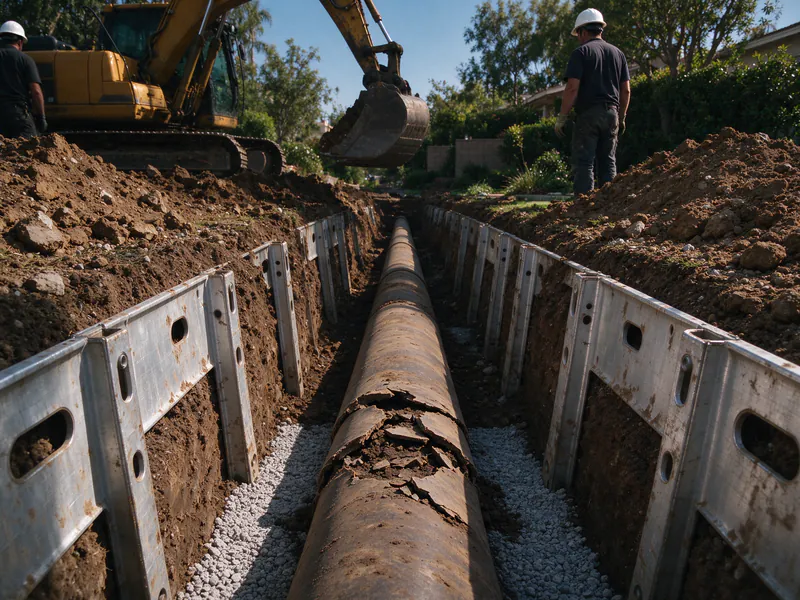
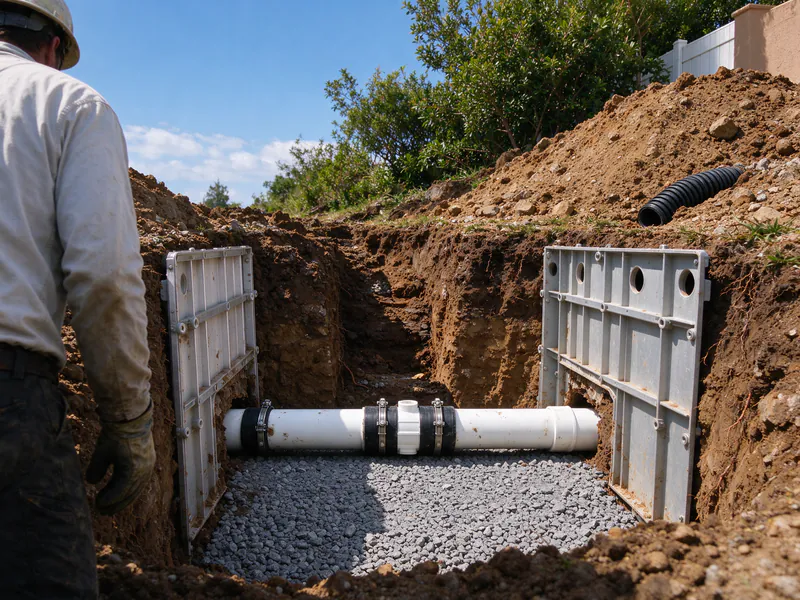
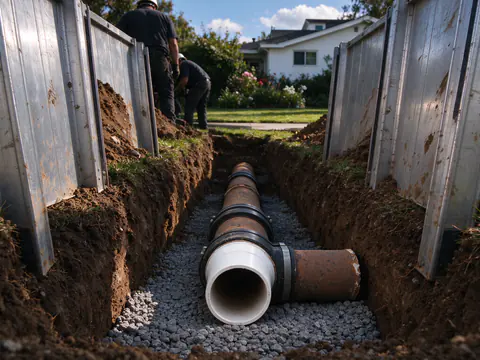
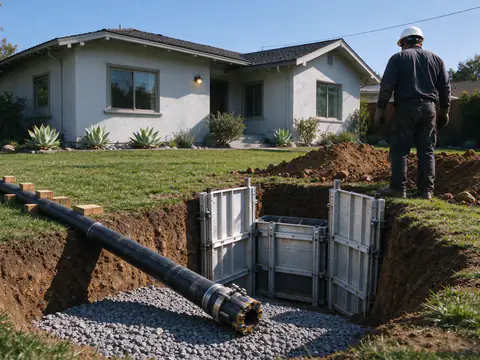
Dig out the section. If the collapse is one isolated spot and the rest of the line is sound, we dig a pit over it, remove the broken pipe and join in new pipe with listed couplings on firm bedding. This is a spot repair, and it’s often the least disruptive way back to a working line. If the remaining pipe has cracks or root-entry joints, we can line it afterward.
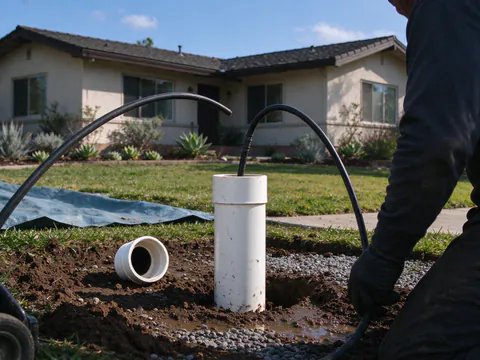
Burst through. If the pipe is failing along its length and the old path can still be threaded, pipe bursting replaces the whole run, sometimes with a small pit at the collapse to clear the way.
Replace the line. Several collapses, a sag, or a poor route point to full replacement by trench or bursting.
A collapse that leaves the house without a working sewer is urgent; our emergency sewer repair page covers the first steps. Keep people out of any sinkhole or open hole over the line, and don’t try to dig to the pipe yourself.
What will the repair cost?
We price a collapse by the repair it needs, which can be a point repair or a full replacement. Our typical range for an excavated spot repair is $1,500 to $5,000, for pipe bursting $60 to $200 a foot, and for trench replacement $50 to $250 a foot. Depth at the collapse, what’s above it, and whether it sits in the street move the total most, and your final price comes from a written quote after we see the job.
If the camera has stopped at a collapse, get an estimate with the footage and the distance, or call us, and we’ll tell you first what is confirmed and what still needs to be.