 San Diego Swift
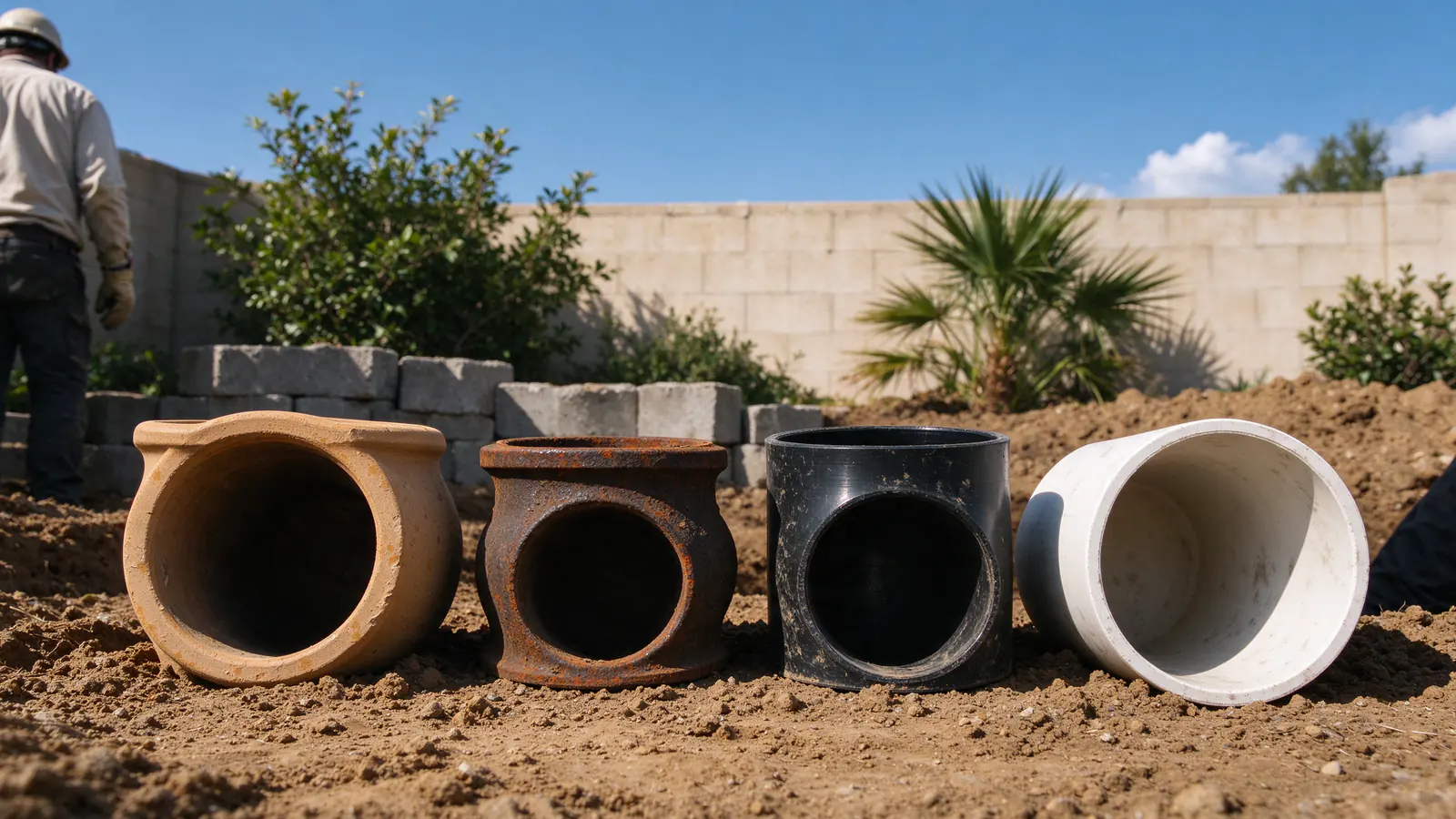
Most San Diego houses drain through one of six materials: vitrified clay, cast iron, concrete, Orangeburg fiber, ABS or PVC. Which one yours has depends mainly on when the house and its lateral were built and whether the line has been repaired since. A camera inspection is the only way to be sure, because the City keeps no record of what private laterals are made of.
That gap matters because material decides the failure you are watching for and the repairs that fit. At San Diego Swift Sewer Line Repair we start every lateral scope by naming the material at each footage mark, and this guide explains what each one looks like, how it ages and what it means for a repair. For how the whole lateral works, see what a sewer lateral is.
Why doesn’t the City know what my lateral is made of?
Because the lateral is private plumbing, and the City only tracks its own pipes. Development Services can tell you where a property’s lateral meets the City main, and SanGIS publishes the mains themselves, but the City has no diagrams or material records for lines on private lots. The material of any one lateral is something footage confirms.
What the public record does show is the material of the mains. City capital projects have spent years replacing or relining vitrified clay mains with PVC, in Encanto, Clairemont Mesa, La Jolla and a citywide trenchless program that also rehabilitated 633 laterals. The City’s lateral rules still allow saddle connections only on clay mains, which tells you clay is common in the public system. Laterals built alongside those mains were often the same material, though that is an inference, not a record.
House age as a first clue
The American Community Survey’s 2020-2024 estimates give a sense of how old the housing stock is. Citywide, 6.4 percent of San Diego’s 568,668 housing units were built before 1940, 20.5 percent before 1960 and 52.4 percent before 1980. The older ZIP codes run far above that.
| ZIP (approximate area) | Built before 1940 | Built before 1960 | What that suggests |
|---|---|---|---|
| 92102 (Golden Hill, Sherman Heights) | 28.5% | not compiled | Highest pre-war share of the ZIPs checked |
| 92116 (Kensington, Normal Heights, Talmadge) | 22.3% | 39.4% | Similar pre-war profile |
| 92103 (Mission Hills, Hillcrest) | 21.7% | 33.0% | Pre-war core, historic districts |
| 92104 (North Park) | 21.3% | 34.0% | Streetcar-era bungalows |
| 92106 (Point Loma) | 20.8% | 55.3% | Pre-war and post-war mix |
| 92117 (Clairemont) | 0.6% | 37.9% | Post-war tracts; 84.3% before 1980 |
| 92126 (Mira Mesa) | 0.7% | 1.6% | Mostly 1970s and later; plastic more likely |
ZIP codes only roughly match neighborhoods, and a house’s age says when its first lateral went in, not whether that lateral is still there. Read the table as odds, then let the camera decide. North Park and Mission Hills have their own pages on what pre-war housing means for the sewer.
The six materials, on camera and in failure
Vitrified clay
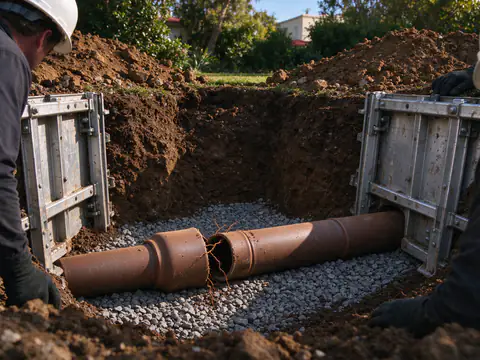
Era: the default for much of the pre-war and early post-war period. On camera: a smooth, glazed tan to reddish-brown barrel, broken by a joint every few feet where one bell receives the next. How it fails: the barrel resists sewage well, but the joints do not. Mortar or early gaskets let go, roots find the gap, and settlement shifts sections out of line into offsets. Clay also cracks under point loads. A clay line can be lined when it is continuous and round, or burst because it shatters cleanly; see clay sewer pipe repair.
Cast iron
Era: common under slabs and close to the house in older and mid-century homes, and in some full laterals. On camera: a dark, rough wall with orange or black scale and bumps of corrosion, and hub joints. How it fails: corrosion works from the inside, building scale that narrows the bore and, over decades, eating the bottom of the pipe into a channel until the wall cracks or splits. Remaining wall condition decides whether descaling and lining make sense; see cast iron sewer replacement.
Concrete
On camera: a grey, rougher wall, sometimes with exposed aggregate where the surface has worn away along the flow line. How it fails: sewer gases and abrasion erode the inside, and joints between sections open and admit roots the way clay joints do.
Orangeburg
Era: a fiber-and-bitumen pipe used in parts of the country in the mid-twentieth century. No source shows how common it is in San Diego. On camera: a black, initially smooth wall that later blisters and flakes. How it fails: it softens and goes oval under soil load, which is deformation in the plain sense: the pipe loses its round shape, the flow area shrinks, and solids catch at the narrowest point. Badly deformed fiber pipe may not take a liner at all.
ABS
Era: black plastic that spread through residential drainage from roughly the 1960s and 1970s on. On camera: a smooth black bore with glued joints. How it fails: joints and fittings are the weak points, roots can still enter a poorly made joint, and plastic laid without good bedding can flatten slightly under load.
PVC
Era: the modern standard, and what most San Diego replacements and the City’s own main projects use. On camera: a smooth white or green bore with long sections and few joints. How it fails: rarely on its own; problems usually come from installation, such as poor bedding that lets a section sag into a belly, or from a bad transition to older pipe.
Ductile iron and HDPE also appear. Ductile iron is a strong, cement-lined iron pipe sometimes used where a line has shallow cover or heavy loads above it. HDPE is the fused black plastic that pipe bursting pulls into place.
Why age turns into deterioration
Age is not the failure; it is the time over which mechanisms add up. Clay joints have had longer for roots to find them and for soil to move them. Cast iron has had longer to corrode. Fiber pipe has carried soil load for longer. The City’s own fact sheet puts it plainly: newer plastic laterals with intact joints may go years without problems, while older concrete, clay or cast iron laterals may need regular inspection or more frequent cleaning. Our guide to how long a sewer line lasts goes into expected service lives.
Mixed laterals and transitions
Many older laterals are not one material. A cast iron stub leaves the foundation, a run of clay crosses the yard, and a PVC section marks an old spot repair. Each change happens at a transition coupling, and those couplings are worth a look on camera because a poorly matched one becomes its own offset. When you read the footage with our camera report guide, note each material and its footage mark; the repair plan follows those marks. Get an estimate with any footage you have, or ask us for a camera inspection to find out.