 San Diego Swift
A sewer camera report is a map of one pipe, measured from one starting point. Every observation on it is a distance from where the camera went in, paired with a word for what the camera saw there. Learn the distances and the words, and the report tells you where the pipe has failed, how badly, and whether the failure is in one place or many.
San Diego Swift Sewer Line Repair bases every scope on this kind of footage, and once you can read it you can ask better questions of anyone quoting the work, us included. How the inspection itself is done is covered on our sewer camera inspection page; this guide is about the result.
What’s on the report
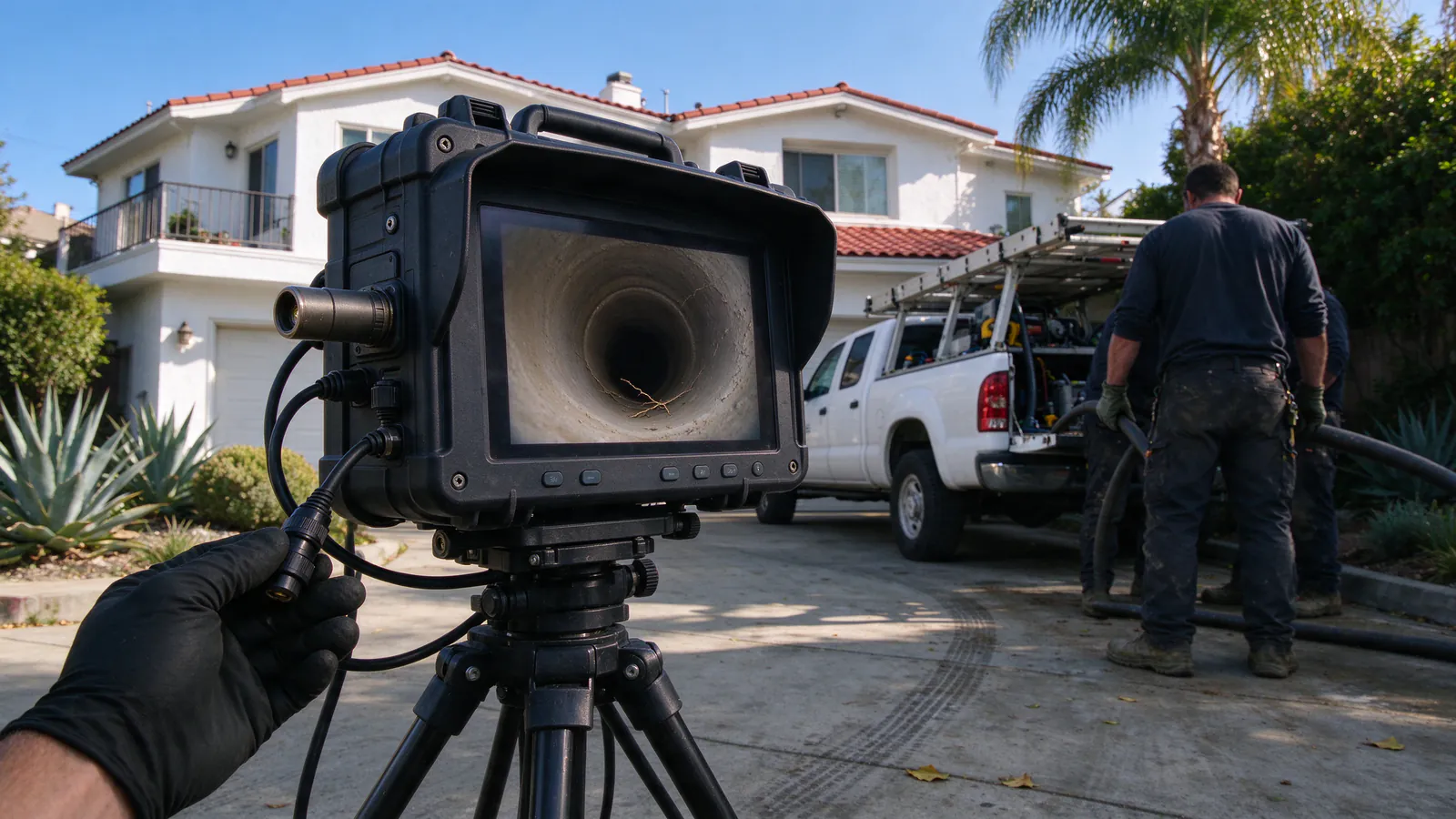
Most reports combine a video file with a written or printed summary. The summary usually lists the address, the date, the access point (which cleanout, or a pulled toilet or roof vent), the direction of travel, the pipe material and diameter where they change, and a list of observations, each with its footage. Many add still images at the important footages, and depths where a locator was used.
The video is the primary record. A still image of a root ball doesn’t show whether the joint behind it is offset, or how far the root mass extends. Keep the full file.
How do you read the footage counter?
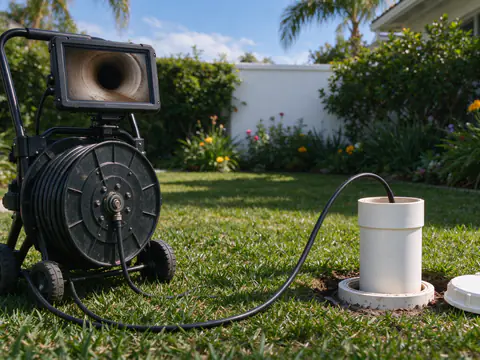
The counter shows how many feet of push cable have gone into the pipe since the camera started, usually zeroed at the cleanout. A finding at 52 feet is 52 feet of cable from that point. Cable can bunch in bends or lose ground on a push, so counter distances are close but not survey-accurate.
That’s why a good inspection pairs the counter with a locate. A sonde in the camera head transmits a signal that a receiver on the surface can find, giving a mark on the ground and a depth at that footage. If your report lists defects without locate marks, ask whether they were taken. A repair is dug at a mark, not at a footage. Our guide to how deep a sewer line is explains what the depth readings mean.
Two other things to check at the start: which way the camera was going, toward the street (downstream) or toward the house (upstream), and where it stopped. A report that ends at 60 feet “camera could not pass” has not seen the rest of the line.
The defect terms
Offset. Two sections of pipe at a joint no longer line up; one end has shifted up, down or sideways. On screen, the joint shows as a step or a lip. Small offsets catch paper; large ones admit soil and roots and may stop a liner from being installed.
Belly (sag). A section has sunk and holds water. The camera lens dips into standing water and the picture goes murky, then clears as the pipe rises again. The report should give where it starts, where it ends and how deep the water gets. See sewer belly repair.
Root intrusion. Roots entering through a joint or crack. Reports often grade it: fine roots like hair at a joint, or a dense mass that fills the pipe. The entry point matters more than the mass; root removal restores flow but leaves that opening.
Crack. A line in the pipe wall without separation. It may run along the pipe (longitudinal) or around it (circumferential).
Fracture. A crack that has opened, with visible separation or the wall starting to move. A fracture is further along than a crack.
Broken pipe and collapse. Pieces of the wall are missing or displaced, or the pipe has lost its round shape. Soil may be visible. A collapsed section usually can’t be passed by the camera or lined. See collapsed sewer line repair.
Infiltration. Groundwater entering the pipe from outside, seen as dripping, weeping or running water at a joint or crack. Its opposite, exfiltration, is sewage leaking out, which a camera can only infer from the defect.
Reports also note deposits (grease, scale, debris), deformation (a pipe going oval, common in Orangeburg) and material changes, where an old pipe meets a repaired section. Our guide to what sewer pipe your house has helps with identifying those.
Standardized coding: what NASSCO is
NASSCO, a standards body for the pipeline rehabilitation industry, maintains a standardized system for coding and grading pipe defects. Inspectors trained in it describe each observation with a consistent code and severity grade, so reports from different inspectors can be compared. Not every residential inspection uses it, and a plain-language report can be just as useful for a single lateral. If the report is coded, ask for the key that explains each code and grade.
Evaluating the pipe’s condition from the report
Once the defects are listed, the condition evaluation is about pattern:
- Localized or spread out? One fracture at 30 feet with clean pipe either side points toward a spot repair. Root entry at a dozen joints points toward lining or replacement.
- Does the pipe hold its shape and grade? A continuous, round pipe without sags is a lining candidate. Sags, collapses and severe offsets are not.
- Where is the property line? In the City of San Diego the owner is responsible for the whole lateral to the main, but the street section brings different permits, so the footage at the property line matters.
- Was the pipe clean? A camera can’t see through roots, grease or murky standing water. If the line wasn’t cleaned first, defects may be hiding; see hydro jetting vs sewer repair.
Have footage but no clear answer?
Send the video and the address, and you'll get a plain reading of what it shows and what kind of repair, if any, it points to.
What to ask for
Ask for the complete video file, with the footage counter visible on screen throughout. Ask where the camera entered, which way it went and where it stopped, and whether it reached the City main. Ask for locate marks and depths at each defect. If the line was cleaned first, ask for footage from after the cleaning. And if the inspection is for a home purchase, our home-buyer sewer inspection page lists what matters before closing.
Our typical range for a camera inspection is $100 to $500; the camera inspection cost guide explains what changes it. If your footage is already in hand, get an estimate or call us, and we’ll start from what the pipe shows.