 San Diego Swift
Sewer backing up at a Poway house? Start with where the problem sits, because Poway divides the sewer lateral differently from any other city in the county. Its lateral service page says the City “will clean your sewer lateral from the property-line cleanout to the sewer main free of charge,” and that Poway is “the only city in San Diego County that assumes responsibility from the property-line cleanout to the sewer main.”
That makes the first question in Poway a practical one: is there a property-line cleanout, and can the City get to it? If your line is backing up and nobody can find one, that is where we start. San Diego Swift Sewer Line Repair repairs and replaces laterals in Poway and installs the cleanouts the City’s service depends on.
Which part of the line is yours?
Picture your lateral in two parts with the cleanout box near the curb as the dividing point. From the cleanout to the main, the City cleans the line when asked, through its service request line or the Poway CityApp. From the house to the cleanout, the line is yours to keep clear and to repair, because the City’s statement covers only the downstream section.
What the City’s page describes is cleaning. It does not set out what happens when the downstream section is cracked or collapsed rather than blocked, so for a structural defect past the cleanout the sensible step is to ask the City before any repair is priced. Cleaning and structural repair are different jobs anywhere: a jetter or cable restores flow, while a broken or offset pipe stays broken after it is cleared. Our guide to hydro jetting versus sewer repair explains where one ends and the other begins.
No cleanout near the curb?
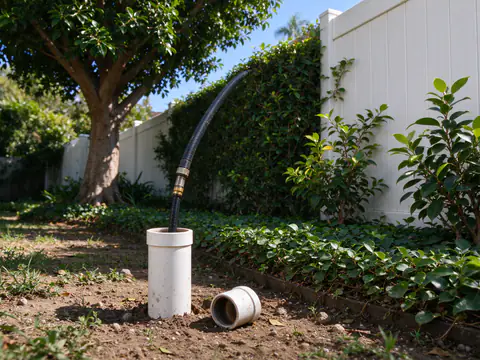
The City’s page is specific about access. The cleanout should be in the front yard near the sidewalk or curb, in a rectangular or round box. “If you don’t have a property-line cleanout, you will need a licensed plumber to install one,” and a cleanout box that has been buried must be exposed before the City will service it.
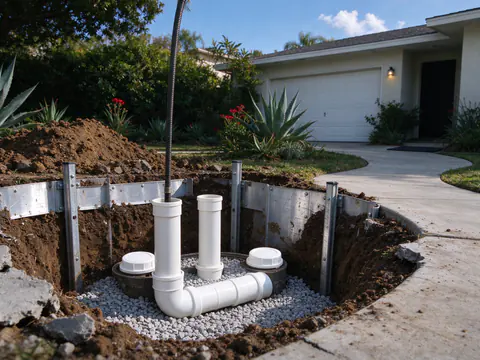
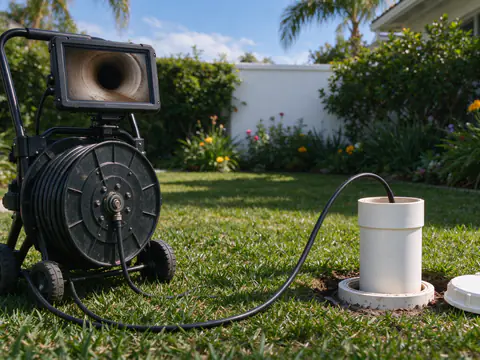
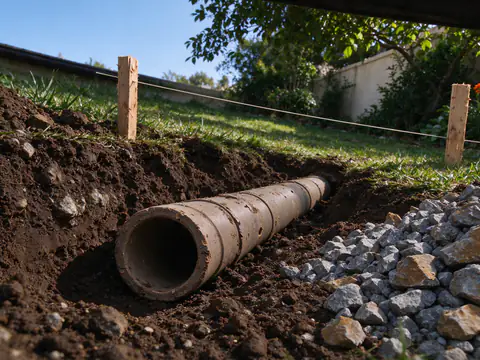
Installing one is a real excavation, not a quick fitting swap. We locate the lateral and measure its depth first, by running a camera from an existing cleanout near the house, so the hole lands on the pipe. We cut out a section and set in a two-way cleanout fitting, with a riser and box brought up to grade. If the camera shows the pipe at that spot is cracked or root-filled, we replace that piece while the hole is open. Our sewer cleanout installation page walks through the steps, and our guide on where to find a sewer cleanout helps you check what the house already has.
Our typical range for a new cleanout is $500 to $3,500, and your final price comes from a written quote after we see the job. Depth, the pipe material, and whether the box goes in lawn, concrete or pavers move it most.
Is the stoppage on your side of the cleanout?
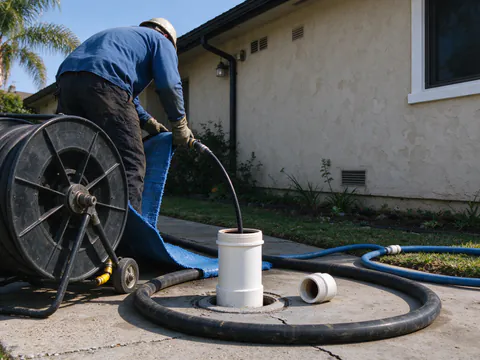
The property-line cleanout answers that. When we open it during a backup, standing water in the cleanout means the blockage is downstream, toward the main, in the section the City cleans. A dry cleanout while the house is backing up puts the blockage between the house and the cleanout, on your side. A camera then confirms the cause.
Leave that check to us. A cleanout cap on a line under pressure can release sewage when it comes off, and the box sits in the yard where it can overflow onto the lawn. Once the cause is clear, the next step follows from it: a City service request for a downstream stoppage, or clearing and a sewer camera inspection for one on the house side. Our root removal page covers what clearing can and cannot do.
Does the City keep coming back to the same section?
A stoppage that returns to the downstream section again and again is telling you something about the pipe, not only about what went down the drain. Roots coming back at one joint, a sag where solids settle, or an offset that catches paper all produce repeat calls, and repeated cleaning does not change any of them. Footage from the cleanout toward the main, with distances marked, is the most useful thing to have when asking the City what it will do about that section. Keep the dates of each service call as well; a record of how often the line stops is part of the evidence, and it helps us judge whether the problem is a defect or a habit, like grease or wipes, inside the house.
What does a Poway lateral look like on camera?
Poway’s housing is younger than San Diego’s urban core. In the Census Bureau’s American Community Survey, only 0.8 percent of Poway’s homes were built before 1940 and 6.9 percent before 1960, while 55.6 percent were built before 1980. Most laterals here date from the 1960s onward, and age alone does not tell you the material; the camera does.
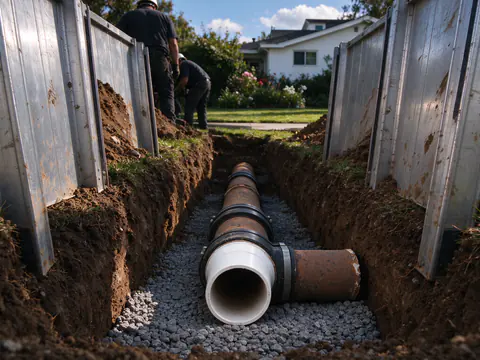
On a lateral of that era, the camera separates joints, grade and roots. A single offset or crack is a case for a spot repair. Root entry at several joints in an otherwise sound run is the classic case for sewer pipe lining, which seals the joints from inside. A section that has settled and holds water is a belly, and a liner will not restore the lost fall, so we dig and re-lay that stretch. Our guide to repair versus replacement shows how the findings add up across the full length.
What permit does the house-side repair need?
Poway issues its own permits; the City of San Diego’s permit types and fees do not apply here. We confirm what a lateral repair on the house side needs with the City of Poway for your address before work starts, and your scope lists it as its own line rather than folding it into the repair.
Trenchless methods still need access. Lining works through cleanouts, which is one more reason the property-line cleanout earns its place, and pipe bursting needs a launch pit and a receiving pit. A full trench replacement makes sense where the line has failed along most of its length. To the north, Escondido puts the whole lateral on the owner, under the street included, which shows how much the City of Poway’s rule changes the math.
Poway lateral backing up?
Tell us whether there's a cleanout near the curb, and we'll tell you which side of it the problem seems to be on.