 San Diego Swift
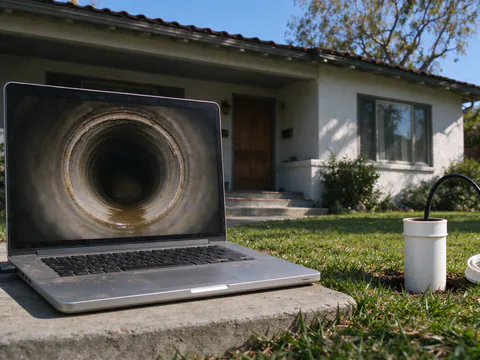
Drains backing up, a line that needs clearing every year, or a house you are about to buy: before anyone quotes a repair, you need to see the pipe. A sewer camera inspection in San Diego is a recorded trip through your lateral, the private pipe between the house and the public main, with every finding tied to a distance and, once we locate it, to a spot on the ground. San Diego Swift Sewer Line Repair scopes laterals for homeowners, buyers and property managers across the City and nearby San Diego County.
The point of the video is to replace guesses with evidence. A backup can come from roots, a sag, grease, a broken joint or a problem in the City’s main, and the symptoms can look the same from inside the house. Footage separates them, and that is why nearly every repair we do, from root removal to full replacement, starts here.
Do you need a camera inspection?
A scope is worth doing whenever your next decision depends on what the pipe looks like: repeated backups, several drains slowing at once, a planned repair, a home purchase, or an old line that has never been seen. It is less useful for a single slow sink, which is usually a branch or trap problem inside the house.
The City’s lateral fact sheet notes that older laterals of clay, concrete or cast iron may need regular inspection, while newer plastic lines with intact joints can go years without trouble. In unincorporated areas served by the County sanitation district, the County’s own guidance suggests a camera inspection every three to five years. A buyer in escrow has a separate reason, covered on our home-buyer sewer inspection page.
How we get the camera into your line
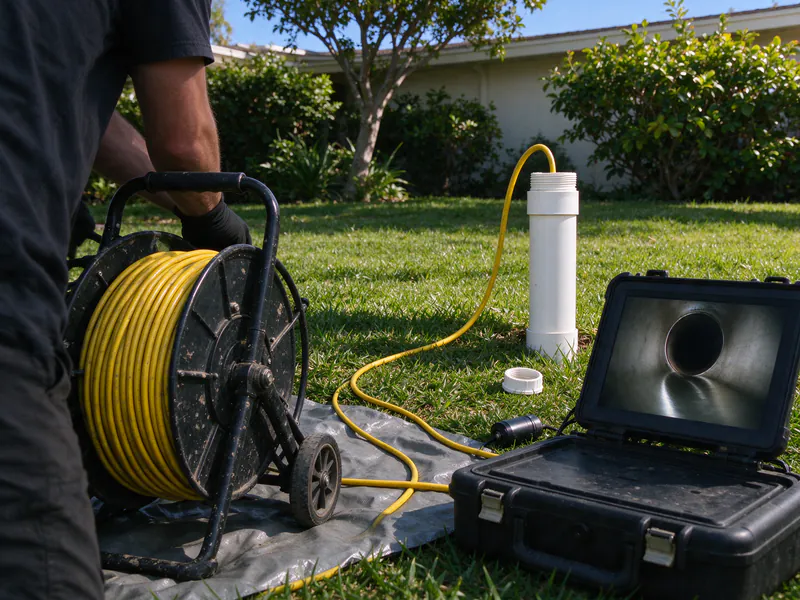
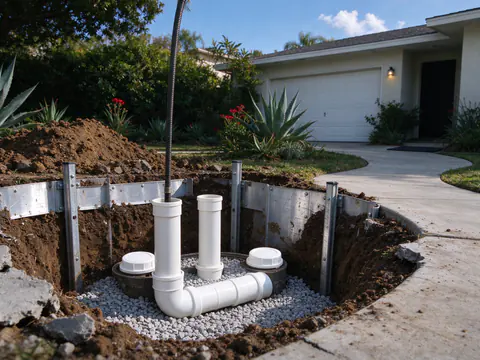
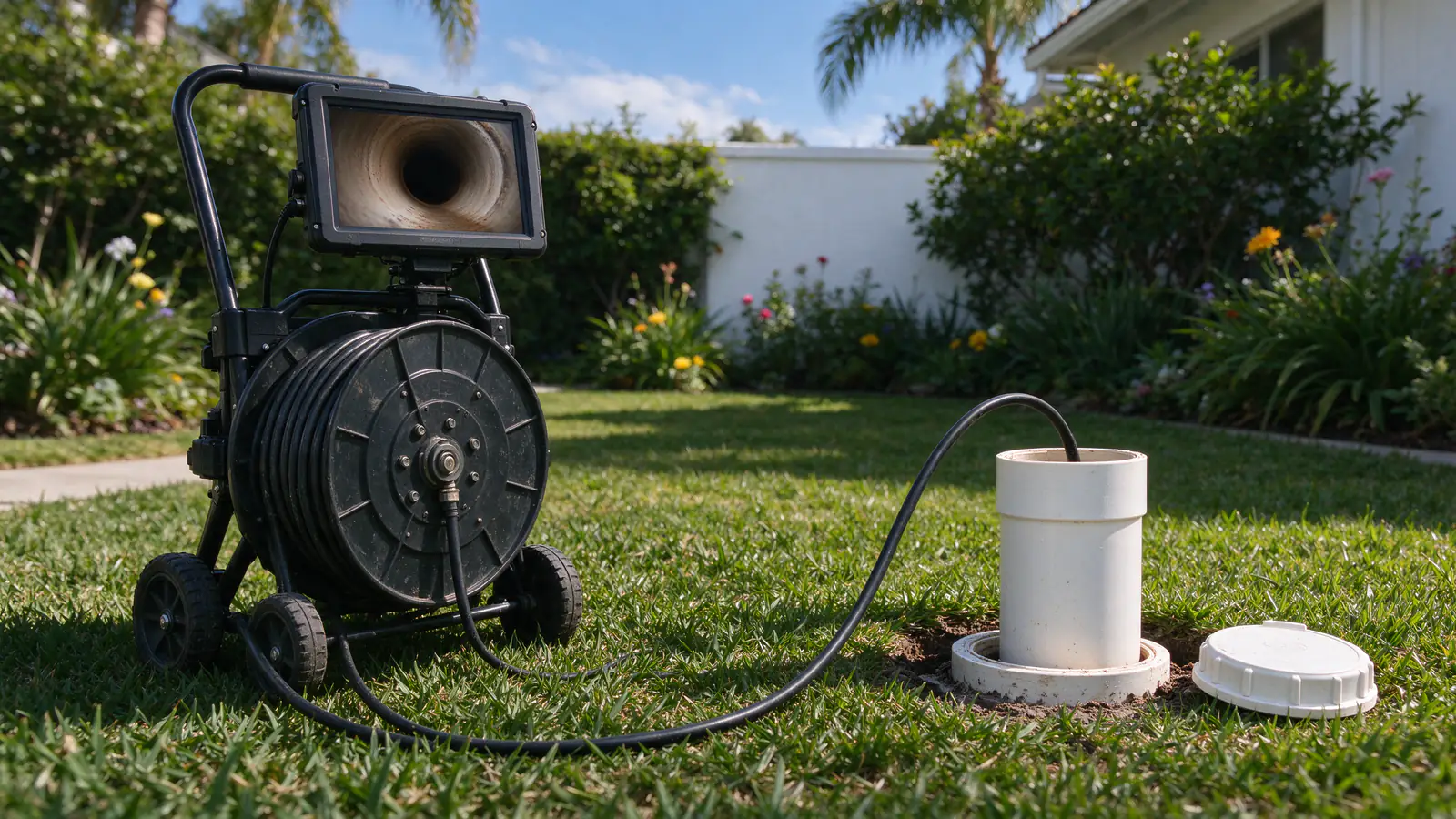
The camera rides on a semi-rigid push rod fed from a reel. It needs an opening into the lateral, and the best one is a cleanout near the foundation or at the front of the lot. A two-way cleanout lets us look toward the street and back toward the house from the same spot. Without a cleanout, we may go in through a fixture opening such as a pulled toilet, which is slower and limits how far the rod reaches. Our guide on finding your sewer cleanout covers where to look.
If the line is backed up, the camera sees only brown water. In that case we clear the line first, by cable or jetter, so the lens can travel and record. Clearing also strips away some of the evidence, which is why a short look before cleaning, even a brief one, is often worth the time.
What will the footage show you?
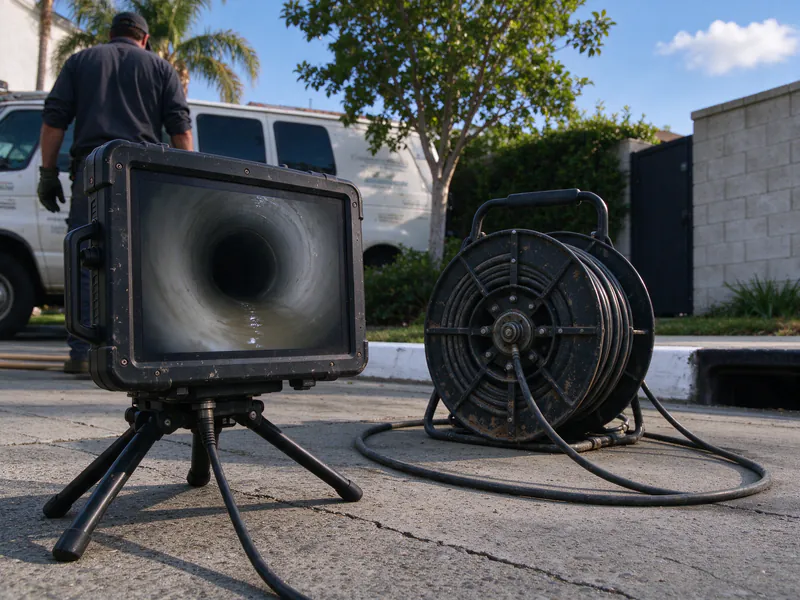
The monitor displays a running distance counter, and we log every observation against it: 18 feet, a root mass at a joint; 34 feet, an offset; 52 feet, the lens dips under water for six feet. Those readings become the map we plan a repair from.
The video reliably shows:
- Material and transitions. Clay, cast iron, ABS, PVC or fiber pipe, and the couplings where one material meets another. Our guide to what sewer pipe your house has explains how each looks on camera.
- Joint condition. Gaps, offsets and roots entering at joints, which matter most in clay.
- Cracks, holes and missing sections, including breaks large enough to show soil.
- Scale and corrosion inside cast iron, and channeling along the bottom of the pipe.
- Sags. Standing water that submerges the lens is the usual sign of a belly.
- The connection where the lateral enters the main, when the rod reaches that far.
It cannot show what sits outside the pipe wall. Bedding, voids in the soil and remaining wall thickness are inferred, not seen. Murky water, steep bends and heavy root masses can stop the camera short. If our run ends before the main, the report says where it ended and why.
Where is the problem on your lot?
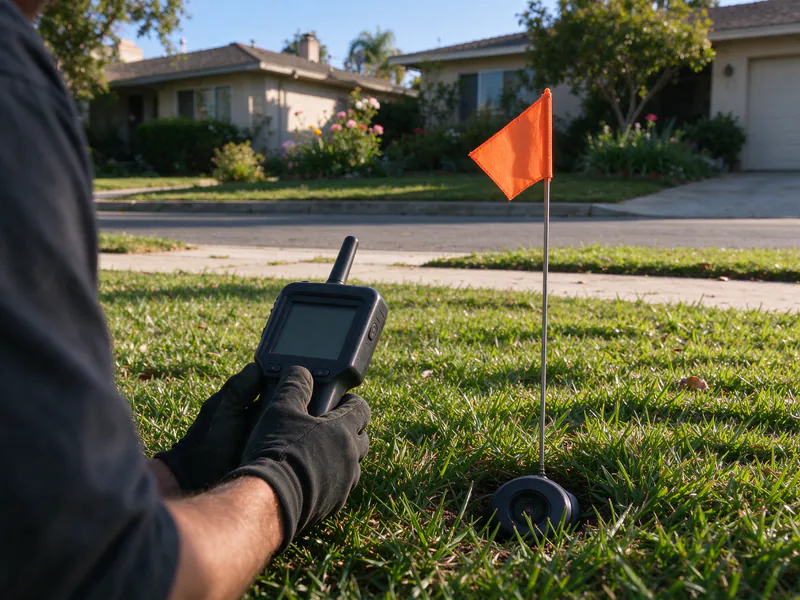
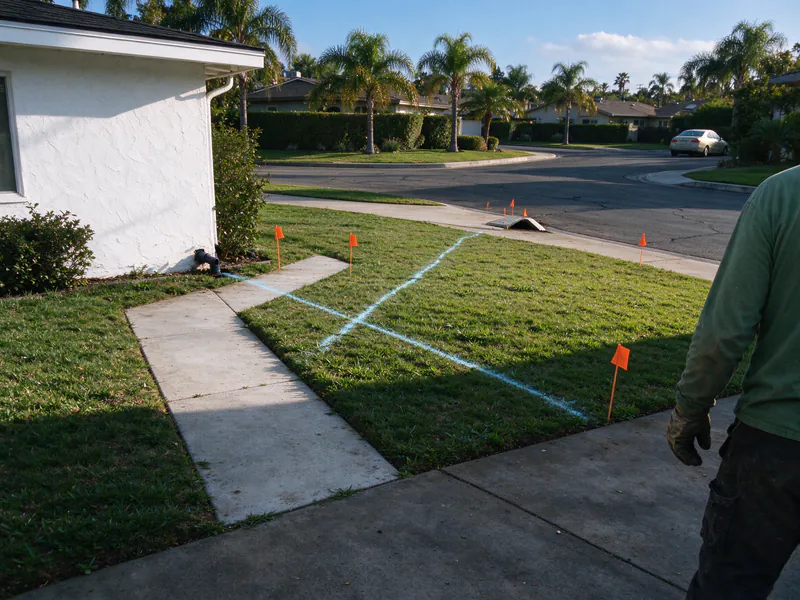
A small transmitter, called a sonde, rides in or just behind the camera head. Above ground, we pick up its signal with a receiver, stand directly over the head, mark the spot and read an approximate depth. Walking the camera back in steps traces the line’s path across your lot.
Locating is what turns “a crack at 34 feet” into “a crack under the left edge of the driveway, about four feet down.” That difference decides whether a repair means lifting pavers, cutting concrete or digging in a planter, and whether a spot repair is practical at all. Readings are approximate. They get weaker with depth and can be thrown off by rebar, metal fencing or other buried utilities, so we check the marks over critical spots more than once.
Development Services can tell you where a property’s lateral meets the City main, and SanGIS publishes the main and manhole layout. The City has no drawings of private lines on a lot, so our locate is often the only record of the route. City standards put a standard public lateral at 5 to 7 feet of cover at the property line, and we compare depth readings near the front of the lot against that.
Already have footage?
Send the video and the address; we'll go through what it shows before anything else is booked.
Is the defect under the street?
In the City, you are responsible for the lateral up to its connection with the main, including the section under the sidewalk and street. The City steps in on its own only when all sewer service is lost and a plumber reports a blockage or break beyond the property line.
For structural defects that have not stopped the flow, the City’s fact sheet tells owners to submit the plumber’s video to the Public Utilities Department’s Construction Support group for review. The office may ask for the footage on a physical drive delivered in person, and the next steps after that are not always spelled out. Before sending, confirm the format the office wants and keep your own copy. Include the address, the distance counter readings and a locate of where the defect sits relative to the property line. Our guide to who is responsible for the sewer lateral covers the rest of that process.
What happens after the scope?
Findings sort into two groups. Roots, grease and debris in a structurally sound pipe are cleaning problems. Broken joints, offsets, sags, heavy scale and missing sections are structural, and cleaning only buys time. When a scope shows both, roots growing through an open joint for example, we clean now and base the repair decision on how widespread the open joints are.
Our guide on how to read a sewer camera report walks through the terms and what each one leads to. Our typical range for a camera inspection is $100 to $500, and your final price comes from a written quote after we know the access. The camera inspection cost guide explains what moves it, such as access, cleaning first and locating. If the footage already exists, get an estimate and send it to us; it may answer the question without a second scope.