 San Diego Swift
The line backed up again, or a scope shows a break out toward the road, and you’re not sure who to call. Spring Valley has no city hall. It is an unincorporated community in San Diego County, so the agency behind the public sewer and the office that permits digging in the road are both County ones, and the rules that apply are the County’s, not those of San Diego or Lemon Grove next door.
The County’s documents also disagree with each other about one thing that matters a great deal: who deals with the stretch of lateral between the property line and the main. San Diego Swift Sewer Line Repair repairs and replaces laterals in Spring Valley, and this page sets out what the County’s sources say, including where they conflict.
Which agency serves your house?
The County Department of Public Works’ sewer lateral page, written for San Diego County Sanitation District areas, says the owner maintains and repairs the lateral “from the building all the way to the point of connection with the public sewer main often located in the middle of the street.” If the part that needs repair is in the public road, a County Excavation Permit is required, through County Planning & Development Services.
Spring Valley sits in the area those County district rules are written for, but sewer agencies differ from one East County community to the next, and a neighboring city or water district can serve a parcel near the edge. So our first step is to confirm which agency serves your address; everything else on this page assumes it is the County Sanitation District. The County’s page also recommends a professional cleaning every year and a camera inspection every three to five years, and notes that cleanouts are usually 3 to 5 feet from the house, sometimes at the front property line.
Who handles the section under the road?
The DPW page is clear that the lateral is yours all the way to the main. Board of Supervisors Policy F-16 reads differently. It says that when the owner has made “a reasonable attempt” to clear the lateral through a licensed plumber or lateral-cleaning firm, shown by a receipt or signed statement, and the stoppage is between the property line and the main, County operations and maintenance personnel “will be responsible to clear or otherwise repair that portion.”
Both are official County sources, and they don’t line up. The policy records board actions from 1969 through 2008 and carried a sunset review date of December 31, 2015, and only the County can say whether it still governs that section. So the practical answer is the honest one: check with the County for your address before assuming either version, and before paying for any digging past the property line.
Keep the receipt from every clearing
Whichever reading the County applies, the evidence it describes is worth having. F-16 turns on a documented attempt by a licensed plumber or lateral-cleaning firm, so keep the invoice from every professional clearing, with the date and what was found. Ask for the camera footage too, with the distance to the stoppage measured from the cleanout. That distance is what places a problem on one side of the property line or the other.
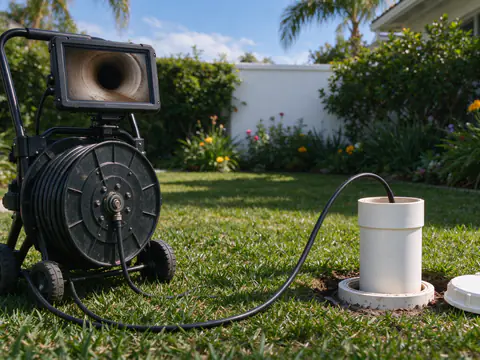
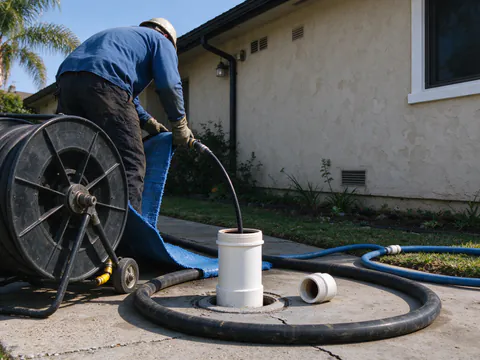
Footage also answers the question a clearing can’t. A line that stops again within months has a cause in the pipe: roots coming in at a joint, an offset that catches solids, a sag that holds water. Root removal restores flow, and our guide to getting rid of roots in a sewer line explains why the roots return until the joint is sealed. Our sewer camera inspection page covers what a useful inspection records, and the guide to reading a camera report shows how to check it.
Where is your cleanout?
Spring Valley’s cleanouts follow a County history. Under Policy F-16, the County cleaned and repaired laterals from the property line to the main until 1969, and both its installation of property-line cleanouts and its routine lateral cleaning ended on July 1, 1969. The County Plumbing Code dropped the property-line cleanout requirement the same year, because a grade-level cleanout near the building is installed instead.
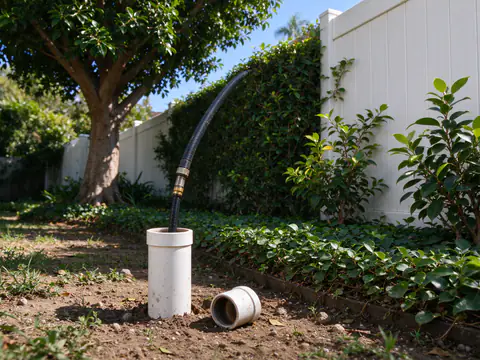
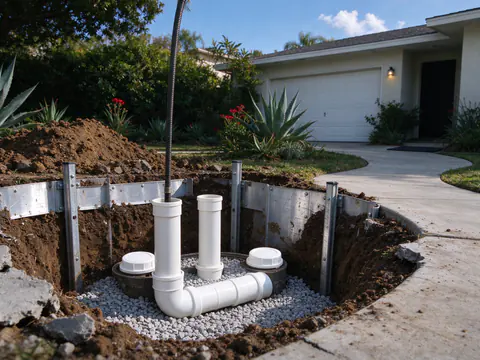
That is why the County’s page expects most cleanouts within a few feet of the house. A camera run from there covers the full length to the main. Where a house has no usable cleanout at all, or the only one is inside, adding one outside is often the first job, covered on our sewer cleanout installation page; our typical range for one is $500 to $3,500. Our guide to finding your sewer cleanout shows where to look.
What could be wrong with your line?
In the Census Bureau’s American Community Survey, 17.0 percent of Spring Valley’s homes were built before 1960 and 59.8 percent before 1980, a little older than the county as a whole. A Natural Resources Conservation Service sample there maps Placentia sandy loam, a soil with a high shrink-swell rating, which can move rigid pipe as it wets and dries. That is one sample, so it is something to look for on camera rather than a verdict on any lot.
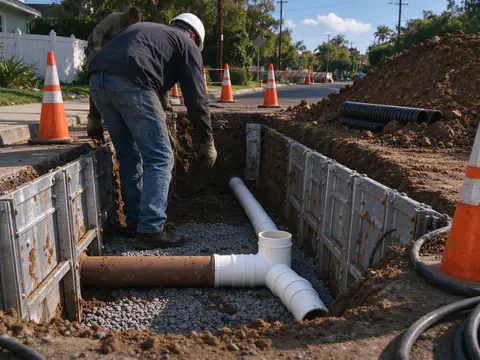
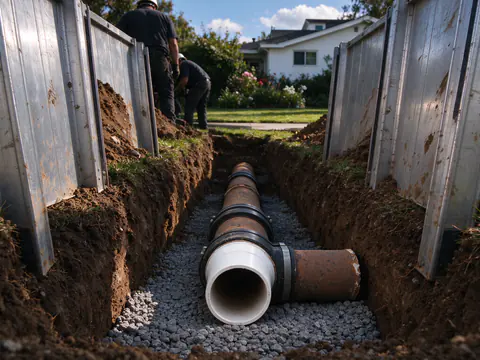
We choose the method from the footage. One cracked or offset section suits a spot repair, and our typical range for one is $1,500 to $5,000. Roots at several joints in a pipe that is still round suit sewer pipe lining, but a liner follows the old pipe’s shape, so it will not correct a belly. A break in the road section is a street sewer lateral repair under the County Excavation Permit, once the County has said how it treats that section. Your final price comes from a written quote after we see the job. Our guide to sewer lateral responsibility shows how the City of San Diego handles the same question, and Lemon Grove, just west, has its own sanitation district rules.
Spring Valley sewer problem?
Send the address, any clearing receipts and the camera footage, and we'll help you work out which side of the property line the problem is on.