 San Diego Swift
Getting roots out of a sewer line is a two-part job: clear the pipe, then close the door. Cutting or jetting removes the roots and gets water moving again. The roots got in through an opening, though, usually a joint or a crack, and unless that opening is sealed or replaced, they grow back through it.
You probably met the problem as a backup, so the order of steps matters. San Diego Swift Sewer Line Repair handles both parts, and the clearing work itself is described on our sewer root removal page. This guide lays out the decision.
Why roots get in and keep coming back
A sewer lateral is warm, wet and full of nutrients, and joints and cracks let a little water vapor out into the soil. Roots grow toward that moisture, find the opening and push through it as hair-fine strands. Inside the pipe they branch into a mat that catches paper and solids, and as they thicken they widen the gap and can push joints out of line.
Cutting removes the growth inside but not the root system outside the pipe, which is still alive and still pointed at the same opening. That is why roots come back to the same footage, and why the City of San Diego places periodic rodding to remove roots “from any source” on the owner under Council Policy 400-10.
What are the options for removing roots?
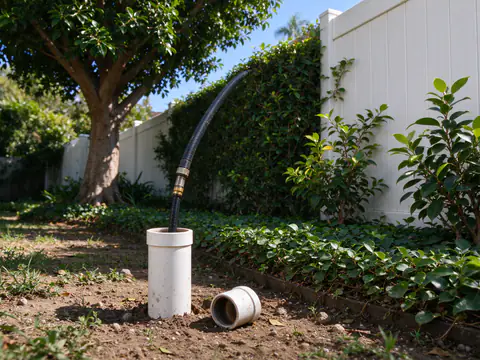
There are two professional ways to clear them: a mechanical cutter on a cable, or a hydro jetter. Both restore flow from a cleanout without digging. After that, the choice is whether to keep clearing on a schedule or to seal the opening with a spot repair, liner or replacement, a decision the camera footage settles.
Step 1: clear the line
Mechanical cutting. A rotating head with blades, driven by a cable, chews through a root mass. It’s quick and effective on dense roots, and it often leaves some growth on the pipe wall.
Hydro jetting. High-pressure water through a nozzle cuts roots and scours the wall more completely, which makes the follow-up camera footage clearer. On a pipe that is already broken, the jetter’s pressure needs care. Our typical range for hydro jetting or root clearing is $350 to $600 per job. Hydro jetting vs sewer repair explains when cleaning is enough.
Either way, this is work for a professional at the cleanout. Do not open a sewer line, rent a machine to cut a lateral, or dig to expose a pipe yourself.
Step 2: look at the clean pipe
With the roots gone, a camera inspection shows the entry point: an open joint, an offset, a crack or a break. It also shows how many entry points there are. A single root intrusion at one joint and roots at every joint along an old clay run are different problems with different answers. How to read a sewer camera report explains the terms.
Step 3: decide whether to seal the opening
| What the camera shows | Option | What it does |
|---|---|---|
| Light roots at one sound joint | Clear on a schedule | Keeps flow, accepts regrowth |
| Roots through one open or cracked joint | Spot repair or a sectional liner | Closes that one opening |
| Roots at many joints, pipe holds its shape | Full lining | A jointless wall with nothing for roots to enter |
| Roots plus breaks, sags or collapse | Replacement | New pipe, with the defects removed |
Clearing on a schedule is a legitimate choice for a sound line with light growth. When the interval keeps shrinking, the footage usually shows why.
Roots back at the same spot?
Send the address and any footage from the last clearing, and the options will be laid out for that joint, not a generic line.
Chemicals, salt and other shortcuts
Root-killing products and rock salt are sold for sewer lines, and whether they work is a common question. We don’t recommend them. None of them closes the opening the roots came through, and putting chemicals into a sewer is a decision with consequences downstream. If a lateral needs roots managed, the reliable sequence is clearing by a professional, a camera, and a repair where the footage calls for one.
The City’s tree-distance rule
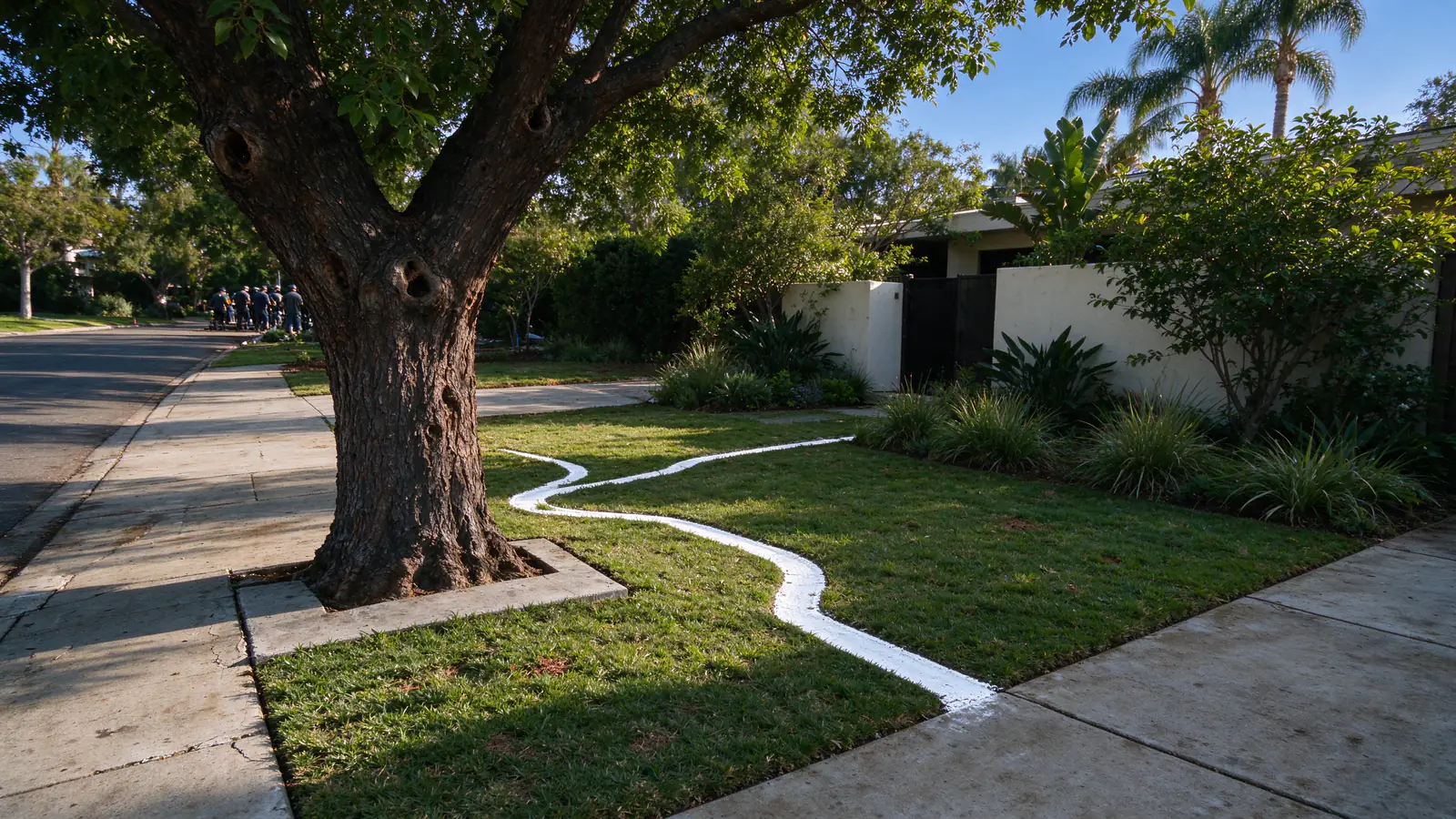
City of San Diego Wastewater Review requirements state that no trees or shrubs taller than 3 feet at maturity may be within 10 feet horizontally of any sewer main or sewer lateral, and a standard public lateral must sit at least 10 feet from trees. Under DSD Information Bulletin 166, a lateral installed within 10 feet of trees becomes a private encroachment lateral that needs an agreement with the City. Public Utilities also advises planting trees and bushes away from the lateral connection.
Those rules govern new laterals and the public right-of-way, but they are good advice on private land too. Before planting, find out where the line runs; a camera locate marks it on the ground. When a lateral is replaced, the route and the distance from existing trees are part of the design.
It doesn’t matter whose tree it was, as far as the City is concerned: the roots-from-any-source language puts the lateral’s maintenance on the owner, and the City bills owners when roots cause a stoppage it responds to in the street. A dispute with a neighbor over a tree is a separate, civil matter. For what to do when roots have already caused a backup, see what to do when your sewer backs up.
If roots keep returning, get an estimate or call us with the address, and we’ll look at closing the opening rather than clearing it again.