 San Diego Swift
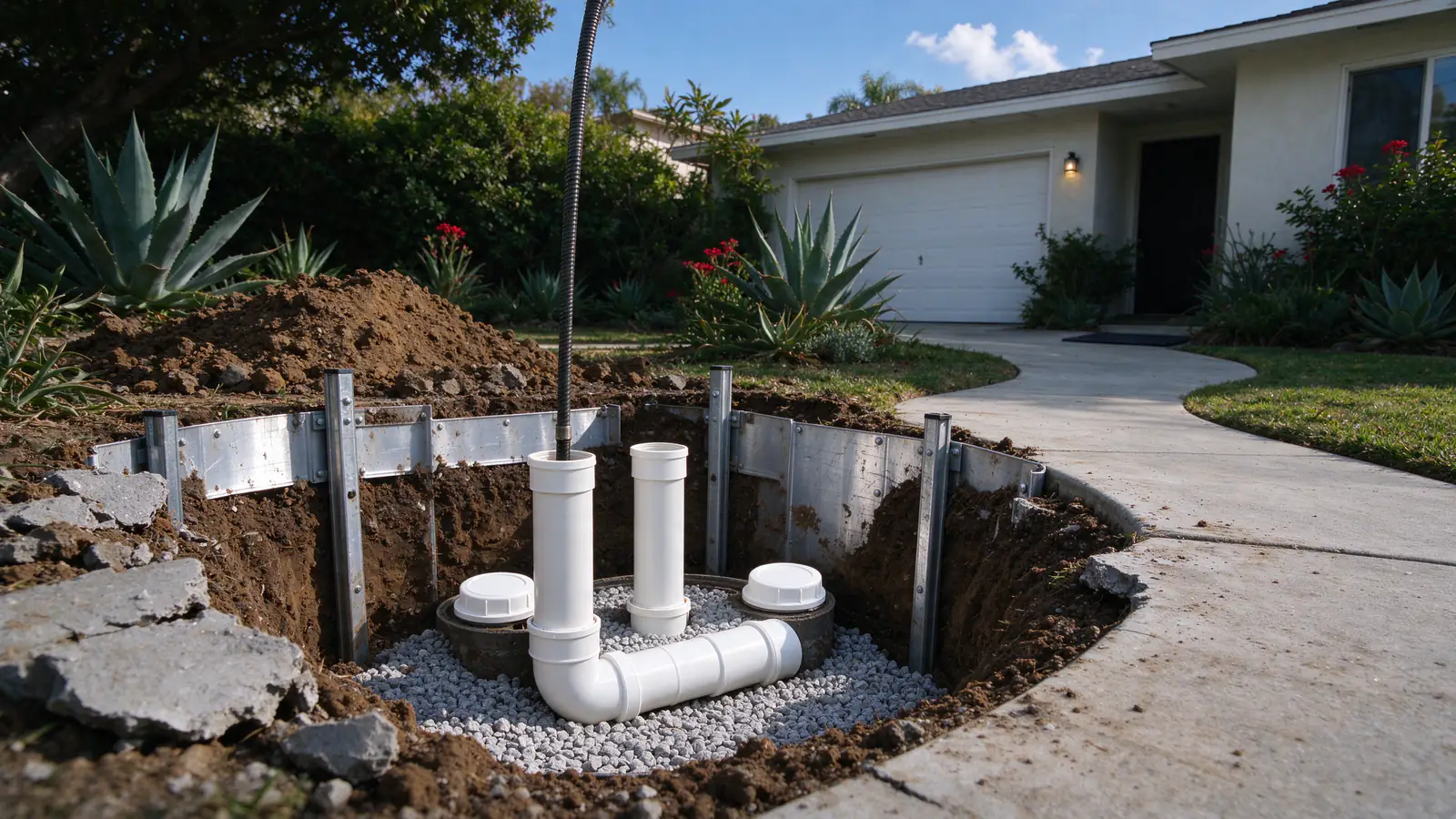
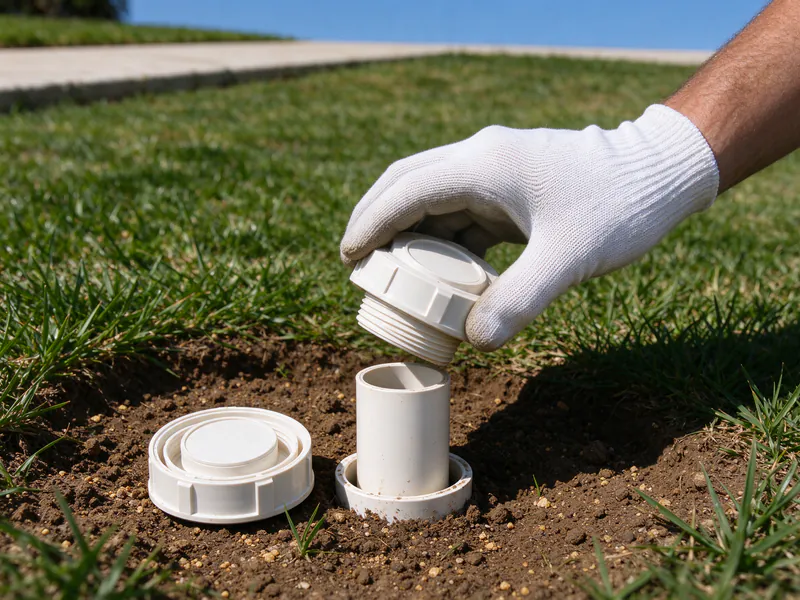
Every backup cleared through a toilet, every camera that can’t reach the street, and every quote that starts with “first we need a way in” traces back to one missing fitting. A sewer cleanout is a capped branch on your lateral that gives a camera, a cable or a jetter a straight way into the pipe. To install one, we locate the line, open the ground at one spot, cut a fitting into the lateral and bring a riser up to grade with a cap. San Diego Swift Sewer Line Repair installs cleanouts across the City and nearby San Diego County.
Plenty of older San Diego houses were built without an outdoor cleanout, or with one that has since been buried, paved over or broken. Without it, every clearing and every camera inspection has to go in through a toilet flange or a roof vent, which is slower, messier and often can’t reach the whole line.
Why add a cleanout?
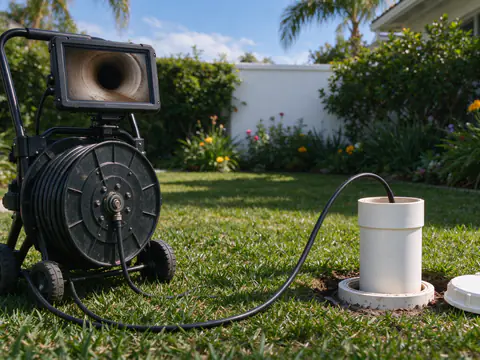
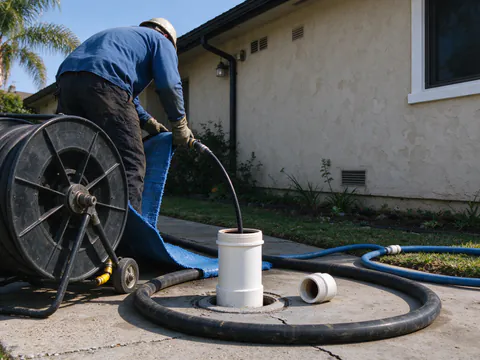
A cleanout makes every later job on your lateral easier. It gives cleaning and camera equipment direct access, so we can clear a backup from outside, run footage to the main, and install a liner without opening the house. It also serves as a relief point, letting a blocked line spill outdoors instead of through a floor drain.
It is often the first step of a bigger repair. Our sewer pipe lining work, for example, depends on access at the right points, and when a scope shows a problem under the street, a cleanout lets us reach the defect and reinspect it later. If you clear roots every year, you gain from one too: each root removal visit goes in at the cleanout rather than through a fixture.
Which kind of cleanout do you need?
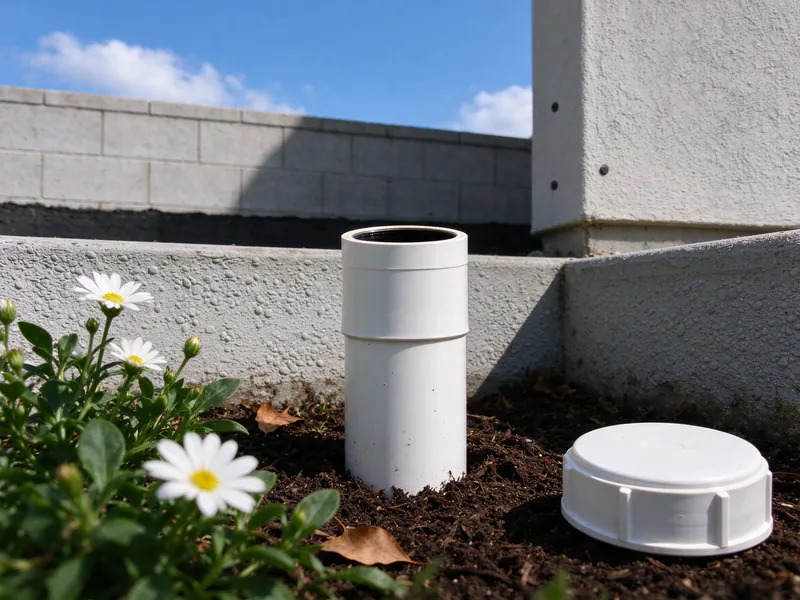
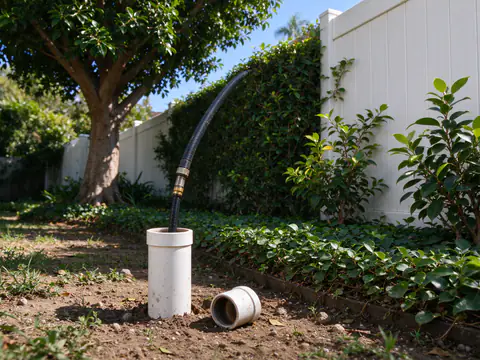
A single cleanout near the foundation faces downstream. It handles routine clearing well but can’t look back toward the house.
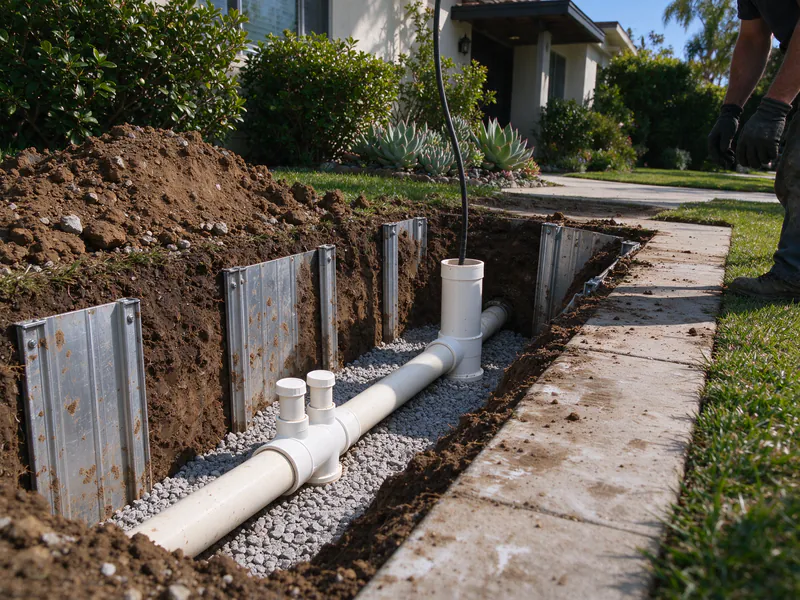
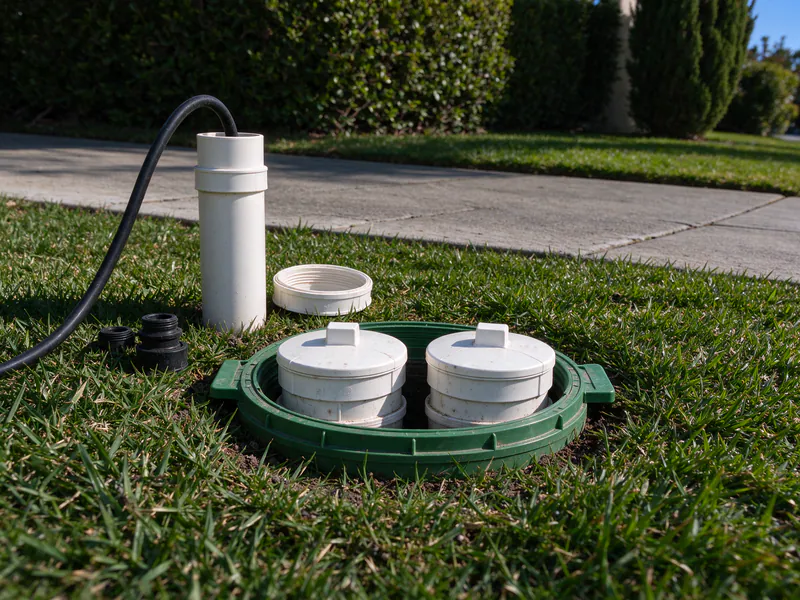
A two-way cleanout sets two openings at one spot, one aimed upstream toward the building and one downstream toward the street. That lets us follow the line with a camera in both directions and work a cleaning head back under the house, which helps on older homes with drains under a slab. City open permit data shows two-way cleanouts being installed in San Diego front yards under no-plan residential plumbing permits, which is the usual permit path for single-family and duplex work.
A property-line cleanout sits near the sidewalk or curb. Its value depends on the agency. In the City of San Diego it is not required, while in Poway it is the starting point for City lateral service.
What does your city or district expect?
The rules differ across the county, and they decide where a cleanout is worth putting at your address.
City of San Diego. The City’s 2013 lateral fact sheet states plainly that the City does not require property-line cleanouts. Current DSD Information Bulletin 166 adds a twist for new laterals: one that places its cleanout on private property has to be built as a private lateral with an Encroachment Maintenance and Removal Agreement, and the City’s Wastewater Review legend shows the standard public lateral with its cleanout on the City side of the property line. For an existing lateral where you simply want access, a cleanout near the house or in the front yard is the common choice. Private-side work follows the City’s plumbing permit; our permit guide covers when the right-of-way gets involved.
City of Poway. Poway cleans laterals from the property-line cleanout to the main at no charge, and describes itself as the only city in the county that takes responsibility for that section. The catch is the cleanout. Poway says it should be in the front yard near the sidewalk or curb, in a rectangular or round box; a house without one needs a licensed plumber to install one, and a buried box has to be exposed before the City will service it.
Unincorporated County. County guidance notes that cleanouts are usually 3 to 5 feet from the house and sometimes at the front property line. County Board Policy F-16 records that the County Plumbing Code dropped its property-line cleanout requirement in 1969, because a grade-level cleanout near the building was being installed instead, and County installation of property-line cleanouts ended that year. If you live in an area like Spring Valley, one still helps when the line is long or difficult to clear.
Unsure where a cleanout should go?
Send the address and the agency that serves it, and we'll explain what placement makes sense.
How we install a cleanout
We start by finding the line. We trace the lateral with a camera from inside the house, or through an existing opening, and mark its path and depth with a locator so the excavation lands on the pipe. The City has no drawings of private lines on a lot, so we rarely skip this step.
Next we dig a small hole down to the pipe at the chosen spot. Depth varies by lot: a cleanout close to the foundation may sit shallow, while one near the property line can be several feet down where standard laterals carry 5 to 7 feet of cover. Deeper holes call for trench protection, and an owner should never dig toward the line with a shovel. We cut out a section of the lateral, set a wye fitting in its place with listed couplings to the old pipe, and bring a riser to grade. Then we check the new fitting and the pipe on each side with the camera before backfill.
Inspection timing follows the permit. Where we use a box, we set it flush with the surrounding grade so it stays visible and reachable.
What does a new cleanout cost?
Our typical range for a new cleanout is $500 to $3,500. A shallow single cleanout in a planter sits near the low end; a deep or two-way cleanout under concrete sits near the top or above it. Your final price comes from a written quote after we see the job, and these are what move it:
- Depth to the pipe at the chosen location, and whether trench protection is needed.
- What sits on top: lawn, a planter, pavers or a concrete walkway or driveway.
- Pipe material and condition where the fitting goes in. Cracked clay or thinned cast iron may need a longer section replaced.
- Locating effort, especially on lines that have never been scoped.
- Cleanout type, single or two-way, and whether a traffic-rated box is needed.
- Permit and inspection requirements for the address and agency.
A scope with a locate answers most of those questions before we write your quote.
Do you already have one?
Before adding one, check there isn’t a cleanout hiding under mulch, a deck or a paver. Our guide to finding your sewer cleanout lists the places to look. If sewage is already coming out of it, the line is blocked downstream; our guide on what to do when your sewer backs up covers the first steps, and the cornerstone lateral guide explains how the cleanout fits the rest of the system. When you’re ready, get an estimate.