 San Diego Swift
A backup, a slow line under a 1950s house, or a camera report that says the break is out toward the street: in Lemon Grove, fixing it means working with two public agencies, not one. The public sewer under a Lemon Grove street is not the City’s. It belongs to the Lemon Grove Sanitation District, a county sanitation district that is a separate entity from the City of Lemon Grove, with its own financing, although the City runs it as an enterprise fund.
For most owners that distinction is invisible until a lateral has to be dug up. Then it decides who issues which permit and who comes out to look at the open trench. San Diego Swift Sewer Line Repair repairs and replaces laterals in Lemon Grove, and we plan each job around both agencies from the start.
Who owns what under your street?
The District, formed in 1947, maintains about 67 miles of collection pipe, which carries Lemon Grove’s sewage to City of San Diego treatment plants. It maintains and repairs the main. The City’s wastewater page puts the private side plainly: “The property owner is responsible for maintenance and repair from the property owner’s structure to the sewer main.”
The paperwork splits along the same line. Connection permits come from the Sanitation District, at City Hall. Repairs or replacement that dig in the public right-of-way need a City Encroachment Permit, because the street belongs to the City, and the work runs under both.
Is the street section yours in Lemon Grove?
Yes. You are responsible for the lateral from the structure all the way to the sewer main, so the part under the sidewalk and street is yours to repair, and digging there needs the City’s Encroachment Permit. The District’s role is the main itself, and it describes no program that takes over the street section of a private lateral.
That puts real weight on where the camera finds the fault. A crack 20 feet from the house is a yard repair. The same crack 50 feet out may be under the sidewalk or the street, which brings the encroachment permit, traffic and pavement restoration into the job. Footage with distances measured from the cleanout tells us which. Our street sewer lateral repair page covers how we open and close a street connection, and the sewer camera inspection page covers what the footage should record.
Why does the trench stay open?
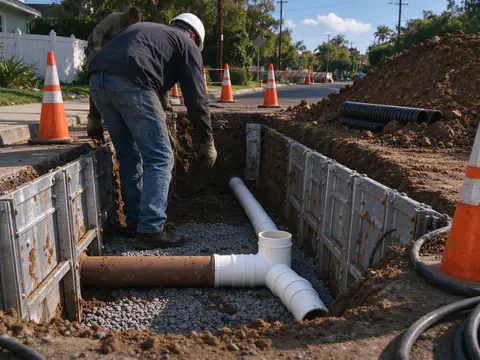
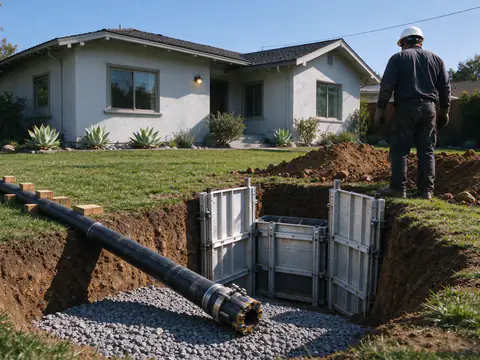
The most practical rule on Lemon Grove’s page is about timing. “When the lateral work is complete, but prior to backfilling, the Sanitation District and the City must inspect the installation.” Only after that is the encroachment area restored, to the satisfaction of both.
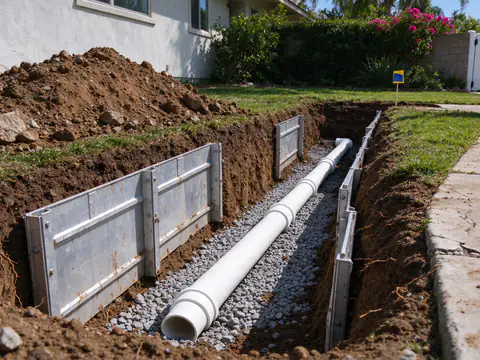
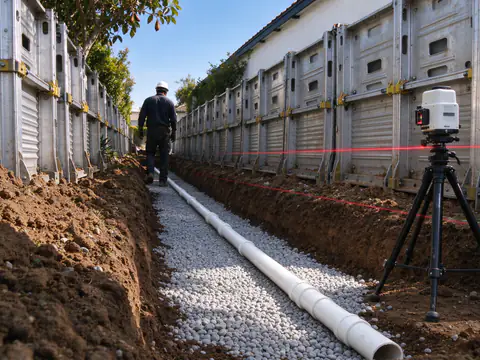
It is the last moment anyone can see what the backfill will hide: the pipe material, its bedding and support, the joints, the slope and the connection to the main. It also shapes the schedule. We keep the trench open, fenced and, where it is 5 feet or deeper, shored, until both inspectors have been out. A job planned without that visit stalls with an open hole in the yard. Our sewer line excavation page explains how a trench is made safe while it waits, and our guide to how long sewer line replacement takes shows where inspections sit in a typical timeline.
Trenchless work is not automatically outside the rule. Lining or pipe bursting still opens access or launch pits, and if any of that digging is in the right-of-way, the encroachment permit and inspection apply to it. Whether a fully on-lot liner needs an inspection is a question we put to the City and the District for your address.
How has your post-war line held up?
Lemon Grove’s housing is older than the county’s as a whole. In the Census Bureau’s American Community Survey, 39.2 percent of the city’s homes were built before 1960 and 71.8 percent before 1980, against 16.9 and 49.5 percent countywide. Plenty of laterals here have been in the ground for 60 years or more, and age is a reason to look, not proof of failure.
The ground matters too. A Natural Resources Conservation Service sample in Lemon Grove maps Placentia sandy loam, a high shrink-swell soil. Clay that swells in wet winters and shrinks through dry summers can shift rigid pipe, opening joints for roots and putting stress on fittings. One sample is not a survey of every lot, so it is a reason to check for movement on camera rather than to assume it.
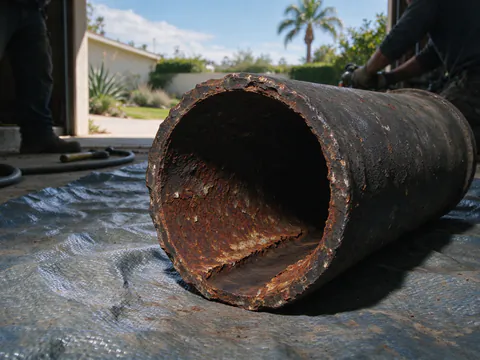
What the camera finds sets the method. Corroded and scaled pipe is covered on our cast iron sewer replacement page, and our guide to what sewer pipe your house has explains how each material ages. Roots at several joints in a round pipe suit a liner; a line broken along much of its length suits bursting or a trench replacement. Our guide to pipe lining versus pipe bursting compares the two.
Line cleared, but will it stay clear?
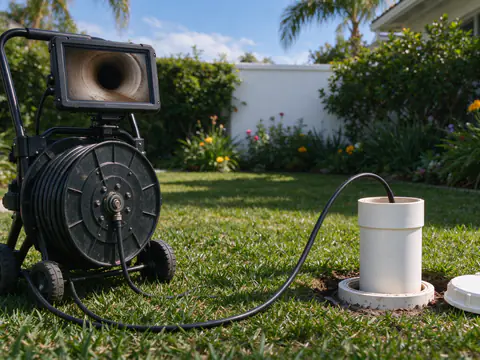
A Lemon Grove sewer problem can start with a backup rather than a known break, and the first visit is then a clearing. That is the right order, but it is only half the answer. A cable or root removal visit restores flow by cutting through what is blocking the pipe; it does nothing to the crack, open joint or sag that let the blockage form. A line that needs clearing every few months is telling you the defect is still there. The useful habit is to camera the line once it is clear, while it is clean enough to see, so the footage shows the pipe wall and not the clog. That footage is what we build the permit, the method and the price on.
What we settle before we price a Lemon Grove job
Before a price means anything, we put three facts on paper: where along the run the defect sits, whether any work reaches the right-of-way, and which permits that brings (a City encroachment permit, a District connection permit, or neither). Restoration of the street or sidewalk is its own line. Our typical range for lining is $80 to $250 a foot and for trench replacement $50 to $250 a foot, and your final price comes from a written quote after we see the job. To the east, Spring Valley is unincorporated, and the County’s rules there differ again.
Lemon Grove sewer line acting up?
Send the address and a scope video if you have one, and we'll tell you whether the fix reaches the street.