 San Diego Swift
Lining and pipe bursting both replace the function of a damaged sewer lateral without a trench along its full length, but they work in opposite ways. Lining cures a new pipe wall inside the old pipe, so it needs the old pipe to hold its shape. Bursting breaks the old pipe apart and pulls new pipe into its place, so it needs room around the path. Which one fits depends on what the camera shows.
San Diego Swift Sewer Line Repair does both, and we recommend neither until we’ve seen your footage. This guide sets them side by side; the broader question of whether to go trenchless at all is in is trenchless sewer repair worth it.
How the two methods work
Lining, or cured-in-place pipe (CIPP), starts with cleaning. We take out roots and scale and film the line to confirm it is continuous. Then we pull or invert a felt or fiberglass tube saturated with resin into the pipe from a cleanout or a small access point, inflate it against the old wall and cure it with hot water, steam or light until it hardens. The result is a jointless pipe inside the old one. We then reopen any branch connections from inside with a cutter.
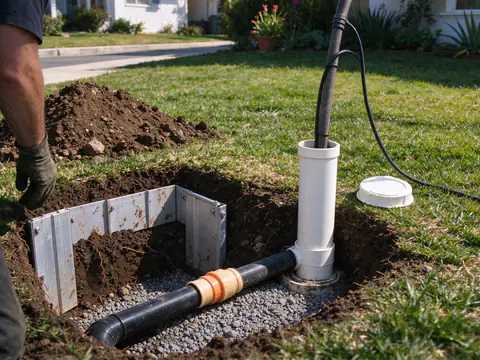
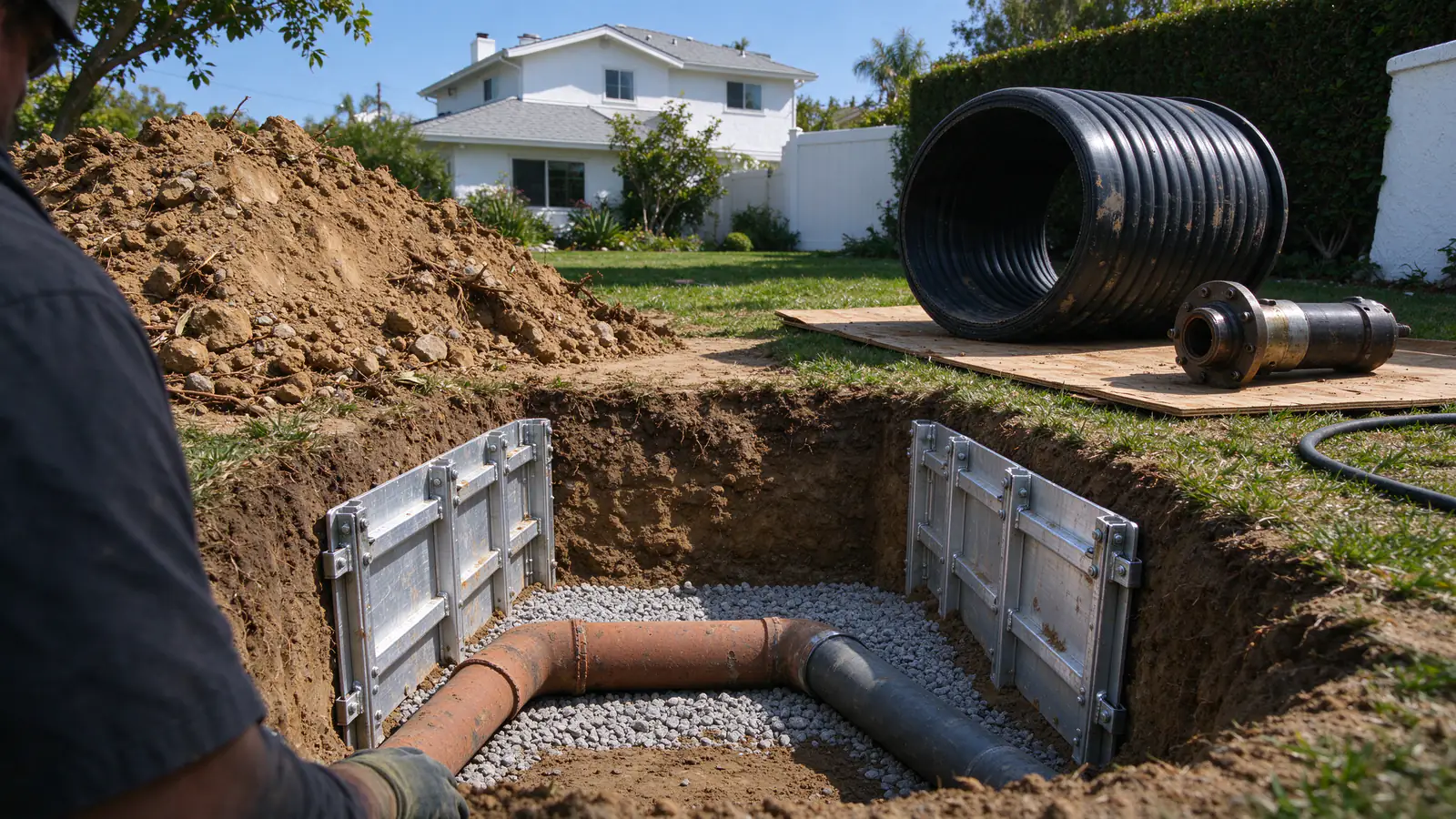
Pipe bursting starts with two pits, one at each end of the run. We pull a cone-shaped bursting head through the old pipe with a cable or rods, fracturing it outward into the surrounding soil, and a string of fused HDPE pipe follows behind the head. When the head reaches the receiving pit, the new pipe is in place along the old route, and we connect it at each end.
Which one fits which pipe condition?
The decision comes down to the host pipe. Lining fits a pipe that is cracked, root-infested or leaking at its joints but still round, open and on grade. Bursting fits a pipe that is broken, badly cracked or too far gone to form against, provided the path is usable and nothing fragile sits close beside it.
| Condition on camera | Lining | Bursting |
|---|---|---|
| Root intrusion at many joints | Strong fit: seals every joint | Fits, but replaces more than needed |
| Cracks with the pipe still round | Strong fit | Fits |
| Collapsed or crushed section | Needs that section opened or dug first | Often pushes through; a crushed spot may need a pit |
| Badly offset joints | Limited: large offsets can wrinkle or block the liner | Usually fits |
| Oval or deformed fiber pipe | Often not suitable | Usually fits |
| Belly or lost grade | Does not fix it; the liner follows the sag | Can ease a shallow sag; cannot fully correct grade |
| Sharp bends or size changes | Depends on the liner; some bends are workable | Difficult; bends often need a pit |
| Gas, water or other lines close alongside | No effect on neighbors | A risk; needs locating and clearance first |
| Want a larger diameter | Not possible; bore shrinks slightly | Possible, often one size up |
A belly is the case most worth repeating. A liner takes on the shape of whatever it is cured inside, so a section that holds water before lining holds water after. If the footage shows standing water, look at belly repair before choosing either method.
The digging each one still needs
Neither method is zero-dig. Lining usually works from an existing cleanout, sometimes needing a new one or a small access pit, plus access at the far end if the connection to the main has to be sealed. Bursting needs a launch pit and a receiving pit, sized for the equipment and the pipe, and more digging at any bend or branch connection along the way. Pits that reach 5 feet or more need shoring under Cal-OSHA rules. Our page on trenchless sewer repair shows how those access points compare with a full trench.
Soil, utilities and the street
Bursting pushes broken pipe into the ground around it, so the soil has to take that displacement. Dense clay resists more than sand, and USDA soil sample points record high shrink-swell clays in places such as Encanto, Mira Mesa, Lemon Grove and Spring Valley. More important is what sits nearby: a gas line or water service laid close to the lateral can be damaged by the expanding head, which is why bursting starts with a locate.
At the street end, San Diego laterals join the main by a wye or, on clay mains, a saddle, and work in the right-of-way needs a Right-of-Way Permit and City inspection whichever method is used. Public Utilities keeps approval letters for the lining and pipe products allowed in public sections, so a liner or bursting pipe that reaches the main should be one on that list. The permit side is set out in our permit guide.
What each costs
Our typical range for lining is $80 to $250 per foot, or $4,000 to $15,000 for a full residential lateral. Our typical range for pipe bursting is $60 to $200 per foot. Your final price comes from a written quote after we see the job, and the per-foot overlap means neither is reliably cheaper. What separates them on a given lot is the extra work: cleaning and connection reinstatement for lining, pit excavation and restoration for bursting, and any spot digs either one needs. The trenchless cost guide breaks those down.
Lining or bursting?
Send the footage; we'll tell you which conditions on it favor each method, and where neither will do.
How we pick one from your footage
A useful report for this decision names the material, the diameter and any changes in it, the location of every bend and branch, each defect by distance, and whether water stands anywhere. NASSCO’s defect coding is the common language for that, and our guide to reading a sewer camera report explains it. Clay and cast iron can go either way; deformed fiber pipe leans toward bursting; a line that is sound but leaking at its joints leans toward lining. The material guide, what sewer pipe your house has, shows how each looks.
A lateral does not have to get one method end to end. It can be split, with an excavated section where needed: a belly dug out and relaid, the rest lined, or a burst run on the private side joined to a lined section under the street. Get an estimate with your footage and our scope will say which method goes where.