 San Diego Swift
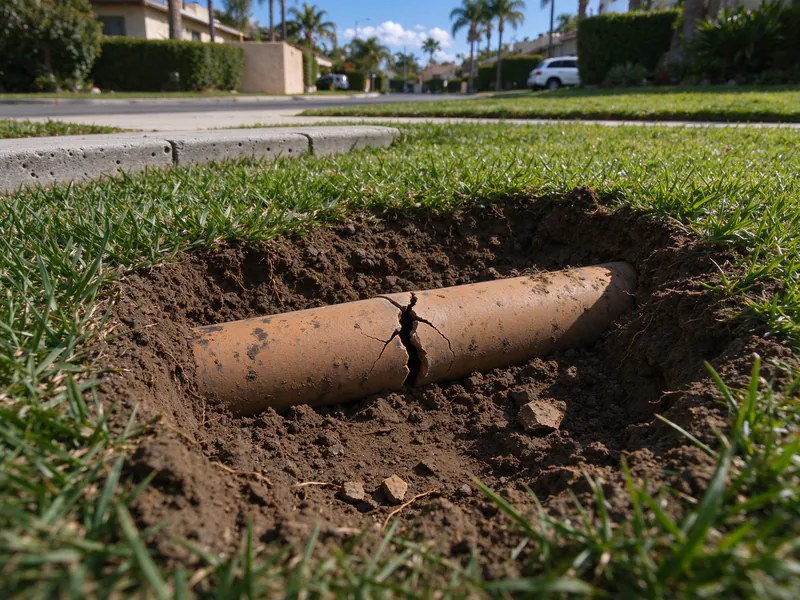
The camera found one cracked joint or one broken section, and the rest of your line looks fine. A spot repair fixes that one problem and leaves the rest of the pipe alone. That might mean we dig a single pit to replace a cracked section, or cure a short liner over a leaking joint from inside the pipe. San Diego Swift Sewer Line Repair does both kinds of spot repair across San Diego, and we recommend one only when the camera shows the rest of the line is sound.
That condition is the whole game. A spot repair on a line that is failing everywhere is money spent on the first of several breaks, and the signs of a broken sewer line rarely tell you which kind you have.
Is one repair enough, or does the whole line need work?
A spot repair makes sense when the defects are few and close together and the pipe elsewhere is sound, round and draining. Lining or replacing the whole line makes more sense when defects repeat along the run, when the pipe material is deteriorating throughout, or when three or four separate repairs would cost close to doing the whole line once.
We judge from the full footage, not from the worst frame of it. A sewer camera inspection run end to end shows whether the defect is isolated or one of many. One root-filled joint in a clay lateral with tight, clean joints everywhere else is a spot repair. The same joint, with a dozen others weeping or showing fine roots, is the start of a lining or replacement conversation.
Cost points the same way. Our typical range for an excavated spot repair is $1,500 to $5,000, and for lining a full residential lateral $4,000 to $15,000. Three spot repairs at the high end can reach the cost of lining the whole line, and lining seals every joint, not just the three. Your final price comes from a written quote after we see the job. The guide sewer line repair vs replacement works through that decision in more detail.
What can one repair fix?
Cracked pipe. Clay is strong in compression but brittle, so a point load from a rock in the backfill, a tree root swelling against the barrel, or soil movement can crack it. A hairline crack may weep for years; a crack that has opened lets roots in and soil out.
Offset joints. Clay and older cast iron were laid in short lengths, and each joint is a place where one section can drop or shift against its neighbor. A small offset leaves a lip that snags paper and wipes; a large one lets soil in and can stop a camera.
Failed joint seals. Older clay joints were packed with mortar or early compression gaskets that harden and shrink. Once the seal goes, roots follow the water vapor in, and the joint itself is the repair site. Root removal clears them for a while, but the opening stays until we seal or replace the joint.
Why did your pipe shift or crack?
Frost heave is not part of the picture here: NOAA’s 1991-2020 normals record no freezing nights in a typical year at Lindbergh Field and only a couple inland. The ground moves for other reasons.
Soil settlement. Backfill that was never compacted properly, over the original lateral or a later utility trench, keeps consolidating for years. As it settles, it drags one pipe section down relative to the next, which opens offsets and can start a sag. This is the classic cause of misaligned joints near the house, where foundation work disturbed the soil.
Shrink-swell clay. USDA soil sampling at points around the metro area found high shrink-swell clay subsoils at places including Encanto, Mira Mesa, Lemon Grove, Spring Valley and Escondido. Those are single sample points, not lot surveys. Clay soil that swells with winter rain and shrinks through the long dry season works rigid pipe back and forth, which is how joints open and barrels crack.
Ground movement and loads. Tree roots growing against a pipe, heavy vehicles over a shallow line, and nearby digging all put stress on brittle pipe, and enough of it ends in a collapsed section rather than a crack. The City’s Seismic Safety Study maps geologic hazards citywide and staff use them to decide whether a permit needs a geotechnical report, but the maps are not site-specific, and most lateral cracks trace to the everyday causes above.
Got footage with a single crack or offset?
Send it with the distance from the cleanout, and we'll tell you which repair fits and what to check either side of it.
How we dig out one bad spot
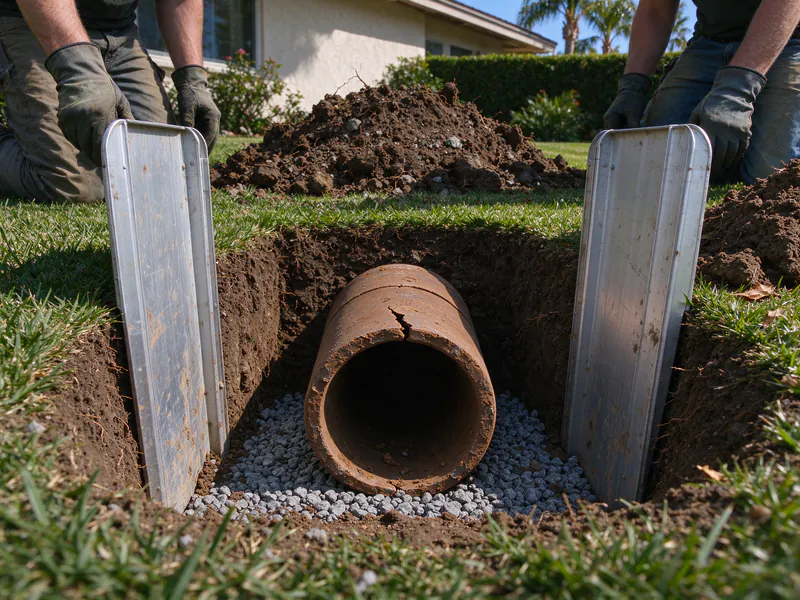
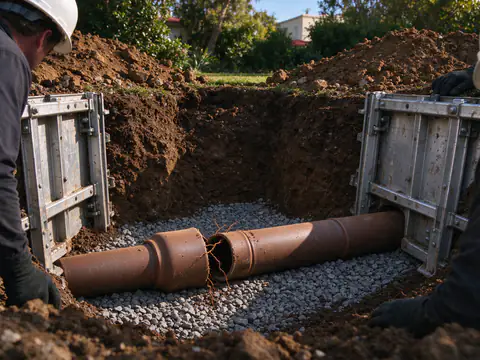
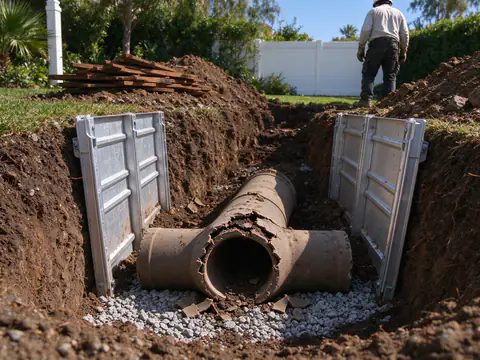
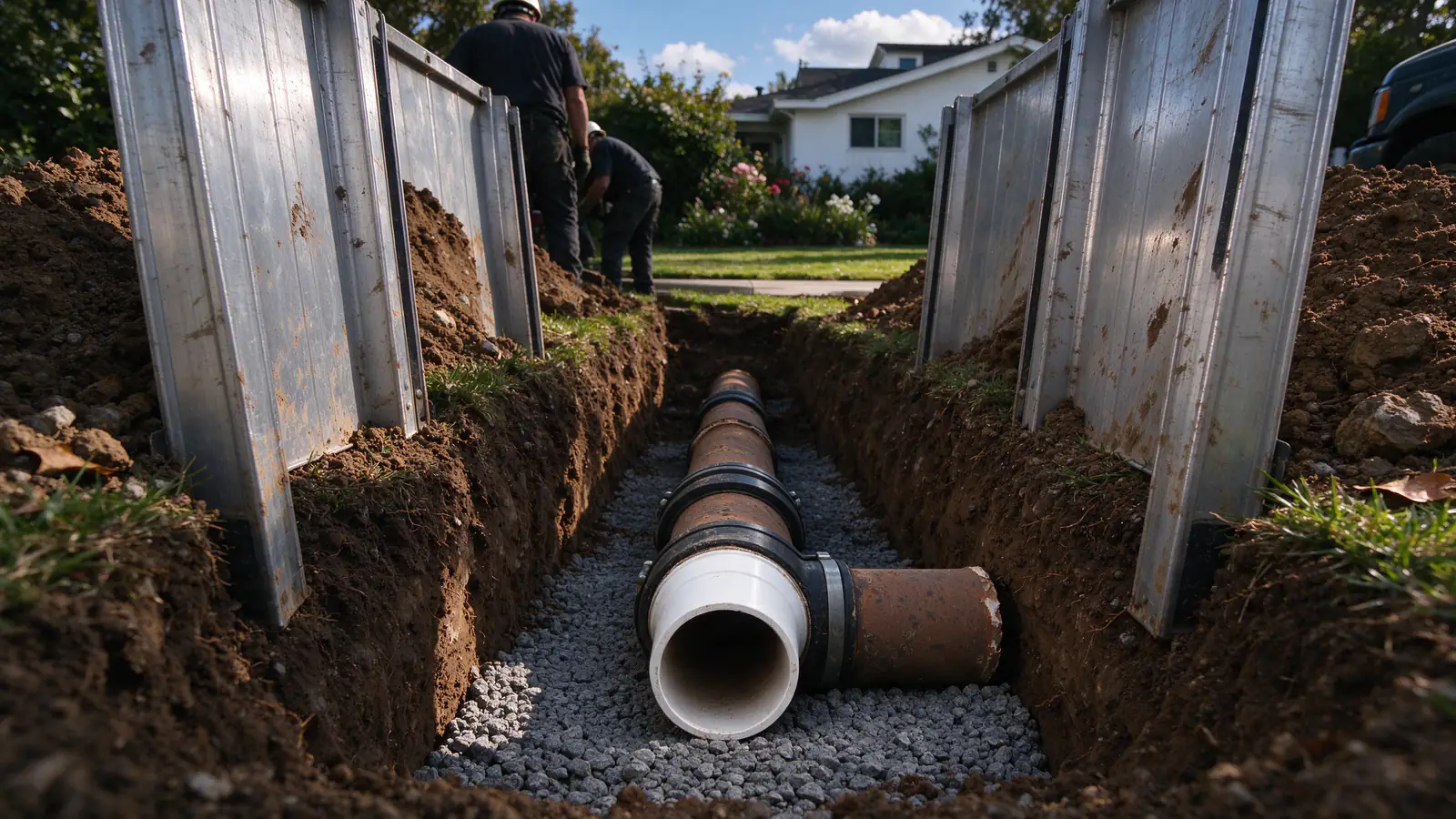
We locate the defect twice: by its footage count on the camera, and by a sonde in the camera head that we pick up from the surface with a locator, so the pit lands over the problem rather than near it. We dig the pit to below the pipe, with shoring where it is 5 feet or deeper under Cal-OSHA rules, and nobody but the trained crew goes in.
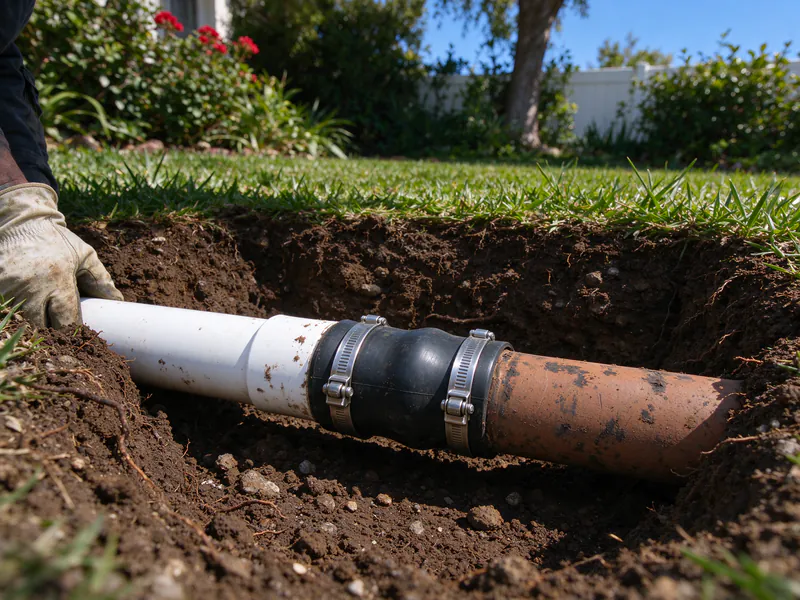
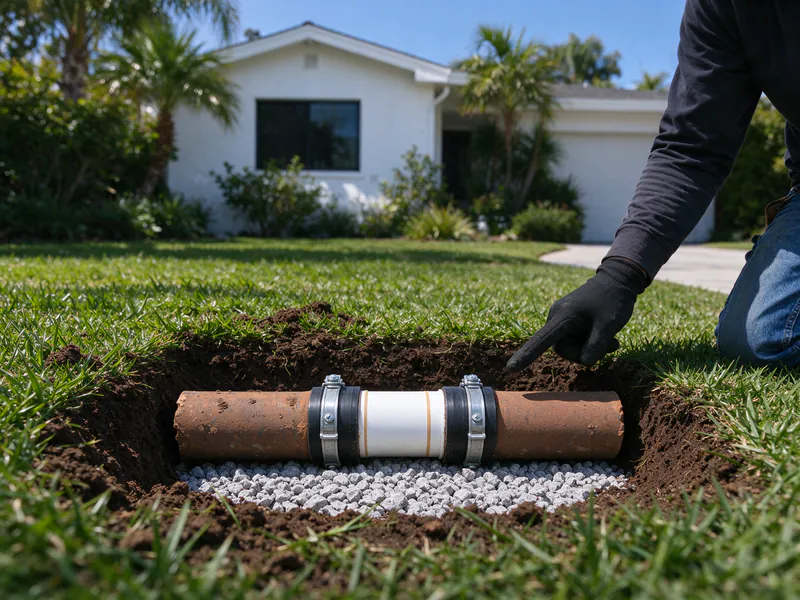
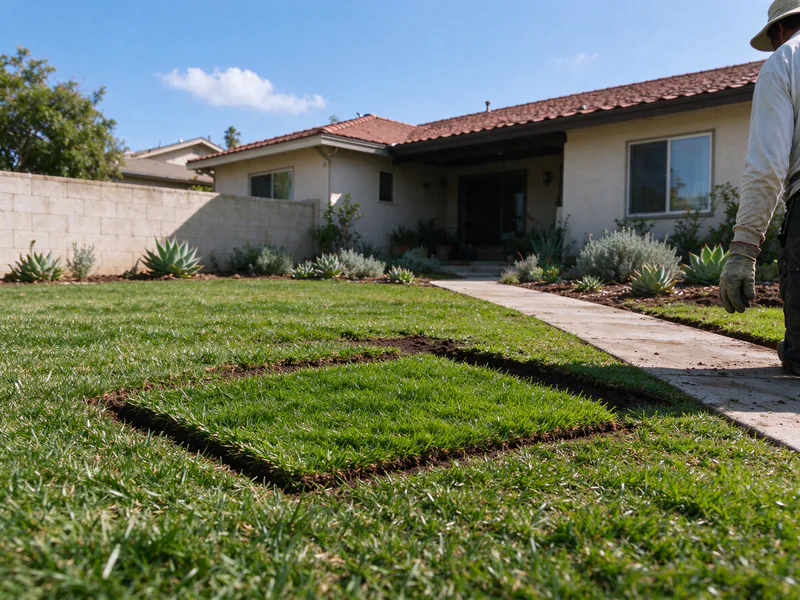
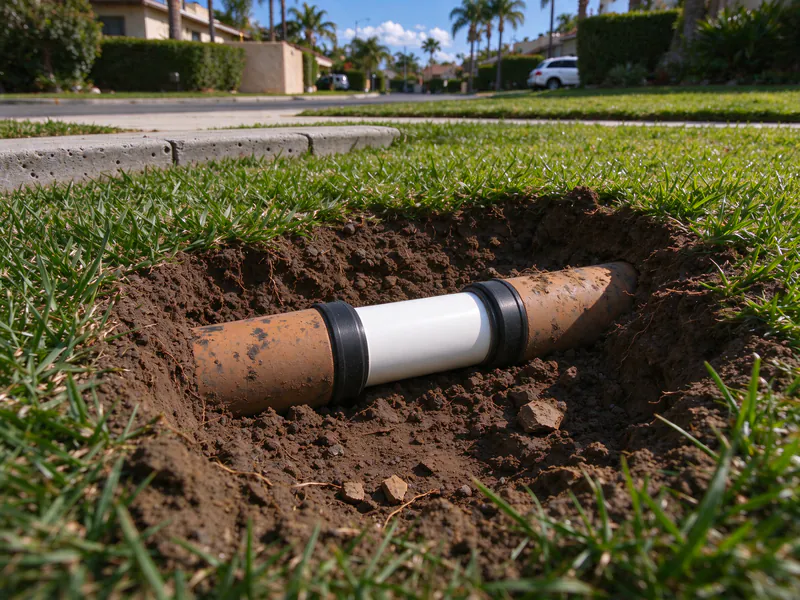
We cut out the failed section and replace it with new pipe, usually PVC, joined to the old pipe on each side with listed transition couplings made for the two materials. The repair rests on firm granular bedding, not loose soil, so it doesn’t settle into a new low spot. After inspection, we backfill the pit in compacted layers and restore the surface as scoped. A final camera run checks the repair and the pipe upstream and downstream, because a repair that pushed the next joint out of line has solved nothing.
Can you fix it without a pit?
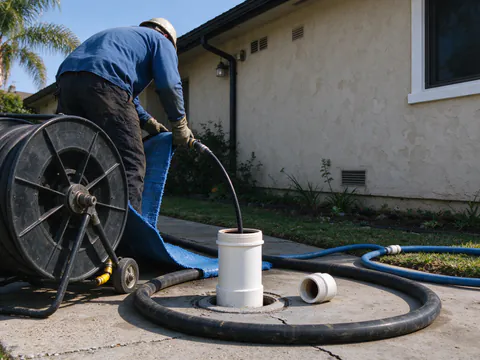
Where the pipe is round and aligned and the problem is a crack or a leaking joint, a sectional liner can do the job without a pit. We push a short resin-saturated sleeve on an inflatable packer to the defect, inflate it against the wall and cure it in place. It seals the spot and leaves the rest of the line as it was, so it suits a lateral whose other joints are tight. It won’t fix a large offset, missing pipe or a sag; those need a dig. We price a sectional liner per job, from the defect, the pipe size and the cleaning it needs first.
What permit does a spot repair need?
On your side of the property line, a spot repair is a sewer piping repair under the City’s Simple No-Plan plumbing permit, $264.25 for a residential repair, for properties that are not historic. If the defect sits under the sidewalk or street, it is still your lateral in the City of San Diego, and the repair becomes right-of-way work with its own permit and inspection; see street sewer lateral repair. For a clay line with joint trouble along its length, clay sewer pipe repair covers the bigger picture.
If the camera has found one bad spot, get an estimate with the footage and the distance noted, or call us, and we’ll give you an honest read on whether that one fix will hold.