 San Diego Swift
Not every Mission Hills lateral ends under the street. If your lot falls away toward a canyon, the pipe can run downhill to a main in an easement or down in the canyon itself, and that one detail decides how we reach the line, who digs and what the permit looks like.
San Diego Swift Sewer Line Repair repairs and replaces sewer laterals across Mission Hills, from the blocks above Presidio Park to the streets that slope toward Hillcrest. Three things are particular to this neighborhood: canyon and easement connections, two designated historic districts, and a large stock of pre-war pipe.
Where does your line actually connect?
The ownership rule is the same as everywhere in the City of San Diego: you are responsible for the lateral from the house to its connection with the public main. What varies on a hillside is where that connection is: Public Utilities says it “may be in the street, past the property line; on an easement; or in a canyon.” Most houses drain forward to a main in the street. Some canyon-rim lots drain backward, downhill, to a main laid in an easement or down in the canyon, which the City reaches through its Canyon Sewer Cleaning Program and Long-Term Canyon Sewer Maintenance Program. Under those programs the City also redirects flows out of canyons into street sewers where it can.
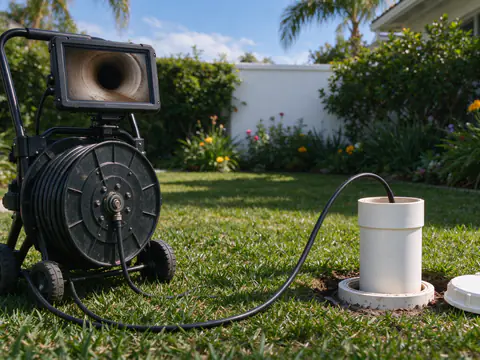
So before we price a repair, our first job is to find out which way your house drains. Development Services can say where a property’s lateral meets the City main, though the City has no drawings of private lines on the lot. We trace the route and depth on the property with a sewer camera inspection and a locator, and our guide to who is responsible for the sewer lateral sets out where the City’s part begins.
Does your line connect in an easement?
A lateral that meets a main inside an easement follows City policies written for exactly that case. The owner is responsible for routine and emergency cleaning and inspection all the way to the main, for having a licensed plumber locate the problem, and for excavating and exposing the pipe. The City then makes repairs only at the connection to the main, once that excavation is done. Work in the easement needs a permit to excavate and a City inspection, an encroachment lateral needs an Encroachment Removal Agreement, and Public Utilities charges a $25 lateral inspection fee for easement and encroachment laterals.
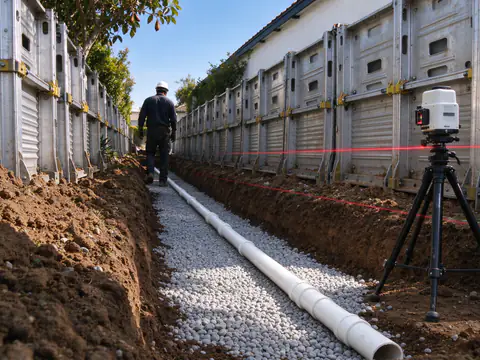
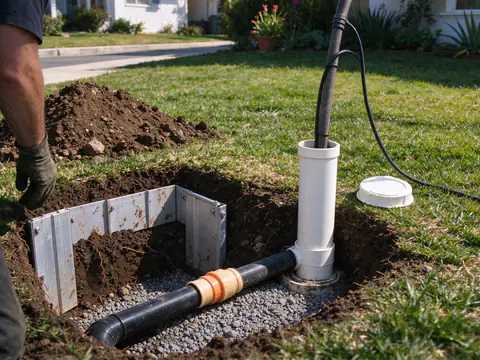
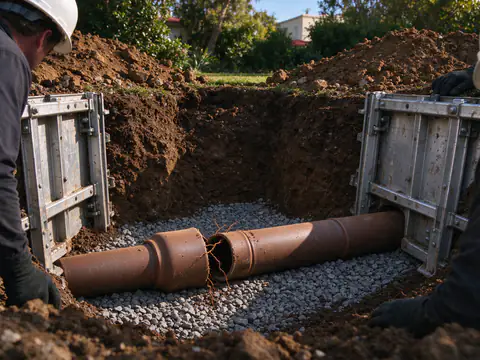
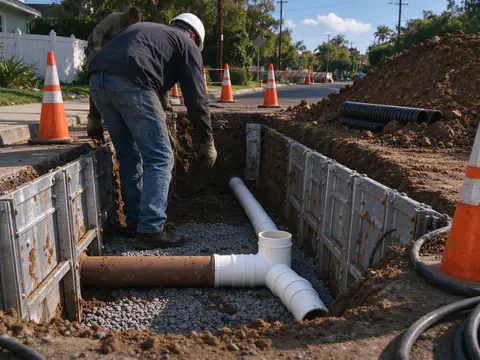
That is where method matters most. A trench down a canyon slope disturbs more ground, and restoring it is slow. A trenchless repair that lines or bursts the pipe from the cleanout can shorten what we have to open, though a pit at the connection may still be needed, and a pipe that has collapsed or lost its fall still has to be dug. Our sewer line excavation page covers how we set up a safe dig.
Is your house in the Mission Hills or Fort Stockton Line district?
Mission Hills is a City-register historic district of 174 parcels built from 1908 to 1942, with designations in 2007 and 2014. The Fort Stockton Line district, 109 parcels of a 1910 to 1939 streetcar suburb, adjoins it. Most single-family sewer work in the City uses the Simple No-Plan plumbing permit, $264.25 for a residential repair or replacement, but Development Services limits that path to properties that are not historic, and a parcel in either district may need historic review first.
For you, that mainly changes the order of things: we confirm the parcel’s status before the scope is final, and the restoration of brick walks, stairs and retaining walls becomes part of choosing the method. Our permit guide explains how each method is permitted in the City.
How old is the pipe under your house?
In the Census Bureau’s American Community Survey, 21.7 percent of homes in ZIP 92103, which takes in Mission Hills and Hillcrest, were built before 1940, more than three times the 6.4 percent share for the City as a whole. The City’s lateral fact sheet notes that older laterals of clay, concrete or cast iron may have root intrusion or deteriorated sections and need regular inspection or more frequent cleaning.
A camera run separates the problems that look alike from the surface. Roots entering at clay joints in an otherwise round pipe point toward a liner or clay sewer pipe repair at the bad joints. Cast iron that has scaled and thinned from the inside is a different case, covered on our cast iron sewer replacement page. A sag that holds water is not corrected by lining, because a liner follows the shape of the old pipe, so we dig at that section. Our guide to reading a camera report shows what each finding looks like on video.
Is a tree near your line?
Uptown permit records show right-of-way permits that pair new sewer laterals with street trees and trenching, and the City’s rules keep the two apart. Its wastewater design requirements bar trees and shrubs taller than 3 feet at maturity within 10 feet of any sewer main or lateral, and a new lateral placed within 10 feet of trees becomes a private encroachment lateral that needs an agreement with the City. Routine rodding to clear roots “from any source” stays the owner’s job under Council Policy 400-10.
When roots are already in the line, root removal restores flow, but it does not close the joint they came through, so they return. Sealing or replacing the run is what ends the cycle. Where the street section is involved, our street sewer lateral repair page covers the right-of-way permit, the $1,412.54 inspection fee per lateral and traffic control.
What we settle before we price a Mission Hills job
Our written scope answers four things: where the lateral connects (street, easement or canyon), whether the parcel is historic, whether any of the work is in the right-of-way, and whether there is a usable cleanout to work from. Each one moves the number more than the footage alone. Our typical range for lining is $80 to $250 a foot and for trench replacement $50 to $250 a foot, and your final price comes from a written quote after we see the job. Our sewer line replacement cost guide shows how those drivers stack up, and North Park, next door to the east, shares the pre-war housing and the historic-district question.
Mission Hills address and camera footage?
Send both and we'll tell you where the line seems to connect and which permit path the parcel faces.