 San Diego Swift
Hydro jetting is cleaning. Sewer line repair is construction. A jetter scours roots, grease and scale off the inside of a pipe and gets water moving again; a repair changes the pipe itself by replacing, lining or re-laying the part that failed. Which one a San Diego lateral needs depends on what is left once the pipe is clean.
Your line backed up, someone jetted it, and now you’re being told it needs a repair. The two get blurred all the time, partly because both often start the same day at the same cleanout. San Diego Swift Sewer Line Repair treats jetting as the first step that makes a diagnosis possible, not as the diagnosis. The service itself is described on our sewer root removal page; this guide is about the decision.
What does hydro jetting actually do?
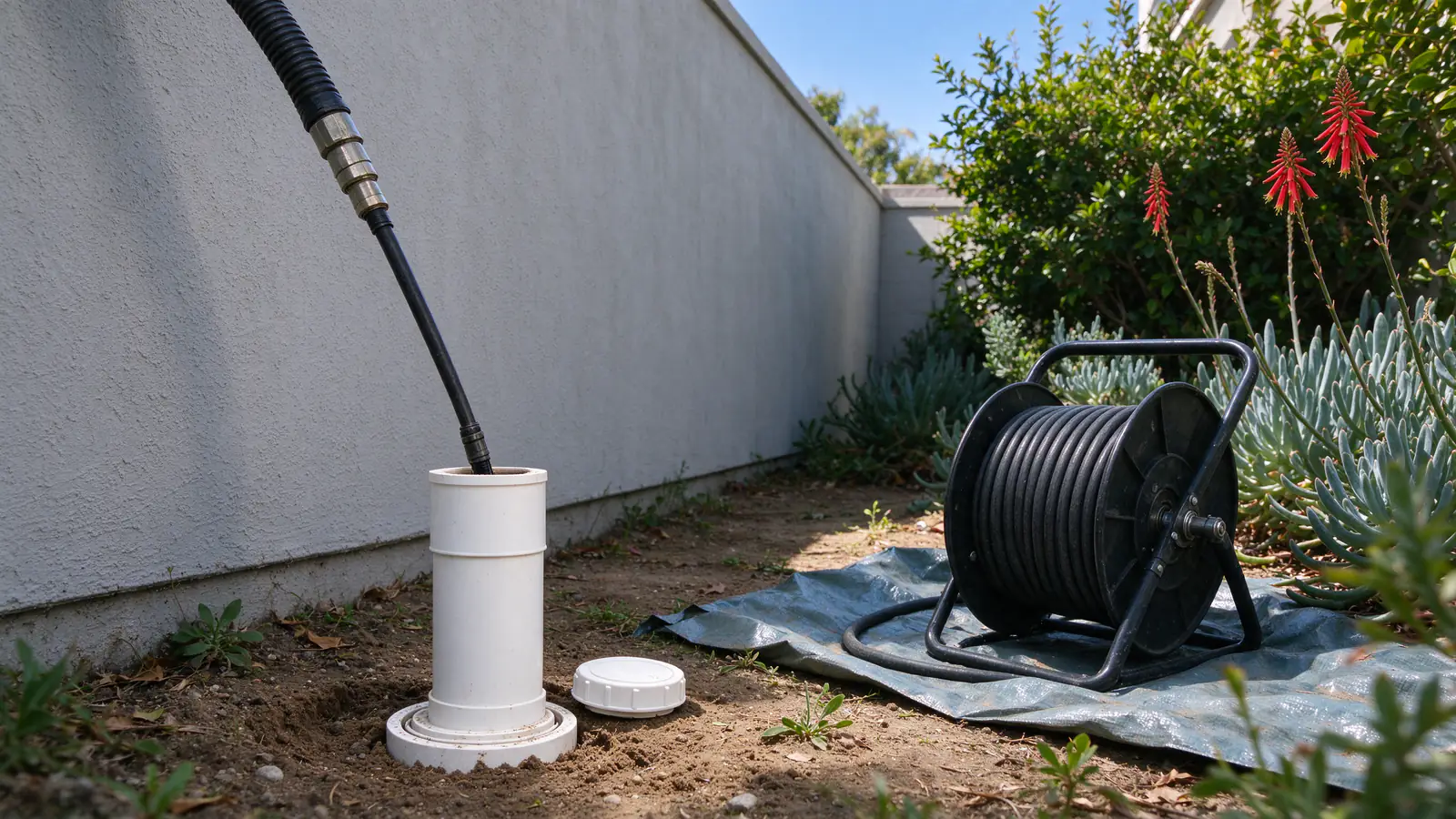
A jetter pushes water at high pressure through a hose to a nozzle with rear-facing jets. Those jets pull the hose forward and blast the pipe wall as it goes, cutting soft roots, stripping grease and breaking up scale. The loosened material washes downstream to the main. It restores the pipe’s open diameter; it adds nothing to the pipe’s structure.
Mechanical cabling, the other common cleaning method, spins a cutting head on a steel cable. It punches through a blockage quickly but tends to leave a ring of material on the wall, while jetting cleans more of the circumference. Neither one is a repair, and choosing between them is a cleaning decision made by the technician on site.
What jetting can’t fix
Some defects are holes or shape changes in the pipe, and no amount of water changes them:
- An open or offset joint. Roots got in through a gap. Cutting them out leaves the gap, and new growth finds it again.
- A crack or fracture. Water and roots pass through it whether or not the pipe is clean.
- A belly. A sag holds water and solids because of its geometry. Jetting empties it for a while; the low point stays low. Our sewer belly repair page covers why grade has to be fixed by excavation.
- A collapse or a missing section. Jetting into a void can wash surrounding soil into the pipe and make things worse.
- Thinned cast iron. Descaling restores flow inside an old iron line, but it also reveals how much wall is left, which can be very little.
So the honest answer to “will jetting fix it?” is that jetting fixes the blockage. Whether it fixes the problem depends on why the blockage formed.
Why the camera comes after the jetter
A camera pushed into a pipe full of roots or standing grease sees mostly roots and grease. Cleaning first lets the inspection see the wall, the joints and the shape of the pipe. The footage then shows one of two pictures: a clean pipe with tight joints, meaning the blockage was a maintenance issue, or a clean pipe with a defect where the blockage kept forming.
That second camera run is the part people skip. A buyer who has the line jetted during escrow without a follow-up scope learns about the defect only when the backups return. Ask for footage after any jetting that was done to clear roots, and keep it. Our guide to reading a sewer camera report explains what the terms on it mean, and the sewer camera inspection page covers how the scope is done.
Jetted, and it's back already?
Send the address and any footage from the last cleaning, and the next step can be based on what the pipe actually shows.
When is jetting the right call on its own?
Jetting alone makes sense when the footage after cleaning shows a continuous pipe with sound joints and no sag, and the blockage came from grease, wipes or light root growth. In that case it is maintenance, and a sensible interval between cleanings, set by how fast material builds up, is a reasonable plan.
It is also the right first move in an emergency where the house has no working drains. Restoring flow comes before deciding on a repair, and our emergency sewer repair page covers that sequence.
When does the footage point to a repair?
The case for a structural repair is strongest when the camera finds a defect that explains the blockage and will keep producing it:
| What the clean pipe shows | Likely direction | Why |
|---|---|---|
| One cracked or root-entry joint, sound pipe either side | Spot repair or a sectional liner | The failure is local, so the fix can be |
| Root entry at joint after joint along the run | Lining or replacement | Sealing every joint costs less than chasing them one at a time |
| A sag holding water | Excavation of the low section | A liner follows the sag; only re-laying the pipe resets the fall |
| A collapse or a deformed section | Dig or pipe bursting | There is no continuous pipe left to clean or line |
| Thin, flaking cast iron after descaling | Lining if the shape holds, otherwise replacement | The wall, not the scale, is the limit |
The broader version of this choice, between patching one section and replacing the whole lateral, is in sewer line repair vs replacement.
The cost of jetting forever
Our typical ranges are $350 to $600 a job for hydro jetting or root clearing, $100 to $500 for a camera inspection, $1,500 to $5,000 for an excavated spot repair and $80 to $250 per foot for lining. Your final price comes from a written quote after we see the job.
The comparison isn’t one jetting against one repair. It is a series of cleanings, at whatever interval the line demands, against a repair that removes the reason for them. In the City of San Diego there is no limit on how many times an owner can pay to clear a lateral, and the City’s fact sheet is explicit that it does not reimburse plumbing costs. When roots or grease cause a stoppage in the street section, the City bills the owner for its response. Our camera inspection cost guide covers what a scope adds to the arithmetic.
If your line has been cleared more than once and the problem is back, get an estimate or call us with the address and whatever footage you have. We start with a clean pipe and a clear picture of it.