 San Diego Swift
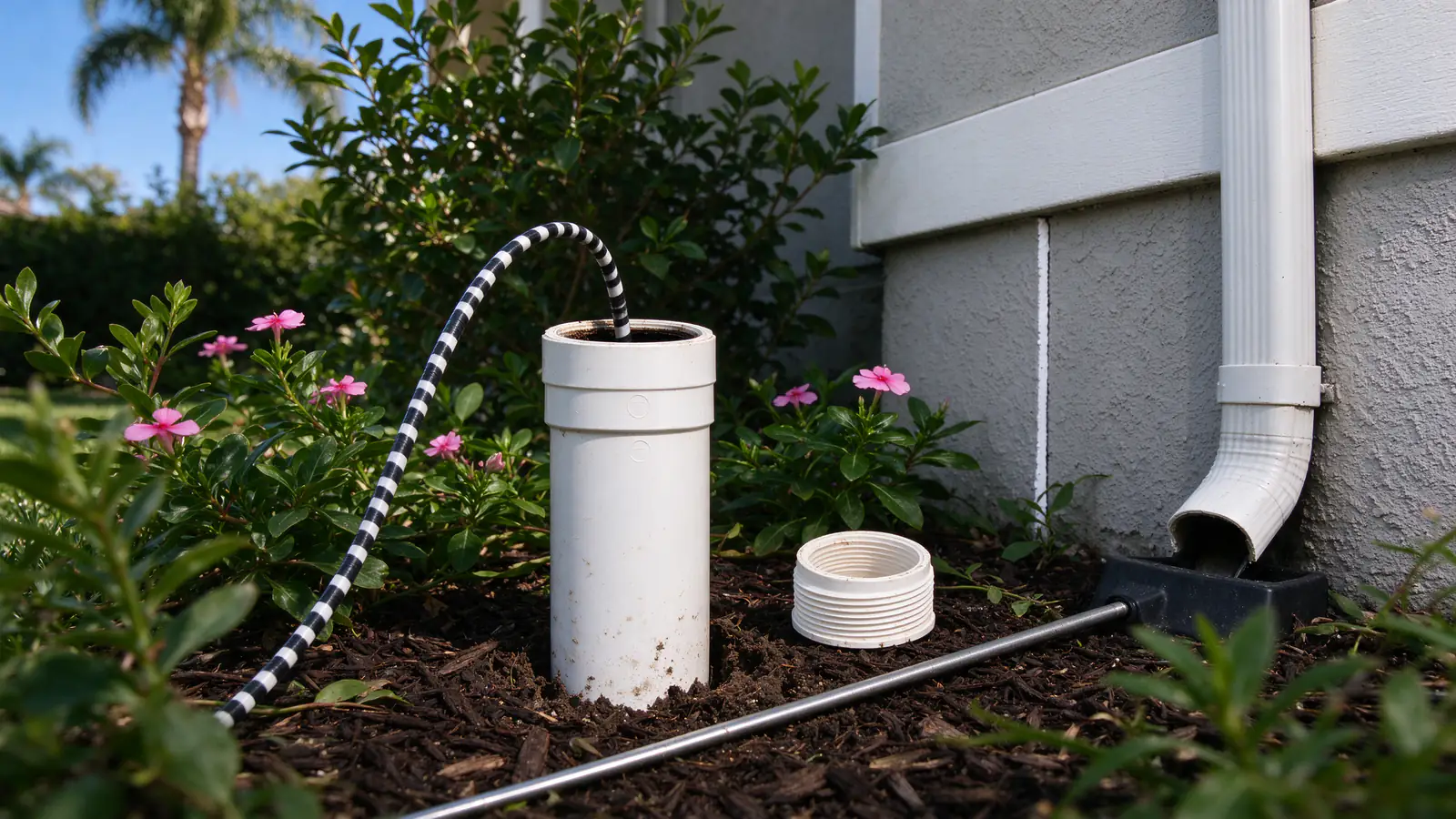
On most San Diego-area houses the cleanout is outside, within a few feet of the foundation, on the side of the house where the main drain leaves: a short capped pipe sticking a few inches out of the ground, or a small lid at grade. Some lots also have a second cleanout near the sidewalk. Plenty of older ones have neither in a place anyone can find.
A cleanout is the capped opening that lets a camera, a cable or a jetter into the lateral, the pipe that runs from the house to the public sewer (our guide to what a sewer lateral is covers the whole system). Knowing where yours is saves time on the day the line stops. At San Diego Swift Sewer Line Repair we start nearly every camera inspection at a cleanout, and when a house has none, adding one is often our first piece of work.
Where is the sewer cleanout on most houses?
Start at the foundation, on the side nearest the bathrooms and kitchen or the side facing the street. San Diego County notes that cleanouts are usually 3 to 5 feet from the house, and sometimes at the front property line. You’re looking for a short capped pipe, or a small round or rectangular lid set level with the ground.
Walk the foundation slowly and check these spots in roughly this order:
- Along the front or side wall, near where the drain line from the bathrooms would leave the house. On a slab house this is often a few feet out from the wall; on a raised-floor house, near the point where the pipe exits under the floor.
- In planter beds and under shrubs. Ivy, mulch and ground cover hide more cleanouts than anything else.
- Beside the front walk or driveway, where a line heading for the street would pass.
- Near the sidewalk or curb, in a box with a lid. That is where a property-line or two-way cleanout sits when there is one.
- Inside, in a garage, a laundry area or a crawlspace. Interior cleanouts are usually on branch lines rather than the main, but on some houses the main cleanout is indoors.
The direction the line runs is a clue. Laterals head toward the public sewer, which in most of the City of San Diego is under the street, but on some lots it runs to an easement behind the house or down into a canyon. If the street side turns up nothing, check the back.
What a sewer cleanout looks like
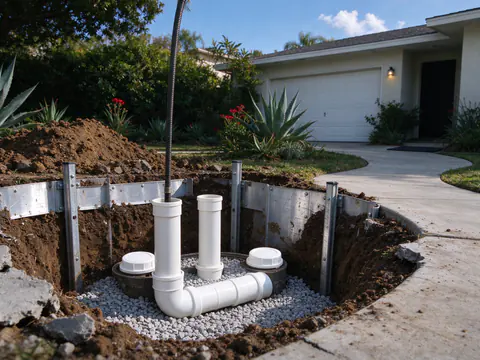
A typical cleanout is a pipe about 3 to 4 inches across, standing a few inches above the soil or cut off at grade, with a threaded plug on top. The plug usually has a square nub or a recessed square so it can be turned with a wrench.
The material tells you something about its age. White PVC or black ABS points to a cleanout added or replaced in the plastic era. Cast iron with a brass plug usually means an original cleanout on an older house. A cleanout set in a ground-level box has a plastic or concrete lid, round or rectangular, and is easy to mistake for something else. A two-way cleanout has an opening facing each direction, toward the house and toward the street, so equipment can go either way; these are common in front yards near the property line.
Several things in a yard look similar and aren’t cleanouts:
- The water meter box, usually near the curb, which holds a meter and a pressurized supply pipe.
- Irrigation valve boxes, which hold valves and wiring.
- Yard or area drains, which have a grate and carry rainwater, a separate system from the sanitary sewer.
- Vent pipes through the roof, which let the system breathe. Plumbers sometimes enter a line through a vent, but it is not a cleanout.
- Gas fittings and backflow devices, which should never be opened by anyone but the utility or a licensed tradesperson.
Why some San Diego houses have no cleanout near the street
For most of the last half-century, nobody had to put one there. San Diego County’s Board Policy F-16 records that the County Plumbing Code dropped its property-line cleanout requirement in 1969, because a grade-level cleanout near the building was being installed instead, and that the County stopped installing property-line cleanouts and routinely cleaning laterals on July 1, 1969. The City of San Diego’s lateral fact sheet answers the question directly: the City does not require property-line cleanouts.
That history explains a common San Diego pattern: one cleanout by the house, none by the sidewalk. It also explains why front-yard cleanouts keep appearing. The City’s open permit data includes no-plan residential plumbing permits to install two-way cleanouts in front yards, usually because owners want access to the whole lateral, including the part under the street, which the owner is responsible for in the City (who owns which part explains why).
New public laterals follow a different drawing. The City’s current standard shows the public lateral with its cleanout on the City side of the property line, and Development Services Bulletin 166 says a new lateral that puts its cleanout on private property has to be treated as a private lateral with an encroachment agreement. That matters for new work at the street, not for the cleanout already in your planter.
Outside the City the rules differ. Poway cleans the lateral from the property-line cleanout to the main at no charge, but only if the house has a property-line cleanout; without one, the owner needs a licensed plumber to install it, and a buried box has to be exposed before the City will service it. The Poway page covers that rule, the Spring Valley page covers the County’s, and our service areas page lists the rest.
What if there is no cleanout at all?
Then it is buried, hidden indoors, or was never installed. A plumber can sometimes reach the line by pulling a toilet or going in through a roof vent, but that is slower and limits what a camera or cleaning head can do. Adding a cleanout gives lasting access, and in the City it is usually done under a plumbing permit.
Records won’t show it. Development Services can tell you where a property’s lateral connects to the City main, but the City has no diagrams of private lines on the lot. On a property with no visible cleanout, a camera put in through whatever access exists, followed from the surface with a locator, traces the line’s path and depth, and usually finds a buried cleanout if there is one.
Leave the probing and digging to the plumber. The lateral and other utilities can be shallow near the house, and a shovel or a steel probe can crack a clay pipe or nick a gas or water line.
Why sewage comes out of an outdoor cleanout
When sewage spills from an outdoor cleanout, the blockage is downstream of it, somewhere between that cleanout and the main, and the line is full back to that point. Sewage escapes from the lowest opening it can reach, and a cleanout cap set low in the yard is often lower than any drain in the house. If it keeps happening, our guide to the signs of a broken sewer line explains what else to watch for.
If sewage from a cleanout reaches the street in the City of San Diego, the City asks owners to call its sewer line at 619-515-3525; crews clean the right-of-way, and the City holds the owner responsible for its response costs if the cause was in the lateral under the property. Our guide to what to do when your sewer backs up covers the rest of the first hour.
Can't find a cleanout?
Tell us the address and what you've seen in the yard, and we'll explain how access can be found or added.
Keeping the cleanout usable
A cleanout only helps if it can be reached and opened. A few habits keep it that way:
- Don’t bury it. Concrete, pavers, decking, soil and turf all hide cleanouts. If the grade is changing, have the cleanout raised to the new surface.
- Don’t cut it down. A cleanout that sticks up in a front yard is annoying, but cutting it below grade without a proper fitting and cap leaves an open path for soil, roots and rainwater, and roots that get in that way end up as a root removal job.
- Keep the cap on and intact. A cracked or missing cap lets in rainwater and debris, and lets out sewer odor. Mowers and edgers break plenty of them; a replacement cap is a small fix.
- Mark it. A note on the house file, or a photo with a measurement from a corner of the house, saves time later.
Once you find the cleanout, it is also where our diagnosis begins. A camera inspection goes in through it, a liner or a cleaning head goes in through it, and the footage counter measures every defect from it. Call us or get an estimate if yours is missing, buried or broken.