 San Diego Swift
Nobody can honestly put a fixed number of years on your sewer line. Two laterals laid the same year, in the same material, can end up in completely different shape decades later, because what ends a lateral is usually something that happens to it: roots at a joint, soil that settles, a driveway poured over it, iron that corrodes from the inside.
What we can tell you is which materials fail in which ways, and which conditions speed that up or slow it down. San Diego Swift Sewer Line Repair bases replacement decisions on footage, not on the age of the house, and this guide explains why. The material-by-material detail on identifying pipe is in what sewer pipe does my house have.
What decides how long a sewer line lasts?
Three things: what the pipe is made of, how well it was laid, and what has happened around it since. Material sets the likely failure mode. Installation sets how well the pipe resists it. Conditions such as roots, soil movement and surface loads decide how fast it arrives. A camera inspection shows the combined result for one particular line.
The City’s own Public Utilities lateral fact sheet frames it the same way: maintenance needs depend on the age and type of the lateral. That is the most specific statement an official San Diego source makes, and it deliberately stops short of giving years.
How each material wears out
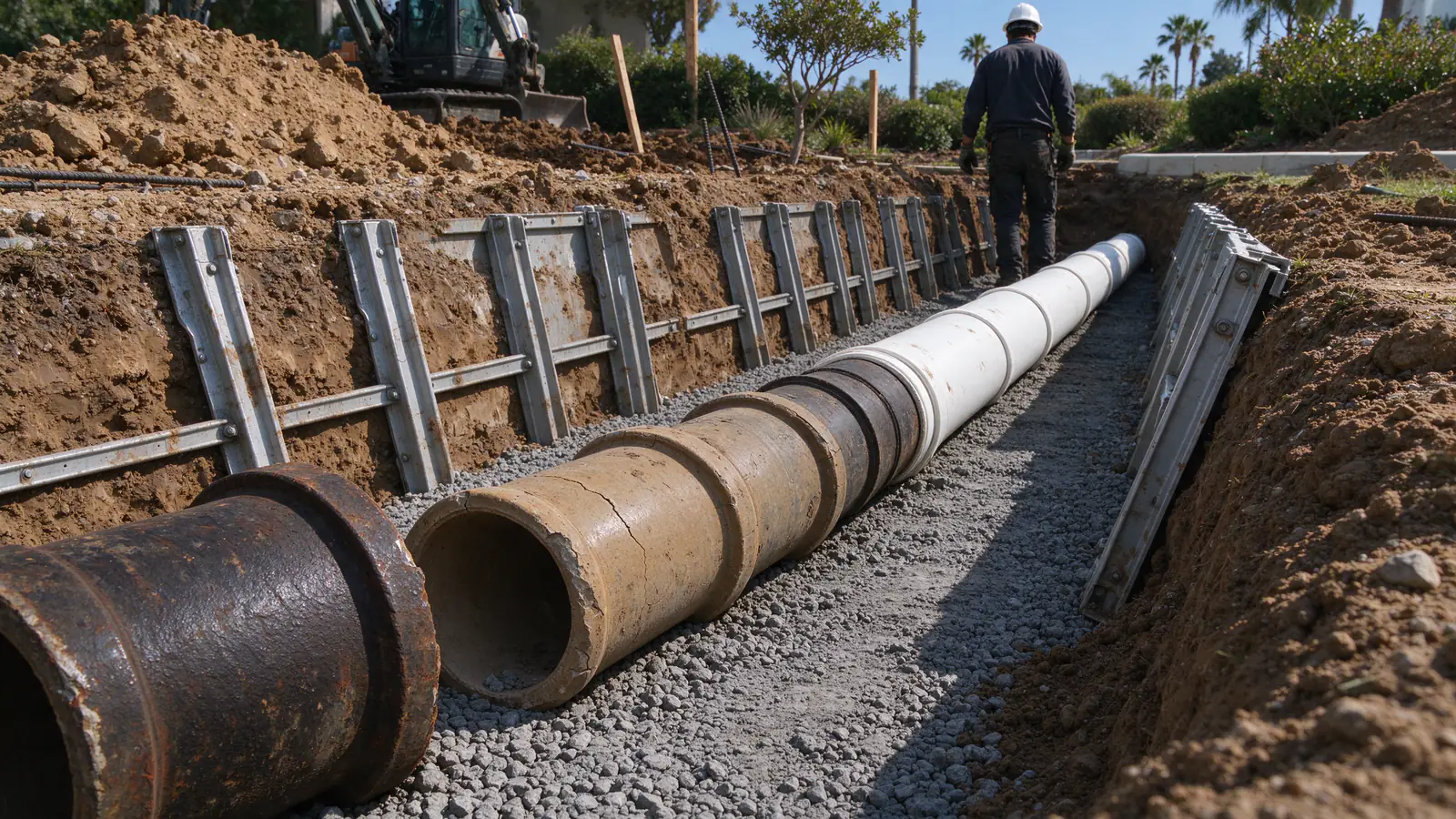
Vitrified clay. The fired-clay barrel itself resists sewage chemistry very well, which is partly why clay mains are still common in the City’s public system. The weakness is the joint. Clay was laid in short lengths, so a lateral has many joints, and older ones were sealed with mortar or early gaskets that open with movement. Every open joint is a place for roots and soil to enter. See clay sewer pipe repair.
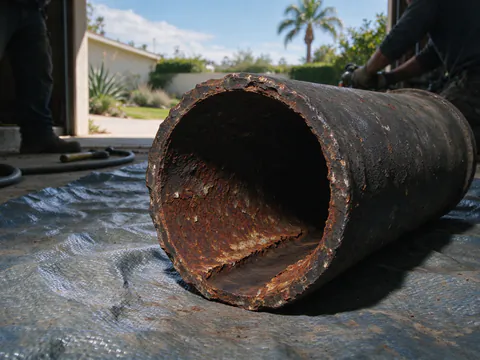
Cast iron. Strong when new, cast iron corrodes from the inside. Scale builds on the wall and narrows the bore, and in some conditions the bottom of the pipe, which carries the flow, channels and wears thin first. Over time the wall loses enough metal to crack or collapse. How far that has gone is visible only on camera, and sometimes only after descaling. The City is replacing cast-iron and clay mains in projects such as La Jolla Improvements 2, which shows those materials aging in the public system too. See cast iron sewer replacement.
Concrete and Orangeburg. Concrete pipe deteriorates at its joints and along the wall, and the City’s fact sheet groups it with clay and cast iron as more prone to roots and deteriorated sections. Orangeburg, a bitumen-impregnated fiber pipe, softens and goes oval under soil load; once deformed it may not be suitable for every lining method.
ABS and PVC. Long sections and solvent-welded or gasketed joints give roots very few entry points, and plastic doesn’t corrode. Plastic laterals fail mostly from installation and outside forces: a joint not fully seated, a section laid on poor bedding that sags, or a pipe crushed by construction equipment.
San Diego conditions that shorten a lateral’s life
Roots. Roots follow the moisture that escapes from a joint, then widen the opening. City design rules keep trees and shrubs taller than 3 feet at least 10 feet from sewer mains and laterals. On many older lots the trees stand much closer than that, which puts roots and pipe in the same ground. Our root removal page covers the consequences.
Soil that moves. USDA soil samples around the metro show clays with high shrink-swell potential at points in Encanto, Mira Mesa, Lemon Grove, Spring Valley, El Cajon and Escondido, and low shrink-swell sands in Mission Valley. Clay that swells and shrinks with moisture shifts rigid pipe and works its joints apart. Those are single sample points, not a lot survey.
Fill and groundwater. A City study describes Mission Bay Park as hydraulic fill over young deposits, with high groundwater and high liquefaction potential. Saturated or loose ground gives a pipe less support and more reasons to settle, which is how a belly forms.
Loads on top. A driveway, a parking pad or a wall poured over an old lateral adds weight and makes later repair harder.
What extends a sewer line’s life
- Keeping solids and grease out. Grease narrows a pipe from the inside regardless of material.
- Planting away from the line. Knowing where the lateral runs before a tree goes in costs nothing; the City’s 10 foot separation is a sensible guide on private land too.
- Inspecting before failure. The San Diego County sanitation district recommends a camera inspection every 3 to 5 years for laterals it serves. A scope shows the first open joint before it becomes the first backup.
- Fixing the first defect properly. A spot repair on one failed joint, with the rest of the line confirmed sound, can be a durable answer. Clearing the same joint repeatedly lets it get worse.
- Good installation when replacing. Bedding, compaction and an even slope are what keep a new pipe from sagging.
What about lined pipe and new pipe?
Lining forms a new jointless wall inside the old pipe, removing root entry points and sealing cracks. Its durability depends on the liner system, the resin and cure, the condition of the host pipe and the quality of installation, so ask any installer for the product’s documentation rather than a number of years. The sewer pipe lining page explains the method.
Replacement in PVC or HDPE removes the old material altogether; sewer line repair vs replacement covers when it makes sense. Neither method comes with a guaranteed lifespan, and anyone offering one is promising something that depends on the ground, the trees and the next owner’s habits.
If your house is old enough that the lateral’s age worries you, the useful next step is footage, not a guess. Get an estimate for an inspection, or call us with what you already know, and see the signs of a broken sewer line for what to watch in the meantime.