 San Diego Swift
You want to know how long the house will be torn up, and there is no single number, because the time in the ground is usually the smaller part of the schedule. What sets the calendar is the paperwork and the inspections around the work: which permit the job needs, whether the street has to be opened, whether that street was paved recently, and whether the excavation will hit groundwater.
A replacement that stays on private property under the City of San Diego’s simple permit moves on a short administrative track. One that crosses the sidewalk to the main adds a right-of-way permit, traffic control and City inspections, and each of those has its own lead time. San Diego Swift Sewer Line Repair builds your schedule around those steps after a camera inspection shows what the line needs, and our scope says which ones apply.
The steps that set the schedule
Every replacement passes through the same stages, though not every job needs every one.
| Stage | What has to happen | What can stretch it |
|---|---|---|
| Diagnosis | Camera inspection and a locate of the path and depth | A line too full to see, which has to be cleaned first; no usable cleanout |
| Scope and method | A written scope naming method, length, depth and restoration | Defects that change the method, such as a sag that rules out lining |
| Private-side permit | The City’s Simple No-Plan plumbing permit for most houses | A historic district or historic site, which may need historic review |
| Street permit | Right-of-Way Permit, Rapid Review or full plan review | A manhole connection that needs plans; correction cycles |
| Traffic control | A traffic control plan and permit for the block | Busy streets and more than one block |
| Moratorium check | Confirming whether the street was resurfaced recently | An Excavation Moratorium Waiver, required before digging |
| Groundwater | A Groundwater Discharge Permit if dewatering goes to the sewer | Low-lying ground with shallow water |
| Fieldwork | Excavation or trenchless installation, then connection | Depth, shoring, what sits over the line |
| Inspections | City inspections after the trench is dug, before connection, and at the end | Inspector scheduling; corrections |
| Restoration | Backfill, compaction and resurfacing to the regional standard drawings | Full-lane repaving on a moratorium street |
How long does the permit take for work on private property?
For most single-family and duplex lots in the City of San Diego, the Simple No-Plan plumbing permit covers a sewer repair or replacement, and the City says it normally issues within two business days. Inspections are scheduled after the invoice is paid. A property in a designated historic district or on a historic site may need historic review instead.
That last point matters in the City’s older neighborhoods. Owners in districts like those in North Park and Mission Hills should expect the permit path to be checked first, because a house that falls outside the simple permit takes a different route through Development Services. Our permit guide covers each path.
Other agencies run their own clocks. Escondido requires a City repair permit before any lateral work begins, even on private property. In Lemon Grove, the Sanitation District and the City both inspect the finished lateral before the trench is backfilled, so the schedule has to leave room for that joint inspection.
When the work crosses into the street
In the City of San Diego the owner’s lateral runs to the main, so a break under the sidewalk or street is still the owner’s job, and that section needs a Right-of-Way Permit with a construction plan. A lateral with a direct wye or saddle connection to the main can go through Minor Right-of-Way Rapid Review; one that connects at a manhole has to be submitted with plans.
Review is iterative. Development Services charges an added hourly fee on projects that are not cleared by the third review cycle, which tells you two things: corrections are normal, and each cycle is calendar time. A complete first submittal is the single biggest thing that shortens this stage.
Traffic control comes next. The City’s traffic control permit is issued per block for an initial period of up to three weeks, with extensions available by the week. Then come the inspections, which are fixed points in the sequence: one after the trench is dug and before the connection to the main, and a final one. The trench can’t be closed until the inspector has seen it. Our street sewer lateral repair page walks through that work.
Streets that were resurfaced recently
The Street Preservation Ordinance protects new pavement. A street that has had an asphalt overlay in the last three years, or a slurry seal in the last year, is under an excavation moratorium, and it can’t be opened until the City approves an Excavation Moratorium Waiver. Restoring a moratorium street can also mean resurfacing the full width of the lane, or curb to curb.
Whether your block is under a moratorium is something to confirm before the schedule is set, not after the permit is filed. A waiver application is one more step in the queue, and the restoration it requires is more work at the end of the job.
Does the 180-day rule mean replacement takes six months?
No. The 180-day figure is a limit, not a typical duration. Since the updated Street Preservation Ordinance took effect on January 1, 2024, most trenching and restoration in the street has to be finished within 180 days. It stops street cuts from being left half-restored, and it gives owners a firm outer bound to hold a contractor to.
Groundwater and dewatering
Some ground holds water close to the surface. City-filed geotechnical reports record groundwater at about sea level around Mission Bay, varying with the tides, and at about 7.8 feet below the surface in one Mission Valley boring. An excavation that fills with water has to be pumped, and in the City of San Diego pumping construction water into the sewer needs a Groundwater Discharge Permit from Public Utilities. The City’s rule is plain: no discharge may occur until the permit is issued, and applicants should apply well ahead. On a lot where groundwater is likely, that permit belongs at the front of the schedule, not in the middle of the dig.
Want the steps for your address?
Send the address and any footage, and we'll list the permits, inspections and street rules that apply before any date is promised.
What the household notices: days without a drain
What matters to most families is not the total job length but how long the house can’t use its drains. That window depends on the method:
- Lining keeps the old pipe in place. The line is out of service while we clean it, install and cure the liner, and reopen branch connections. There is little open ground, but the drains still can’t be used during the cure.
- Pipe bursting needs a launch pit and a receiving pit. The line is out of service while we pull the new pipe through and connect it at each end. Our comparison of pipe lining vs pipe bursting covers which pipes suit each.
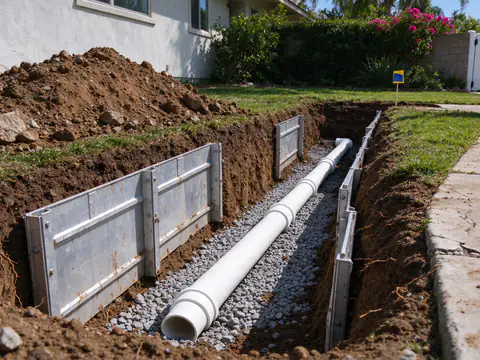
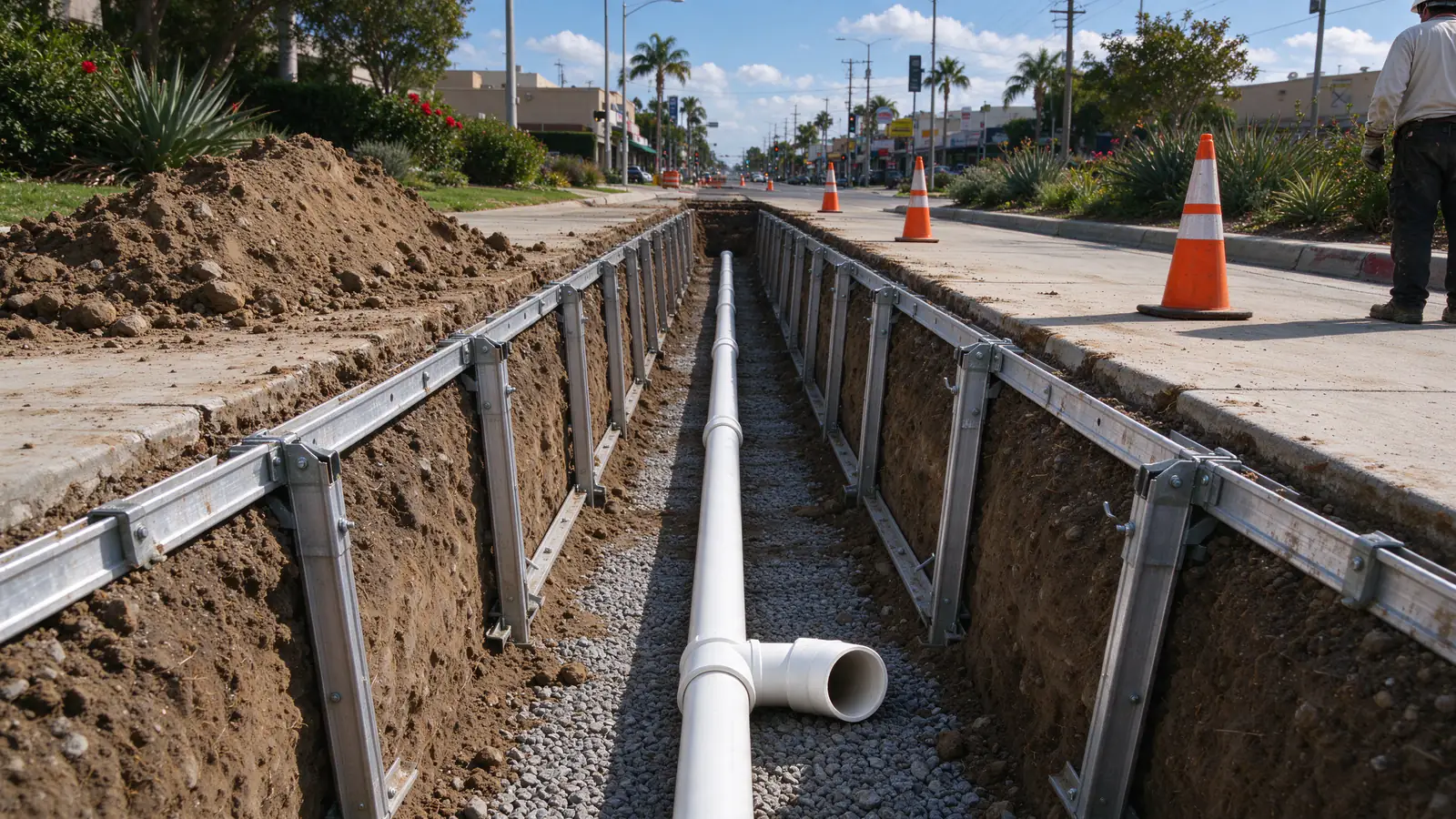
- Open-trench replacement has the most open ground and the longest stretch where the old line is cut. Trenches 5 feet or deeper need Cal-OSHA shoring, which adds setup time and keeps the area off-limits to everyone but the crew.
Ask how many days the line will be out of service, separately from how many days the job lasts. They are different numbers, and the first one decides whether a temporary toilet makes sense.
Emergencies and the schedule
A line that has failed completely changes the order of things, not the rules. Permits still apply. In the City of San Diego, when a licensed plumber finds a break or collapse beyond the property line and the house has lost all sewer service, the plumber can file a Plumber’s Report on the City’s sewer emergency line, and the City investigates within 24 hours. What it does next depends on what it finds.
Cleaning can sometimes restore flow for a while so the replacement can be permitted and scheduled properly, but it is not a repair and it won’t work through a collapse. When the toilets don’t work, it is easy to feel rushed into a single quote. Renting a temporary toilet while you compare bids is reasonable: a day spent getting a second scope rarely costs as much as the wrong method. Our emergency sewer repair page and the guide to what to do when your sewer backs up cover the first steps.
Questions to ask about the schedule
Before signing, ask for each of these in writing. Our guide to comparing sewer repair quotes shows how to line them up side by side.
- Which permits does this job need, and who files them?
- Does any of the work cross the property line, and is the street under a moratorium?
- Which inspections are required, and at what point in the work?
- How many days will the house be without a working drain?
- What happens to the schedule if the camera finds something new once the line is opened?
The answers, more than the method, will tell you how long your replacement is likely to take. The sewer line replacement page covers the methods themselves, and the cost guide covers what each step adds to the price. When you’re ready, call us or get an estimate and we’ll lay out the sequence along with the scope.