 San Diego Swift
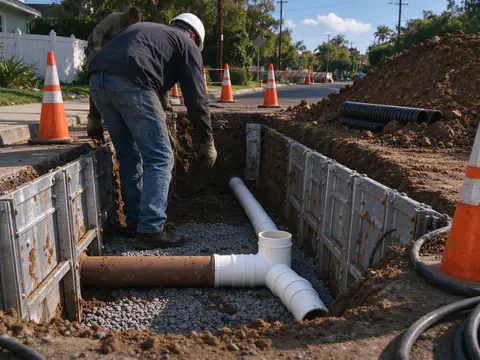
There is no single depth, but there is a standard. In the City of San Diego, a standard lateral sits within 5 to 7 feet of cover at the property line, according to Development Services Information Bulletin 166. Toward the house it is usually shallower; at the street it keeps falling until it drops into the main, which can sit deeper still.
Depth matters because it decides how a repair is done and what it costs, often more than the length of the pipe does. San Diego Swift Sewer Line Repair measures it before we price anything, and this guide explains where the numbers come from. For the street section itself, see street sewer lateral repair.
How deep is a sewer line at the property line?
For a standard lateral in the City of San Diego, 5 to 7 feet of cover at the property line. That range comes from DSD Information Bulletin 166. A lateral outside it, shallower or deeper, cannot be a standard public lateral and has to be built as a private lateral, with an encroachment agreement the City calls an EMRA.
“Cover” means soil above the top of the pipe, not the depth to its bottom. A 4-inch lateral with 6 feet of cover has its invert, the inside floor of the pipe, a few inches lower. The distinction matters when a contractor quotes excavation depth, because the trench has to reach below the pipe to bed it.
Why the depth changes along the run
A lateral works by gravity, as our guide to what a sewer lateral is explains, so it has to fall steadily from the house to the main. City Wastewater Review requirements set the minimum slope at 2 percent for public laterals and 1 percent for private ones. At 2 percent, every 50 feet of pipe drops one foot. A lateral that leaves the foundation 18 inches down may be several feet deeper by the time it reaches the sidewalk, even on flat ground.
The ground is rarely flat, though. On a lot that slopes up from the street the lateral may stay close to the surface across the yard and then run deep under the front setback. On a lot that sits below the street, the line may have to work hard to keep its fall, and some lots connect to a main in an easement behind the house or down in a canyon instead, which the City’s Public Utilities page names as possibilities. We check which one applies at each address.
Slope rules set the depth; local weather doesn’t. San Diego has no meaningful frost: NOAA’s 1991 to 2020 normals record an average of zero freezing days a year at Lindbergh Field. Depth here is about slope, cover and the main, not about keeping pipes below a frost line.
The drop to the main
The main runs under the street, generally below the laterals it serves, and a lateral reaches it with a final drop through a fitting at the connection. City requirements specify a “drop to main” of 1.2 feet for 6 to 8 inch mains, increasing to 1.8 feet for a 15 inch main. Bulletin 166 also makes any lateral with vertical bends between the cleanout and that final one-eighth bend a non-standard private lateral.
Mains are not all at one depth either. City main projects in La Jolla have laid new mains between 8 and 15 feet deep, according to the project’s environmental filing. That is one project, not a citywide figure, but it shows why the connection end of a lateral can be the hardest part to reach. Our permit guide covers the right-of-way rules that apply once the street is opened.
How your own line’s depth is found
Nobody has to guess. During a sewer camera inspection, the camera head carries a sonde, a small transmitter, and a locator on the surface picks up its signal and reads the depth at points along the run. The result is a marked path on the ground with a depth at each mark. If there is no cleanout to start from, adding one comes first. Development Services can tell an owner where a property’s lateral connects to the City main, and SanGIS publishes data on mains, but the City keeps no drawings of private lines on the lot.
Water can complicate the picture. A City-filed geotechnical report in Mission Valley logged groundwater about 7.8 feet below the surface in one boring, and a City study of Mission Bay Park found groundwater near sea level, rising and falling with the tides. Where a dig reaches groundwater, pumping it into the sewer needs a Groundwater Discharge Permit from Public Utilities before any discharge.
Why depth changes the method and the cost
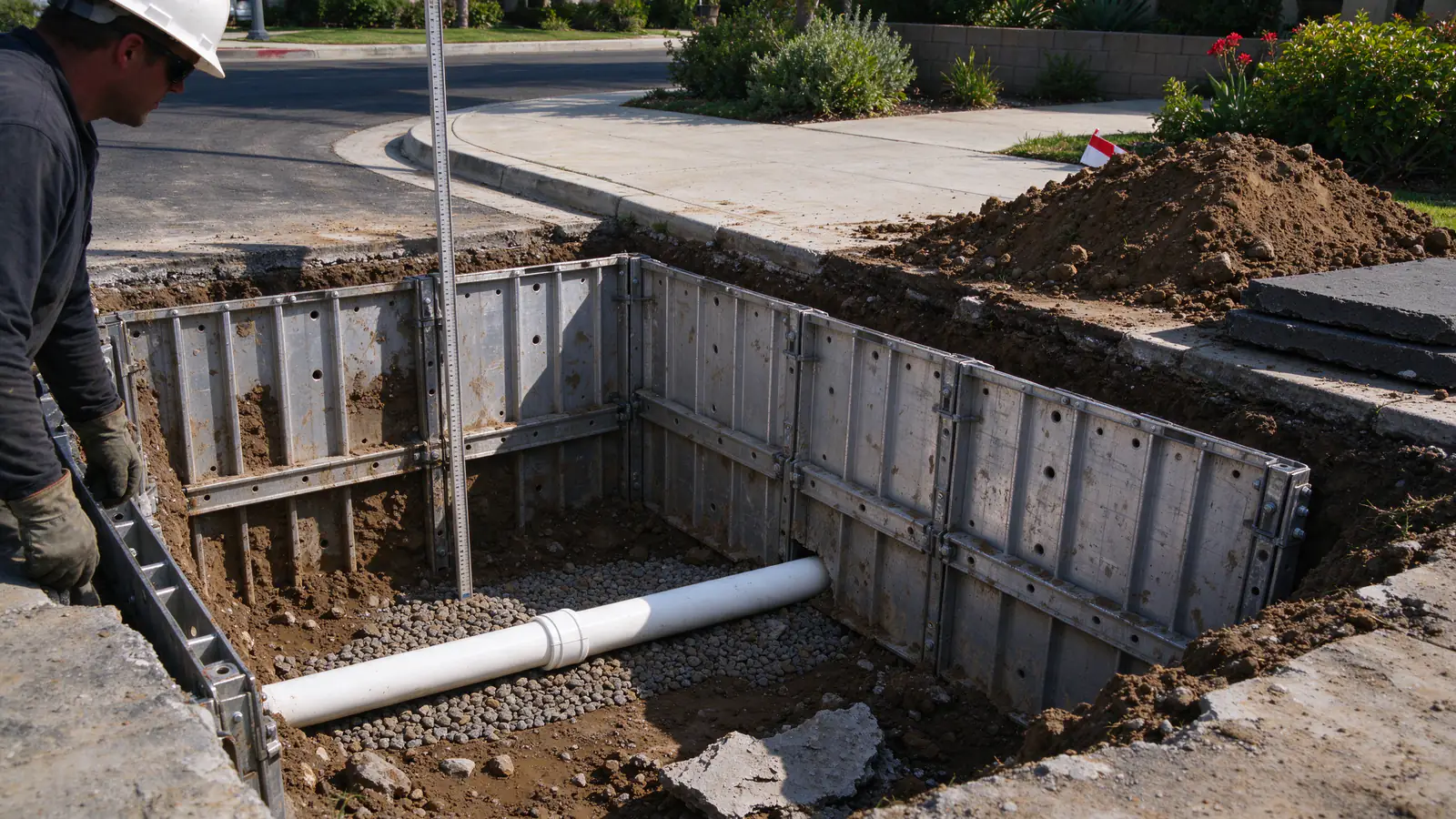
Open trench. Each extra foot means more soil to remove, haul or stockpile, more backfill to place and compact, and more time. At 5 feet or deeper, Cal-OSHA requires shoring, and the City’s own easement-lateral policy repeats that requirement. A deep trench across a front yard also means more restoration. See sewer line excavation.
Pipe bursting. The pits at each end have to reach the pipe, so a deep line means deep pits, each one shored. The run between the pits is not dug at all, which is where bursting gains on a deep, long line. See pipe bursting.
Lining. Installed from the cleanouts, a liner is barely affected by depth. That is a real advantage on a deep lateral, provided the camera shows a continuous pipe that holds its shape; is trenchless sewer repair worth it weighs that tradeoff. A sag stays a sag after lining, however deep it is. See sewer pipe lining.
Spot repair. A single dug repair at 3 feet and one at 8 feet are very different jobs, even though both fix one joint. Our typical range of $1,500 to $5,000 for an excavated spot repair spans exactly that kind of difference. Our cost guide puts depth alongside the other drivers.
If you know roughly where your line runs but not how deep it is, get an estimate or call us, and our locate will answer it before we choose a method.