 San Diego Swift
Want to avoid tearing up the driveway, and wondering what that costs? We quote both trenchless methods per foot of pipe, and their ranges overlap. Our typical range for lining (cured-in-place pipe) is $80 to $250 per foot, or $4,000 to $15,000 when a whole residential lateral is lined. Our typical range for pipe bursting is $60 to $200 per foot. Your final price comes from a written quote after we see the job.
What those per-foot numbers leave out is where most of the variation lives: cleaning the pipe so it can be lined, digging the pits that bursting needs, reopening branch connections, and, inside City limits, the permits and street fees when the work reaches the main. San Diego Swift Sewer Line Repair prices trenchless sewer repair after a camera run, because whether your pipe can be lined or burst at all is the first cost question.
Lining and bursting ranges side by side
| Lining (CIPP) | Pipe bursting | |
|---|---|---|
| Our typical range per foot | $80 to $250 | $60 to $200 |
| Per residential lateral | $4,000 to $15,000 | Priced from the length and the two pits |
| What sets the total | Cleaning, bends and reopened connections | Pit depth and what sits over each pit |
| What you end up with | A new pipe wall formed inside the old pipe | New HDPE pipe pulled along the old path |
| Digging | Access at the cleanouts, sometimes a small pit | A launch pit and a receiving pit |
| Fits when | The host pipe is continuous and holds its shape | The old pipe is broken but its route is usable |
Neither range means anything if the method doesn’t suit the pipe. A liner follows the host pipe’s shape, so it needs a line that is still round and continuous; collapsed, badly offset or crushed sections have to be opened first. Pipe bursting breaks the old pipe outward as the new one comes in, so it needs room around the path and a check for gas and water lines nearby. Our comparison of pipe lining vs pipe bursting covers which pipe suits which.
What’s inside a trenchless sewer repair price
| Part of the price | What sets it | The figure or input |
|---|---|---|
| Cleaning before lining | Roots, grease or cast iron scale that has to come off the pipe wall | Hydro jetting or root clearing: our typical range is $350 to $600 per job |
| Camera before and after | Confirming the pipe can be lined or burst, then checking the finished line | Camera inspection: our typical range is $100 to $500 |
| Access | An existing cleanout, a new cleanout, or a pit | A new cleanout: our typical range is $500 to $3,500, set by depth and what’s over the line |
| Pits for bursting | Depth, soil, and the surface over each pit | Priced per job; restoration of concrete or pavers is the swing item |
| Reopening connections | Branch lines that join the lateral and must be cut open after lining | Count and location of the branches |
| Labor | Time on the job, which depends on length, prep and method | Mean plumber wage in the San Diego metro: $37.78 an hour, versus $34.70 nationally (May 2025 BLS OEWS data) |
| Private-side permit | The City’s no-plan plumbing permit for a residential repair | $264.25 per house, first unit (Bulletin 103) |
| Street section | Right-of-way permit and City inspection when the work reaches the main | $1,412.54 inspection per sewer lateral; plan check from $3,179.40 when plans are required (Bulletin 502) |
| Traffic control | Needed when equipment or a pit occupies the street | $353.13 and up to review the plan; the permit is $131.52 a block, good for an initial three weeks (Bulletin 177) |
Keep in mind that a wage is not a billing rate. A billed rate also has to pay for insurance, licences, trucks, the lining or bursting rig and the office behind them. The wage line only explains why local labor sits about 9% above the national mean.
The street rows apply only when the trenchless work reaches the main or needs a pit in the right-of-way. For work at the public connection, the City’s Public Utilities construction page also lists approved materials, including approval letters for lining and pipe products, so the product used in the street section has to be one the City accepts.
Why lining and bursting prices move differently
Lining is a preparation job. Most of the cost beyond the liner itself is getting the pipe ready. We clean a line packed with roots, coated in grease or crusted with scale until the wall is bare, and confirm it on camera before the liner goes in. A cast iron line that has scaled heavily takes more of that work than a clay line with a few root intrusions. After curing, we reopen every branch connection from inside. Bends, changes in pipe size and transitions between materials all add time.
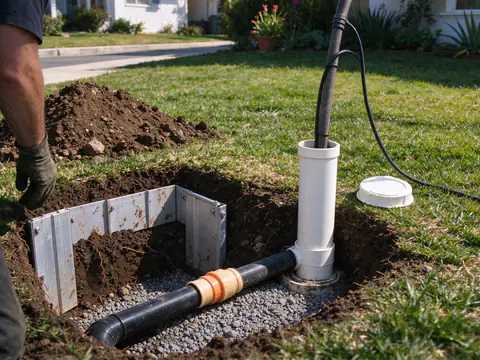
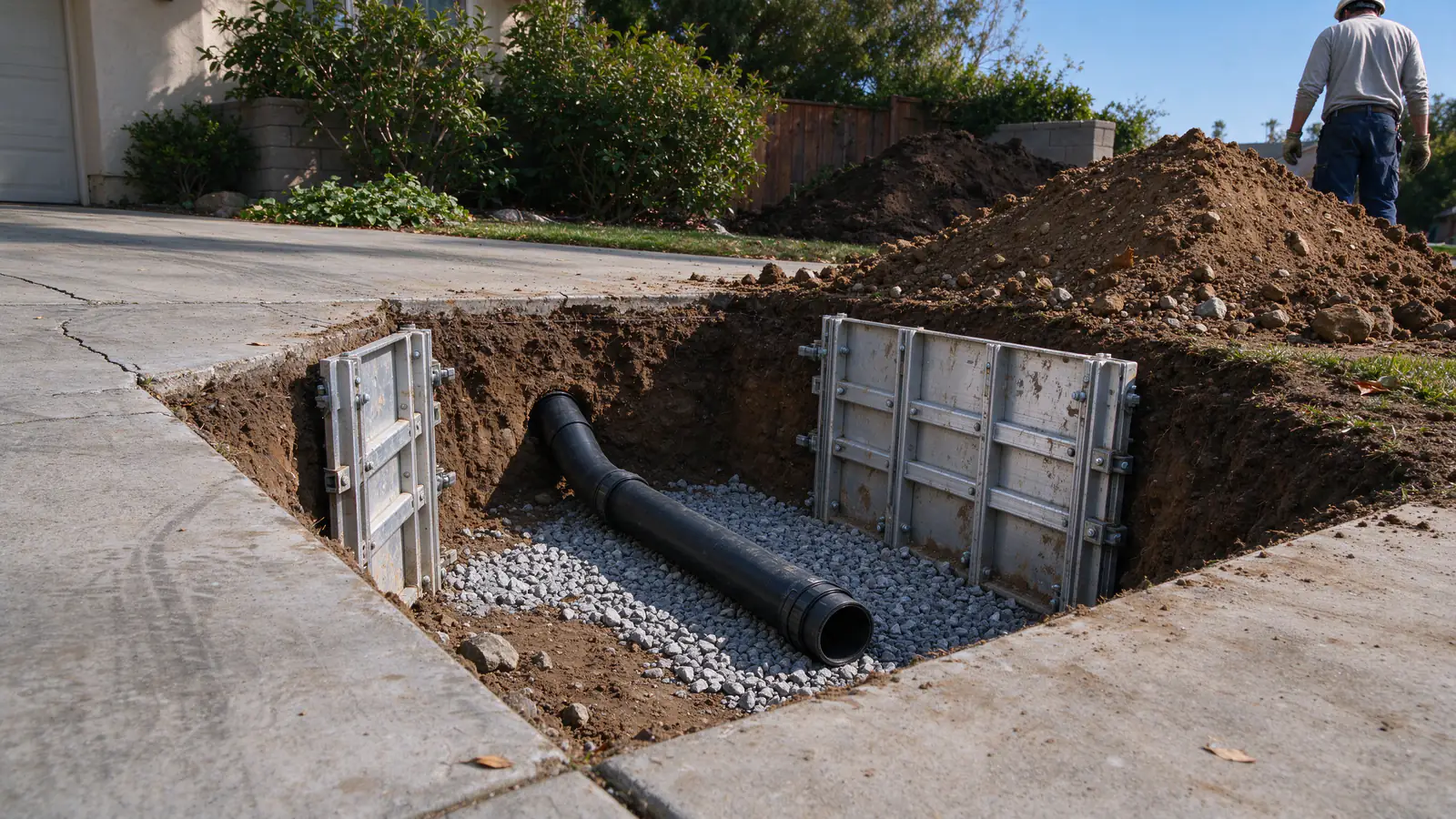
Bursting is a pit job. The per-foot price covers pulling the new pipe; the pits are where totals separate. A pit in lawn is a modest dig and a quick restore. A pit that lands in a driveway, a stamped-concrete walk or beside a block wall is not. Depth matters too. City Bulletin 166 expects 5 to 7 feet of cover over a standard lateral where it crosses the property line, so a pit there is often deep enough that Cal-OSHA shoring rules (5 feet and deeper) apply. Our guide to how deep a sewer line is covers depth in more detail. Ground conditions play in as well. Where reports filed with the City record water close to the surface, as around Mission Bay and in a Mission Valley boring at about 7.8 feet, a wet pit needs pumping, and discharging that water to the sewer requires a Groundwater Discharge Permit first.
When trenchless isn’t the cheaper choice
Trenchless saves money when the cost of digging and restoring is high and the pipe suits the method. It loses that edge in a few situations:
- A belly in the line. A liner takes on the shape of the pipe it lines, sag included. A section that holds water still holds it after lining. Correcting lost grade means excavating that section, which is covered on our sewer belly repair page.
- A crushed section or a joint that has shifted far out of line. The liner can’t pass, and bursting may not either. We dig that section out first, and the job becomes a combination.
- A short, shallow line under lawn. When there is little to restore, open-trench replacement can come in at or below the trenchless price, and it resets the grade as well. The sewer line replacement cost guide covers the trench ranges.
- No access. A house with no usable cleanout needs one added before lining, which adds a dig of its own.
None of that means trenchless is a poor choice; it means the price comparison only holds once the camera has shown your pipe is a candidate. Our guide to whether trenchless sewer repair is worth it works through the decision.
Is your line a trenchless candidate?
Send the camera footage if you have it, or the address if you don't, and we'll tell you whether lining or bursting fits before we quote either.
Illustrative budgets
The examples below simply multiply our typical ranges by a length. They are illustrations, not quotes for any property; real totals depend on the camera findings, access and restoration.
- A 60-foot lateral lined from an existing cleanout, private side only: multiplying 60 feet by $80 and by $250 gives $4,800 to $15,000. Add cleaning ahead of the liner if the quote lists it separately ($350 to $600) and the City’s $264.25 permit.
- The same 60 feet replaced by bursting, both pits in lawn: $60 and $200 times 60 feet gives $3,600 to $12,000 before the pits are restored. Move one pit into a concrete driveway and the restoration line grows.
- Either method carried on to a City main below the pavement: the City’s fees stack on top, starting with $1,412.54 to inspect the lateral in the right-of-way, at least $353.13 to review a traffic control plan, $131.52 for each block of traffic control permit, $3,179.40 and up for plan check when the connection needs plans, and then resurfacing the cut.
Reading a trenchless quote
A trenchless quote should say what it is for: the method and its length, whether cleaning is included or extra, whether a camera run is included before and after, how access will be made, how many connections will be reopened, which permits it carries, and whether it ends at the property line or reaches the City main. A quote far below another tends to leave one of those lines out. Our guide to comparing sewer repair quotes sets two quotes against each other, the camera inspection cost guide covers the first step, and the street sewer lateral repair page covers the work past the sidewalk. Call us or get an estimate when you’re ready to put numbers to your own line.