
 San Diego Swift
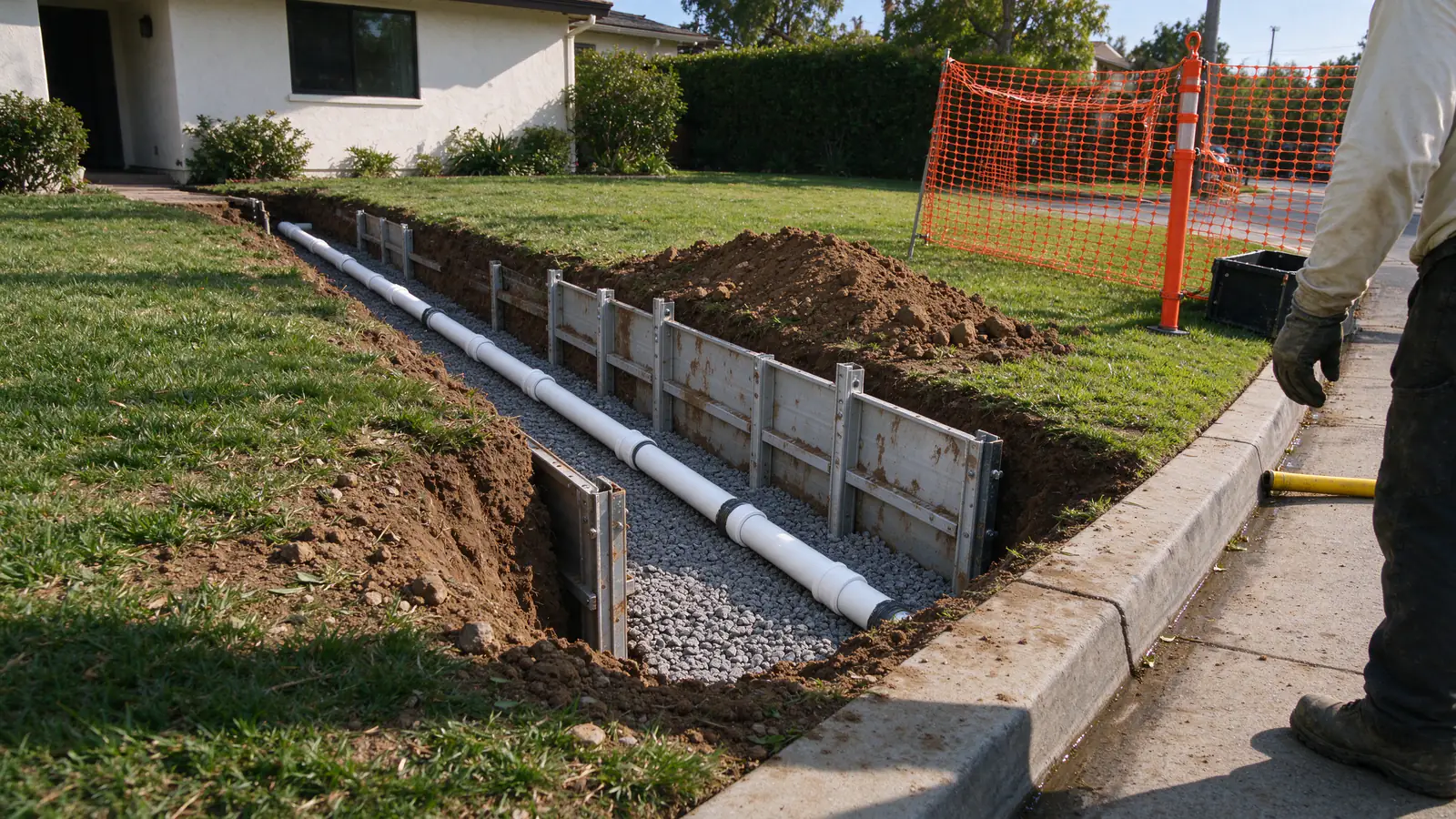
Owners who are about to replace a sewer lateral usually want to know one thing first: what actually happens, and in what order? San Diego Swift Sewer Line Repair repairs and replaces laterals across the City of San Diego and nearby San Diego County, and this post walks through the stages a City of San Diego replacement typically moves through. For the method comparison itself, see sewer line replacement.
The starting point: a hypothetical house
Picture a single-family house on a paved City street, with a lateral that has backed up more than once. Nothing about it is real; it is built from conditions that are common here. About half the City’s homes, 52.4 percent in the Census Bureau’s 2020-2024 American Community Survey, were built before 1980, so laterals laid decades ago are common, though the material of any one line is something only the camera confirms. A repeat clog by itself doesn’t prove the pipe has failed, which is why the first step is footage rather than a shovel.
Step 1: Clear the line and run a camera
If the line is blocked, it is cleared first so the camera can see. Then a sewer camera inspection goes in through the cleanout and records the pipe with a footage counter, while a locator marks the path and depth on the surface. If there’s no usable cleanout, adding one often comes first; it’s also the access a liner or a jetter needs later.
Step 2: Read the footage and pick a method
The footage decides the method. The table shows how common findings usually point, though a real scope weighs all of them together.
| What the camera shows | Where it usually points |
|---|---|
| One cracked or offset joint, sound pipe on both sides | Spot repair or a sectional liner |
| Continuous pipe that holds its shape, with cracks or root entry along it | Sewer pipe lining, if bends and size changes allow |
| Broken pipe along a usable path | Pipe bursting, a pit at each end |
| A sag that holds water, or a line laid too shallow | Open-trench replacement, the only method that resets the grade |
In this example the line is replaced by open trench, because that is the version with the most steps to explain. Our guide to sewer line repair vs replacement covers when a smaller repair is the better call.
Step 3: Find the connection and check the street
Next comes the question that most shapes the job: where does the lateral meet the City main? Development Services can identify that connection point, but the City has no diagrams of private lines on the lot, so the locate fills in the rest. The connection may be under the street, in an easement or in a canyon.
If the street section has to be opened, two rules apply early. San Diego’s municipal code says that where a lateral already serves a lot and the street has been paved, that lateral must be reused unless the City grants an exception, so the new pipe normally meets the old connection point. And under the Street Preservation Ordinance, a street resurfaced recently may be under an excavation moratorium; our post on the Street Preservation Ordinance explains what that adds.
Step 4: Permits
For a single-family house or duplex, the private side uses the City’s Simple No-Plan plumbing permit: $264.25 for a residential repair or replacement under DSD Information Bulletin 103. It normally issues within two business days, and inspections are scheduled once the invoice is paid. A property in a designated historic district may need historic review instead; see our post on historic district sewer permits.
If the job reaches the right-of-way, it needs a Right-of-Way Permit with a construction plan (Bulletin 166). A lateral with a direct wye or saddle connection can go through Minor Right-of-Way Rapid Review under Bulletin 165; a manhole connection is submitted with full plans. The City’s fees include a $1,412.54 right-of-way inspection per lateral, plan check from $3,179.40 for up to five sheets when plans are required, traffic control plan review from $353.13, and a traffic control permit of $131.52 per block for up to three weeks (Bulletin 177). City crews no longer install laterals; the City directs owners to a Class A licensed contractor. Our permit guide lists each permit by situation.
Planning a replacement like this one?
Send the address and any footage, and we'll outline which of these steps your line would actually need.
Step 5: Mark, dig and shore
Before any digging, other buried utilities along the path are located and marked, because gas, water and electrical lines can cross a lateral’s route. The trench then follows the marked line. The City’s easement-lateral policy calls for shoring to Cal-OSHA standards when an excavation is 5 feet or deeper or the soil is poor, and standard laterals sit at 5 to 7 feet of cover at the property line, so shoring is a normal part of the street end. Near Mission Bay or in Mission Valley, where City-filed reports record shallow groundwater, pumping a trench into the sewer needs a Groundwater Discharge Permit from Public Utilities before any discharge.
Step 6: Lay the new pipe
New pipe, usually PVC, goes down on bedding at a steady fall. City review standards call for at least 1 percent slope on private laterals and 2 percent on standard public ones. A 4- to 6-inch lateral connects to the main by a wye or saddle, with saddles allowed only on clay mains, and any unused lateral is capped at the property line. A cleanout goes in so the line can be inspected and serviced later.
Step 7: Inspect, backfill and restore
In the right-of-way, the City inspects after the trench is dug and before the connection, then again at final. The easement-lateral policy calls for backfill in 12-inch lifts, and street resurfacing follows San Diego Regional Standard Drawing SDG-107 for asphalt or SDG-108 for concrete. Under the Street Preservation Ordinance, most trenching and restoration must be finished within 180 days. Yard and hardscape restoration is whatever the written scope says, which is why it should be in writing; our guide on how to compare sewer repair quotes shows what to look for.
Step 8: A final camera run, and keep the records
A last camera pass through the finished line confirms the new pipe is continuous, connected and holding its fall. Keep that footage with the permit records: it answers a future buyer’s sewer scope before anyone asks.
What changes the sequence
Bursting and lining skip most of the trench but still need pits or cleanout access. A connection in an easement or canyon follows the City’s easement rules, where the owner exposes the pipe and the City repairs only at the main. Outside the City the rules change: Poway, Escondido and Lemon Grove each handle laterals differently. On cost, our typical range for trench replacement is $50 to $250 per foot, before permits and restoration; our sewer line replacement cost guide breaks down the rest, and how long sewer line replacement takes covers scheduling.
When you’re ready to map your own line onto these steps, get an estimate with the address and any footage you have, or call.