 San Diego Swift
You’ll probably pay for a sewer lateral the same way they would pay for a new roof: from savings, from borrowing against the house, or from a mix, with the timing of the work arranged around the money where the pipe allows it. The City of San Diego doesn’t list a lateral rebate, and its fact sheet states there is no reimbursement for plumbing expenses, so your own budget does most of the work.
San Diego Swift Sewer Line Repair does not offer financing, and we don’t recommend any lender. This guide lays out the options owners use, the trade-offs of each, and how a job can sometimes be split so the urgent part is paid for first. Everything here starts from the same place: a camera inspection and a written scope, because the cheapest money is the money you don’t borrow for work the line doesn’t need.
Start with the scope, not the loan
Owners who start by asking how to pay are often working from the scariest number they’ve heard. The first step is a number that belongs to your line. Our replacement cost guide gives our typical ranges; your written quote narrows them to a figure, and the sewer line cost estimator gives a rough band in the meantime.
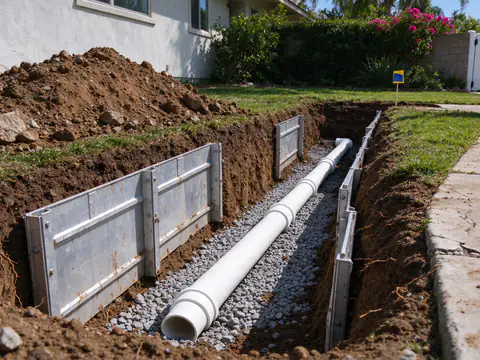
Three things in the scope move it most. The first is the method: a line that can be lined avoids most digging, while a sag or collapse pushes the job to bursting or excavation. The second is length and depth. The third is the street: in the City of San Diego the owner is responsible for the lateral to the main, so a break under the street, covered on our street sewer lateral repair page, brings in a right-of-way inspection of $1,412.54 per lateral, traffic control and resurfacing on top of the work. Knowing which of these apply before you arrange money keeps you from borrowing too little or too much.
It also helps to separate what must be done now from what could wait. The section on staging below explains how that works.
Ways owners pay, and the trade-off of each
| Source | How it works | What to watch |
|---|---|---|
| Savings or an emergency fund | Pay from cash on hand | Leaves less cushion for the next surprise |
| Home equity line or loan | Borrow against the house’s equity | Secured by the home; approval and closing take time; fees and variable rates |
| Cash-out refinance | Replace the mortgage with a larger one | Resets the loan; only makes sense if the new rate and costs work |
| Unsecured personal loan | A fixed loan not tied to the house | Higher rates than secured borrowing; check fees and terms |
| Credit card | Pay on a card, sometimes on a promotional rate | High interest once any promotion ends |
| Contractor payment schedule | Deposit, progress payments and a final payment | Terms vary by contractor; tie payments to finished milestones |
| Insurance endorsement | A service line endorsement, if the policy has one | Many base policies exclude the lateral; read the limits |
| A private warranty plan | The service line warranty the City promotes, if already enrolled | Its own caps, exclusions and waiting periods |
| A home sale | A repair credit or price change negotiated in escrow | Only available while the sale is open |
None of these is right for every household, and the decision about borrowing is yours and your lender’s. Two points apply to all of them. Borrowing against the house takes time to arrange, which matters if the line has already failed. And whatever pays for the job, a payment schedule tied to finished stages, such as a passed inspection or a completed connection, protects you better than one tied to dates.
Insurance deserves its own read. Many homeowners policies exclude the lateral itself, and a backup endorsement usually pays for damage inside rather than the pipe; our guide to whether homeowners insurance covers sewer line repair explains the difference.
Does the City of San Diego help pay for a sewer lateral?
Not directly. The City doesn’t list a lateral rebate or grant (Public Utilities can confirm for your address), its fact sheet says there is no reimbursement for plumbing expenses, and there is no limit on how many owner-paid cleanings a lateral can need before the City steps in. The City acts on the street section only when all service is lost and a plumber files a report.
Even that exception has conditions. The City may correct a total blockage or break in the right-of-way section at no cost to the owner only when all sewer service is lost and a licensed plumber files a phone report. It won’t work inside the property line, it won’t work where a private structure such as a block wall blocks access, and it bills the owner for its response when the cause was a lack of routine maintenance, such as roots or grease. Our guide to who is responsible for the sewer lateral in San Diego covers how a plumber establishes where the failure is.
There is one case where the City pays: a backup caused by the City’s own main. Under Council Policy 400-10, the City can cover cleanup, property damage, additional living expense and reasonable plumbing bills tied to finding the problem, once a main stoppage is confirmed. Stoppages in the lateral are excluded. A written claim generally has to reach Risk Management within six months.
Home repair help from the County
The City of San Diego doesn’t list a sewer lateral assistance program, and other cities and sewer agencies in the county set their own, so ask the one that serves your address. The County of San Diego’s published materials do describe a general Housing Repair Loans and Grants Program that lists plumbing systems among the health and safety items it addresses, and indicate the program has used a waitlist. It is not a lateral program, eligibility rules apply, and only the County can tell you its current status, so check directly before planning a repair around it.
A housing nonprofit or your lender may know of other local help. Treat any program as a possibility to confirm, not as part of the budget, until it is approved in writing.
Want the scope split into stages?
Send the footage and the address, and we'll show what has to be done now and what, if anything, can safely wait.
Staging the work to spread the cost
Staging means paying for the part of the job that can’t wait, and planning the rest. Whether it is possible depends entirely on what the camera shows.
When staging can work. If the line has one failed section and the pipe on either side is sound, a spot repair fixes that section and buys time for the rest. Our typical range for an excavated spot repair is $1,500 to $5,000. A line with roots at the joints but no structural break can sometimes be kept flowing with scheduled cleaning while the owner saves for lining; our typical range for hydro jetting or root clearing is $350 to $600 per job. That is maintenance, not repair: roots come back through the same joints, so it only works as a bridge to a real fix. Our page on root removal explains what cleaning can and can’t do.
When staging doesn’t work. A line that has collapsed, a house with no working sewer, sewage surfacing in the yard, or a sag that clogs every few weeks all need the structural repair now. Waiting usually adds cleanup and emergency calls to the bill rather than saving money.
When staging costs more. Every separate job carries its own fixed costs. Each private-side job in the City needs its own permit, $264.25 for a residential repair or replacement. Each opening of the street brings another right-of-way inspection, traffic control plan and permit, and resurfacing. Splitting street work into two visits means paying for those twice, and if the street is resurfaced between visits, the second visit may need a moratorium waiver and full-lane restoration. For the street section, one well-planned job is almost always cheaper than two.
Our guide to sewer line repair vs replacement helps decide whether a partial fix or a full replacement is the better spend for your line.
Before you sign: payment terms worth settling
A clear agreement protects your money whichever way you pay. Settle these points in writing:
- The deposit and the schedule. What is due before work, what is due at each stage, and what is due at completion.
- Milestones, not dates. Payments tied to a passed inspection or a finished connection, not to a calendar.
- Changes after the line is opened. How a change in scope is priced and approved if the camera or the excavation finds something new.
- What the price includes. Permits, street work, traffic control and restoration should each be named, or named as excluded.
- The final camera run. A last scope of the finished line before final payment shows you paid for what was promised.
Our guide to comparing sewer repair quotes shows how to set two quotes side by side on these terms, and the trenchless repair cost guide shows where lining or bursting might bring the total down. When you have a plan for the money, call us or get an estimate with the address and any footage.